
Thermal
-
 An energy supplier in Finland has announced the upcoming construction of an underground seasonal thermal energy storage facility about the size of two Madison Square Gardens that could meet the heating demands of a medium-sized city for up to a year.
 -
 A new industrial-scale “sand battery” has been announced for Finland, packing 1 MW of power and a capacity of up to 100 MWh of thermal energy for use during those cold polar winters. The new battery will be 10 times bigger than a prior pilot plant.
 -
 Defense contractor Teledyne FLIR has unveiled its new thermal sniper scope that can see its own bullets fly by day or night at ranges up to 2,200 m (1.3 miles), allowing them to engage targets at long range while remaining unseen.
 -
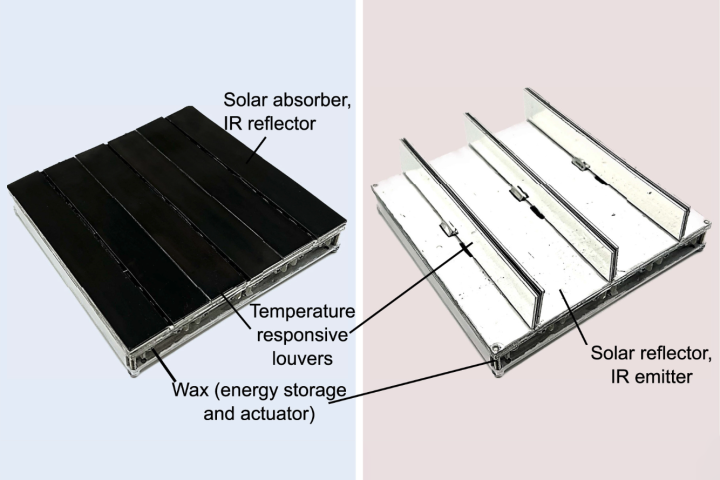 Using a temperature-driven "wax motor," researchers have created an adaptive roof tile system that helps keep a room at a comfortable 18 °C (65 °F). It delivers an extraordinary 3.1X reduction in cooling energy consumption, and 2.6X for heating.
 -
 In an average day, tropical oceans absorb about 278 petawatt-hours of solar energy. Harvesting just 1/4000th of that energy would supply the entire world's daily electricity – and ocean thermal energy conversion provides a possible method.
 -
 Energy prices around the world have been rising alarmingly since 2021. While some have shared advice on how to heat the person rather than the home, researchers at KTH are working on a building material that could help regulate indoor temperatures.
 -
 Ohio State researchers have shown how a common ceramic material can change its thermal conductivity in response to an electrical field, opening the door to solid-state heat switches that could make thermoelectric generators much more efficient.
 -
 Polar Night Energy says it's developed and commercialized a super-cheap, super-simple way of storing energy for anywhere between hours and months, simply using heated sand. Its first 8-megawatt-hour thermal battery has gone online in Finland.
 -
 The extremely hot interior of Earth is slowly cooling down, but exactly how fast is unknown. By studying how well a common deep-Earth mineral conducts heat, researchers have now found that the planet’s interior may be cooling faster than expected.
 -
 Berkeley Lab engineers have developed a roof coating that can keep a building warmer or cooler, depending on the weather. When it’s warm out the material will reflect sunlight and heat, but it switches itself off in winter, reducing energy use.
 -
 Australian researchers have created what may be one of the most thermally stable materials ever discovered. This remarkable advanced material, made of scandium, aluminum, tungsten and oxygen, doesn't change in volume at all between 4 and 1,400 Kelvin.
 -
 Air conditioners and other cooling systems are among our biggest consumers of electricity. Now researchers have developed a hybrid device that can not only cool buildings drastically without using electricity, it captures solar energy to heat water.
Load More