
Spintronics
-
 Scientists have confirmed the existence of a strange new form of magnetism. Hiding right under our noses, the team says that “altermagnetism” can be found in everyday materials and could have major technological uses.
 -
 A brand new form of silicon might help extend its use into the future. Engineers at North Carolina State University have discovered a material called Q-silicon, with new properties that could have important uses in quantum computers and spintronics.
 -
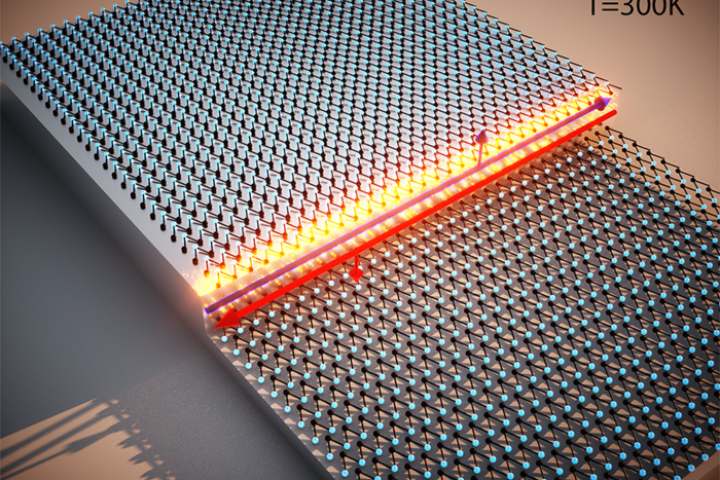 Many quantum effects can only be produced at extremely cold temperatures, which limits how useful they would be in real-world tech. Now, Princeton researchers have demonstrated a strange quantum state taking place in a material at room temperature.
 -
 Graphene has a lot of useful properties, but magnetism isn’t usually one of them. Now, researchers have managed to induce an “artificial magnetic texture” in graphene, which could have major implications for the emerging field of spintronics.
 -
 Spintronics promises devices that are faster and more energy efficient than conventional electronics, but a major hurdle has been how to effectively generate the spin current in the first place. Now, scientists have devised a new method for quickly creating currents using ultra short laser pulses.
 -
 Graphene is extremely strong for its weight, it's electrically and thermally conductive, and it's chemically stable ... but it isn't magnetic. Now, however, a team from the University of California, Riverside has succeeded in making it so.
 -
 Exciting times are ahead in the high-tech industries with the discovery by three independent groups that a new class of materials mimic the special electronic properties of graphene in 3D.
 -
 Physicists at the University of Cambridge have developed a spintronic shift register that allows information to be passed between different layers of a 3D microchip.
 -
 ScienceNew “spintronic” OLED technology promises to be brighter, cheaper and more environmentally friendly than the LEDs found in the current crop of TVs, computer displays, traffic lights and other electronic devices.
 -
 ScienceScientists have directly observed spin waves (nanoscale magnetic waves), created by magnetic nanocontacts.
 -
 Researchers have found that electric fields can manipulate a magnetically polarized current.
 -
 The proposed Racetrack computer memory system would reportedly be 100,000 times faster than today's hard drives.
Load More