
Semiconductors
-
 Graphene is the Novak Djokovic of materials – it’s so damn talented that it’s getting boring celebrating each new victory. But an exciting new upstart is challenging graphene’s title. Meet goldene, a 2D sheet of gold with its own strange properties.
 -
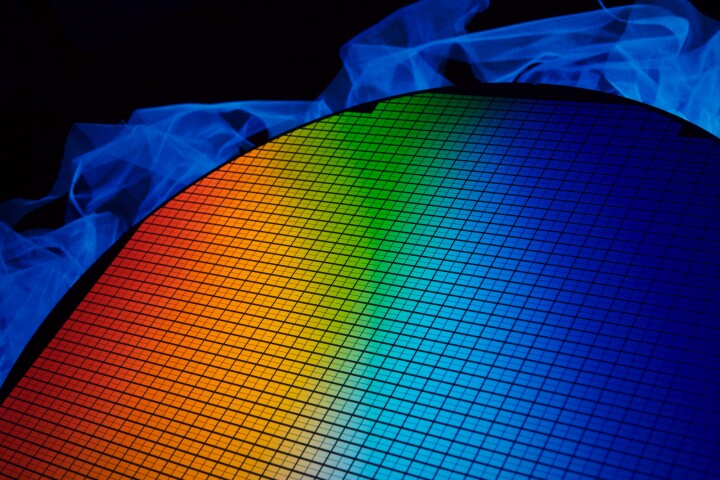 Scientists have found that a “superatomic” material is the fastest and most efficient semiconductor ever. Taking advantage of a tortoise-and-hare mechanism, the new material can transport energy much faster than silicon.
 -
 Water is usually something you’d want to keep away from electronic circuits, but engineers in Germany have now developed a new concept for water-based switches that are much faster than current semiconductor materials.
 -
 Researchers at ETH Zurich have created a crystal made entirely of electrons. The structures have been theorized for decades, but this marks the first time they’ve been experimentally confirmed in the lab.
 -
 Scientists are claiming a breakthrough in the development of graphene nanoribbons, devising a method that has enabled them to efficiently produce the ultra-thin strips directly on the surface of semiconductors for the first time.
 -
 For a few years scientists have predicted a fifth kind of phosphorus should be possible, but it had yet to be confirmed. Now, researchers in Germany have managed to show that blue phosphorus does exist, and mapped out its different properties.
 -
 A team of Chinese scientists has developed a new nanoparticle-based film that can store information as 3D holograms, improving data density, read and write speeds and stability in harsh conditions.
 -
 Normally if you push something, it moves away from you, but theoretically objects with negative mass would move towards you instead. Scientists from the University of Rochester have now developed a device that can create particles that exhibit negative mass.
 -
 Engineers at Stanford have developed a new component to help stretch the potential of wearable electronics.
 -
 Resistive random-access memory (RRAM) is an emerging tech that relies on temperature and voltage to store data, although exactly how is a mystery. Now a team has investigated the chips and found the optimal temperature range was lower than expected, paving the way for more efficient memory.
 -
 Researchers at the University of California San Diego claim to have created the world's first microelectronic device that has no semiconductors, instead employing low-power laser optical control to increase its conductivity by more than 1,000 percent.
 -
 They're not the first transistors created using carbon nanotubes (CNTs), but researchers at the University of Wisconsin-Madison (UW-Madison) claim their new carbon nanotube transistors are the first to outperform the best silicon transistors available today.
Load More