
Self-cleaning
-
 General Motors has received a patent for a fascinating self-cleaning technology that could eliminate the annoyance of smudgy fingerprints all over touchscreens. It's a photocatalytic system, triggered by ultraviolet LEDs built into the RGB matrix.
 -
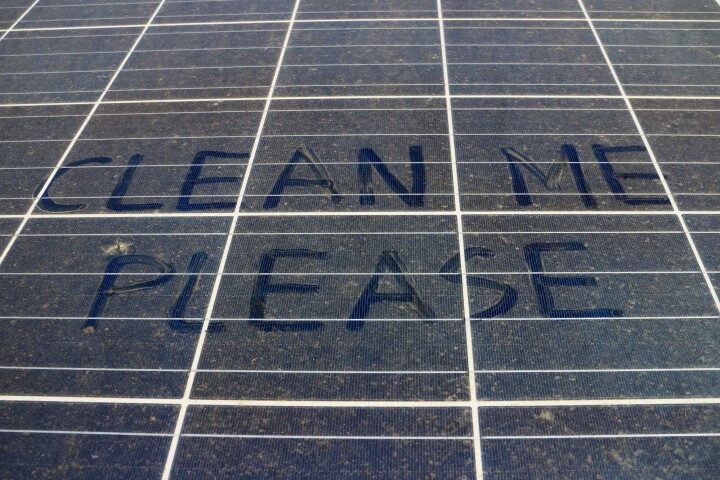 Solar panels can’t operate efficiently if they’re caked in dirt, but cleaning them regularly can be a time-consuming process. Engineers in Germany have now developed an ultra-thin coating that can make solar panels and other surfaces self-cleaning.
 -
 If you're designing a plastic for applications such as food packaging, you want it to stay clean but you don't want it to stick around for centuries once discarded. A new lotus-leaf-inspired material may fit that bill.
 -
 Like anything else, concrete structures get dirty over time, and it's a hassle to clean them. Such chores may soon no longer be necessary, however, as scientists have developed what they claim is a self-cleaning concrete that isn't heavy – or weak.
 -
 A revolutionary new type of smart window could cut window-cleaning costs in tall buildings while reducing heating bills and boosting worker productivity. Partially inspired by the reflective properties of moth eyes, this smart window is said to be self-cleaning, energy-saving, and anti-glare.
 -
 How would you like to be able to wash your car by just hosing it off – no soap, scrubbing or drying? You may be able to in the not-too-distant future, thanks to an ultra-hydrophobic (water-repelling) paint that can be applied to a variety of surfaces, and that stays on once applied.
 -
 With the help of very high-power laser beams, researchers at the University of Rochester have created micro and nanostructures that turn metals black and make their surfaces very easy to keep clean and dry.
 -
 A researcher at City University of Hong Kong (CityU) has developed a self-cleaning coating made up of nanoparticles that removes stains from cashmere by exposing the garment to light.
 -
 Nissan is currently testing out a prototype that it says could make car washes a relic of the past. The test car benefits from a new nano-paint treatment that repels dirt and grime. The automaker is putting the car through the dirty wringer to see how well it holds up in the real world.
 -
 ScienceUnlike adhesive tape, gecko's feet retain their sticky qualities even after many, many uses. Now, thanks to research being conducted at Carnegie Mellon University and Germany's Karlsruhe Institute of Technology, we may one day be using self-cleaning reusable gecko-inspired tape.
 -
 The close of 2013 gives us an excellent opportunity, though satiated with holiday feasts, to look back on a year that has been filled with scientific accomplishment.
 -
 ScienceThe research team responsible for the SLIPS technology that creates the slipperiest known synthetic surface has improved upon their technology. By now making it transparent and more durable, it now has potential for creating scratch-resistant lenses and self-cleaning windows and solar panels.
Load More