
Photon
-
 Move over, macro: researchers have created the world’s smallest silicon LED and holographic microscope, and among its uses is a hack that'll let you use your smartphone to view objects as tiny as a single human skin cell in brilliant high resolution.
 -
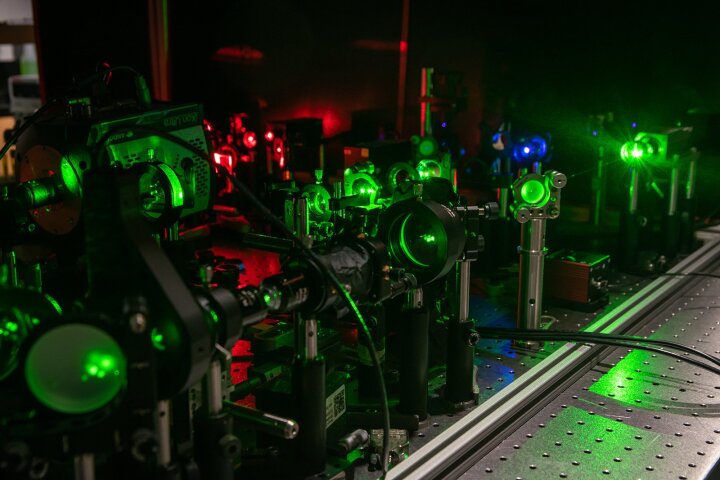 Caltech scientists have created a quantum microscope that taps into the quirky quantum rules to see tiny details much more clearly. Using pairs of entangled photons allows the instrument to double the resolution of images without damaging the sample.
 -
 Scientists have demonstrated a technique to allow quantum computers to store more information in photons of light. The team encoded eight levels of data into photons and read it back easily, representing an exponential leap over previous systems.
 -
 Physicists at the Max Planck Institute have developed an efficient new method to drive the quantum entanglement of photons, and demonstrated it by entangling a record number of photons. The technique could be a boon for quantum computers.
 -
 Solar cells still have plenty of room for improvement. Researchers at New York University Tandon have now developed thin film that boosts solar cell efficiency by converting wasted wavelengths of light into ones that can produce energy.
 -
 Scientists have created a “quantum flute” that can coax photons to move in sync and interact with each other, which they almost never do in nature. The device could help improve future quantum computer designs.
 -
 A new type of radar can measure objects down to centimeters. The new technique uses a photonic system to generate much higher bandwidth signals, enabling radar that can detect smaller objects, and even monitor patient vital signs in hospitals.
 -
 Quantum computers are so far held back by their complexity. Engineers at Stanford have now demonstrated a new relatively simple design for a quantum computer where a single atom is entangled with a series of photons to process and store information.
 -
 Astronomers have detected the highest-energy light ever seen. Hundreds of gamma rays were detected with ultra-high energies, with the most powerful signals crossing the Peta-electronvolt threshold – much higher than thought possible in our galaxy.
 -
 Engineers at Stanford have created a new optical device that can easily manipulate light into basically any color desired. The system uses a series of modulators to fine-tune the frequencies of individual photons to change their color.
 -
 Dark matter makes up the majority of matter in the universe, but it’s strangely shy about making its presence known. Now physicists have designed a new test to search for signs of two candidate particles, using the quirky world of quantum technology.
 -
 Physicists in Germany have measured the shortest timespan ever recorded. The team measured the time it takes for a photon of light to travel the length of a hydrogen molecule, and found it to occur in just trillionths of a billionth of a second.
Load More