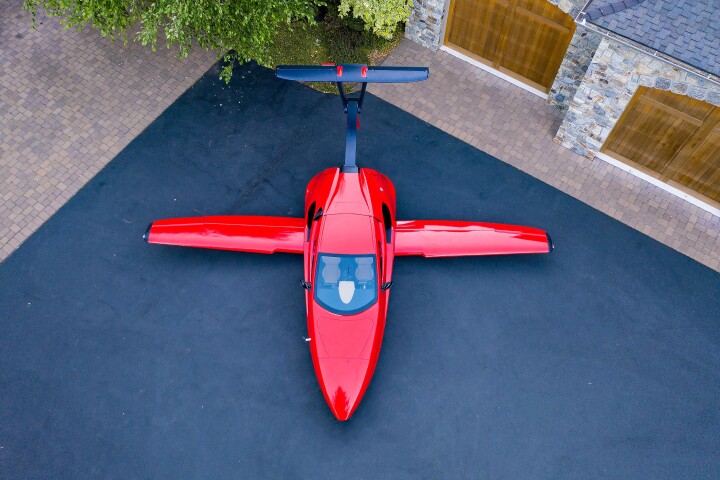
Personal Flight
The first flying machine - the hot air balloon
By Mike Hanlon

Human flight turns 222 years old on Monday. The hot air balloon was the first sustainable form of flight, with the first passengers, (a sheep, duck, and rooster) taking to the skies on September 19, 1783 and the first humans breaking the shackles of gravity on November 21,1783 were Pilatre de Rozier, who was also to become the first man killed in an ballooning accident, and infantry officer Marquis d'Arlandes. The flight took place in the centre of Paris lasted 25 minutes and covered a little more than five miles and the balloon was built of paper and silk by the Montgolfier brothers, Joseph and Ettienne. The Montgolfiers were well-educated paper merchants who had read the work of English scientist Joseph Priestly on the properties of air and had the skills to adapt the available technologies Read More
The modern hot air balloon
By Mike Hanlon

Ballooning went mainstream in 1960 when the Raven prototype ‘modern’ hot-air balloon demonstrated that man had finally found a cost-efficient, lightweight material for the balloon envelope in the form of polyurethane coated nylon, with the burner powered by cylinders of propane. The first U.S. national championships followed in 1963 and further advances to material technology and LPG burners have seen the sport evolve into a substantial tourism industry with more than 5000 registered balloon pilots in the United States and a larger number in Europe. Every major city in the world offers balloon flights to tourists and if it is something you have never done, we thoroughly recommend it. There's no noise (at least most of the time when the burners aren't firing) to get between you and the environment of the birds, and a remarkable platform from which to survey almost anything, let alone something as complex as a real-life city. The following photographic essay was taken yesterday over Melbourne, Australia in a Hot Air Balloon using a Sony DCS-F707 Cybershot 5 megapixel 5x optical zoom camera and a Kodak Easyshare P850 5 megapixel 12x optical zoom camera. Read More
Star Wars-style Pod Racing comes to life - the Rocket Racing League blasts off
By Mike Hanlon

October 28, 2005 Think of a cross between Star Wars Pod Racing and Formula 1 and you have the Rocket Racing League (RRL) – a new formula racing competition with nuclear levels of spectator appeal. The first demonstration flight of the new RRL series was held earlier this month at the X PRIZE CUP in New Mexico (USA). Former astronaut Colonel Rick Searfoss piloted the RRL's EZ-Rocket in a series of crowd-thrilling manoeuvres. The EZ-Rocket is the precursor vehicle to the Mark-1 X-Racer, which is currently under development with planned test flights in the Spring and Summer of 2006. The Mark-1 will utilise a modified airframe from Velocity Aircraft and a single 1,500 - 1,800 pound liquid oxygen (LOX) and kerosene rocket engine. This engine will have twice the thrust of the development vehicle and will be extremely bright and visible in contrast to the development prototype EZ-Rocket which uses LOX and alcohol. As an aerospace entertainment organization, the RRL will combine the competition of racing with the excitement of rocketry with a series of competitions across the United States, with the finals taking place each year at the X PRIZE Cup in New Mexico. RRL races will operate much like auto races, with the exception that the "track" will be in the sky. Courses are expected to be around two miles long, one mile wide, and about 5,000 feet high, running perpendicular to spectators. The X-Racers, will take off from a runway both in a staggered fashion and side-by side and fly a course based on the design of a Grand Prix competition, with long straight-aways, vertical ascents, and deep banks. Each pilot will follow his or her own virtual "tunnel" or "track" of space through which to fly, safely separated from their competitors by a few hundred feet. Read More
ATG’S Javelin Prototype takes flight
By Mike Hanlon

October 1, 2005 Aviation Technology Group’s much-awaited Javelin took to the skies for the first time yesterday in Colorado. Born from the intense desire to offer military performance to the general aviation market, the US$2.795 million two-seat executive jet will be available in 2008 and the military trainer versions will be available prior to that – the successful 35 minute maiden flight indicates all is well with the planned roll-out and with the order books now heading for 100 sales for the new two-seat jet aircraft capable of .925 Mach (1130 kmh), you’d best get your money down quickly if you’re planning on being the first on your block to have one of these babies. Read More
Your own helicopter for under US$20,000
By Mike Hanlon

September 21, 2005 Flying is not a sport generally associated with those people who are light of wallet – which makes the Mosquito Ultralight helicopter something of a rarity. The entire kit for the Mosquito can be purchased for US$20,000 and if you think the minimalist Mosquito leaves you a bit vulnerable, there’s the fully enclosed Mosquito XE and XEL which can be purchased for US$23,000 apeice. Building the kits will cost you about 200 to 300 hours to build or you can have the plane built for you for a flat US$4000. Getting airborn for under US$20,000 in your own, new helicopter is quite a feat – we’re not aware of any other helicopter in this price category and on top of that, both Mosquito variants offer very low maintenance and operating costs. Read More
Mach .925 performance in a two seater business jet
By Mike Hanlon

April 1, 2005 It takes but a glance at the Javelin personal jet to understand that it was born from the intense desire to offer military performance to the general aviation market. The existence of a market prepared to pay US$2.5 million for a two-seat jet aircraft capable of .925 Mach (1130 kmh) is now verified as the Aviation Technology Group (ATG) is holding 80 firm orders for the Javelin accounting for the entire first year of production. Initial customer deliveries of the FAA-certified Javelin are slated for early 2007 so if you get your order in now, you’ll still be waiting until 2008 to be the first in your neighbourhood to have one of these beauties. Read More
An "affordable" personal jet aircraft
By Mike Hanlon

March 15, 2005 The Sport-Jet is a single-engine, all-fibreglass, pressurised aircraft designed for single-person operation by a pilot trained in piston-powered airplanes. The Sport-Jet is powered by a single turbofan in the 1,350-pound class (such as Pratt & Whitney PW615 or Williams International FJ-33) will cruise at 340 knots at 25,000 feet (above 95% of all weather), and can carry four persons (plus pilot) over 1,000 nautical miles. Certification of the Sport-Jet is anticipated two years from now and it is expected to sell for under US$1 million when it reaches market late in 2007. Read More
First non-stop and non-refueled, around-the-world solo flight
By Mike Hanlon

March 7, 2005 Steve Fossett and the Virgin Atlantic GlobalFlyer have achieved their aviation world record for their non-stop and non-refueled, around-the-world solo flight. After 67 hours and 1 minute of gruelling sleep deprivation and 12 unappealing diet milkshakes, Steve finally touched down in front of an excited crowd of public and press at Salina Municipal Airport at 19:48:56UTC on March 3, despite having some very worrying problems earlier in the flight. Read More
The Jetpod gives vision to the future of flight
By Mike Hanlon

The Jetpod is a Very Quiet Short Take-Off and Landing twin-jet aircraft, can cruise at 300 knots (350 mph, 550 kmh) and requires just 125 metres to take-off or land using a combination of horizontal and vertical thrust. The Jetpod takes off then reconfigures from a VQSTOL jet into a fast-jet accelerating to 350 mph in just a few seconds. Just 16 months from first flight, the jetpod could represent the future of transport. Read More
Preparations for world's first human landing WITHOUT a parachute
By Mike Hanlon

January 3, 2005 Jumping out of a plane without a parachute is not something we recommend but that's exactly what B.A.S.E. jumper Jeb Corliss has been doing to help pave the way for the world's first landing attempt without a parachute.
Up to now, he's been testing speeds and fall rates in the wing-suit so that he can determine what's required to be able to land the wing-suit without a parachute. Corliss and Go Fast! - sponsored test pilot Luigi Cani teamed up to gather the data. Jeb flew in free fall donning a parachute alongside Luigi, who was at the controls of the world's smallest and fastest parachute-known as the ICARUS VX-39. The two were able to gather data using GPS systems attached to Luigi that tracked exact forward speeds, exact fall rate and the glide angles so the calculations could be done to determine what apparatus would be needed for a safe landing. Read More
Da Vinci's Ornithopter ready to fly after 500 years
By Gizmag Team

December 3, 2004 Humankind has dreamed of flight since ancient times, but until now most attempts to fly by flapping wings, either using human muscle or mechanical power, have failed. Over 500 years ago, Leonardo da Vinci conceptualised a self powered flying machine that would achieve both lift and thrust with flapping wings alone and named it the "ornithopter". Now, hot on the heels of the 100th Anniversary of the Wright Brothers pioneering air flight and the recent X Prize won by Burt Rutan for civilian, privately funded space flight, a team of scientists, engineers, and historians in Toronto have taken on the challenge to make Leonardo's orinthopter dream a reality. Read More
CT2K ultralight for personalised long-distance travel
By Gizmag Team

November 23, 2004 The CT2K ultralight sports aircraft is so compact it almost looks like a toy. Yet with only a 9.3m wingspan, 2.16m height, 6.22m width and 262kg (empty) weight, it can travel over 2,000 km on a full tank. German designers and manufacturers Flight Design has been selling the ultralight CT2K plane throughout Europe and now it is flying high in over a dozen countries in a resurgence of personalised, ultralight flight. Read More
Skyblazer dual mode 'Flying Car' concept
By Gizmag Team

November 8, 2004 Automobiles and airplanes were both inventions of the late 19th and early 20th centuries. Both technologies were heralded as examples of technical progress and both carried the promise of great personal freedom that is still being explored today with the possibility of dual mode 'flying cars'. These futuristic concept vehicles have been covered in gizmag before, notably the Moller M400 Skycar, and now another prototype is being proposed by Robin Haynes with his 'Skyblazer roadable aircraft'. Read More
Man flies like a bird - a jet-powered bird!
By Mike Hanlon

October 8, 2004 Man has been attempting to fly for around 2400 years yet has only begun to master the process in the last century. In the history of flight, 2004 is shaping as a good year. One of the pioneers of human flight, Yves Rossy, recently achieved a landmark which went largely unheralded. Rossy’s feats might well go down among the most daring as well as momentous in aviation history. Rossy made headlines in 2003 when he flew 12 kilometres for the loss of just 3000 metres of altitude, achieving his feat by jumping out of plane wearing three metre, carbon fibre wings. Read More
Human powered helicopter grounded
By Mike Hanlon

In 1980, the American Helicopter Society issued a reward of US$20,000 for the first group to build a human powered helicopter. The conditions of flight were to hover in a 10 metre square zone for a minute and reach a height of three metres. Since then around 20 unsuccessful attempts have been made on the feat and none have come close, with the most recent attempt on August 10, 2004 from the University of British Columbia having failed also. Read More
The Airscooter: a helicopter for the home?
By Mike Hanlon

January 21, 2005 The AirScooter II is an ultralight helicopter designed for easy control and manoeuvrability that looks set to take personal recreational airborne vehicles to new heights. Designed by AirScooter Corporation, the AirScooter II is a vehicle that has looked to aviation's past to help develop its future. In building and designing the AirScooter II, inventor and AirScooter Corporation cofounder Woody Norris and his team have successfully adapted a technology that has had a long line of difficulties in getting off the ground. We all recognise the modern helicopter, with its main rotor and tail rotor, but in terms of rotorcraft, the coaxial type had seemed likely to be limited to high-tech military and large transport helicopters. but things are progressing well and the future looks incredibly bright for the innovative and intelligent design of AirScooter II, an ultra-lightweight coaxial rotorcraft helicopter. Read More
CarterCopter: a high-speed, low-cost helicopter
By Mike Hanlon

Mass personal flight will become a reality sometime this century and one of the companies vying for a share of this lucrative market will be Carter Aviation, creator of the CarterCopter - a VTOL (vertical takeoff and landing) aircraft projected to cruise at 800 kmh (500mph) at 45,000 feet or 300 kmh at sea level. Suitable for designs as small as a two-seater, all the way through to Jumbo size, the CarterCopter's future is very promising. Read More
VTOL AirBike Concept
By Mike Hanlon

Saturday July 26, 2003 Swapping internal combustion for turbine power, Allied Aerotechnics is developing a VTOL (Vertical Take-off and Landing) motorcycle concept designed to access areas that are totally out of reach for any other type of vehicle. Read More
M-400 SkyCar pre-sales underway
By Mike Hanlon

UPDATED November 15, 2004 After recent successful tethered hovering flights of the M400 Skycar, including at the at the WIRED NextFest in San Francisco in May, 2004, Moller International is accepting deposits to secure delivery positions this groundbreaking vehicle. A 10% deposit of US$100,000 will put you in the top 100 on the delivery list for the M-400 Skycar, which is expected to be FAA-certified for use by the end of 2005. Over 100 reservations have already been placed and demand is expected to grow as the working model nears production. Read More
Skydiving becomes Skyflying
By Mike Hanlon

While down is usually the direction that most matters when jumping from a plane at altitude, the Skyray attachable rigid-wing system promises to add airplane-like agility to skydiving. Read More
Powered parachuting on a recumbent bike
By Mike Hanlon

It not exactly what Spielberg's ET had in mind, but it's as close as you can get to a flying bicycle without extra-terrestrial intervention. The Para-Cycle is a semi-reclined, 3-wheel recumbent bicycle combined with a powered parachute... Read More
Human Powered Flight
By Mike Hanlon

It's a dream shared by anyone who has ridden a bicycle up a steep hill - human powered flight. NASA achieved this feat as part of the Daedalus project over a decade ago with the Light Eagle and Daedalus aircraft flying record breaking distances of 59km and 199km respectively. Designed and constructed by a group of students, professors, and alumni of the MIT, the goal was aircraft fly 115km (the distance that Daedalus is said to have flown when he escaped from King Minos on wings made from wax and feathers) and provide research data for the design and manufacture other high-altitude, long endurance aircraft. Read More
Aero Chute - the cheapest form of flight available
By Mike Hanlon

Human flight has never been more attainable than with the Australian-designed Aerochute - the powered parachute needs less than 15 metres to become airborne, can top 70kmh and the average person can be flying solo after just a few hours of tuition. Most importantly, it is very safe to fly, being close to stall and spin proof, and should the engine stop, it simply lands like a parachute. The Aerochute DUO doesn't have a traditional fixed wing, so flying can only take place when the weather conditions are suitable. If the wind gets above 15 knots, the Aerochute can't fly, which is entirely understandable once you've seen a powered-parachute take-off. Read More
Mercedes (concept) Flying Car
By Mike Hanlon

In the recently released sequel to "Men in Black" (MIB II), agent Kay and agent Jay cruise the alien beat in a black 2003 Mercedes-Benz E-Class sedan that not only provides a stylish ride but transforms into a space car to help hunt down the villains... Read More
The Next Step: Cars that Fly
By Mike Hanlon

It would look right at home on the set of Bladerunner or the latest Star Wars film, but the Moller M400 Skycar - a versatile, economical, safe, environmentally-responsible Flying Car - is definitely for real.June 3, 2004 It would look right at home on the set of Bladerunner or the latest Star Wars film, but the Moller M400 Skycar - a versatile, economical, safe, environmentally-responsible Flying Car - is definitely for real. Opening up the next frontier in automotive personal transport, the SkyCar is a VTOL (Vertical Takeoff and Landing) vehicle with a cruising speed of 600kmh, a range of more than 1400km, runs on almost any fuel from diesel to natural gas and achieves better fuel efficiency than many sports cars (15mpg or 19 litres per 100km). Read More


rob yates
- November 26, 2009 @ 12:49 UTC