
Organic
-
 Solar cell efficiency may get a bump from bumps. New research suggests that building tiny domes into the surface of organic solar cells could boost their efficiency by up to two-thirds, while capturing light from a wider angle.
 -
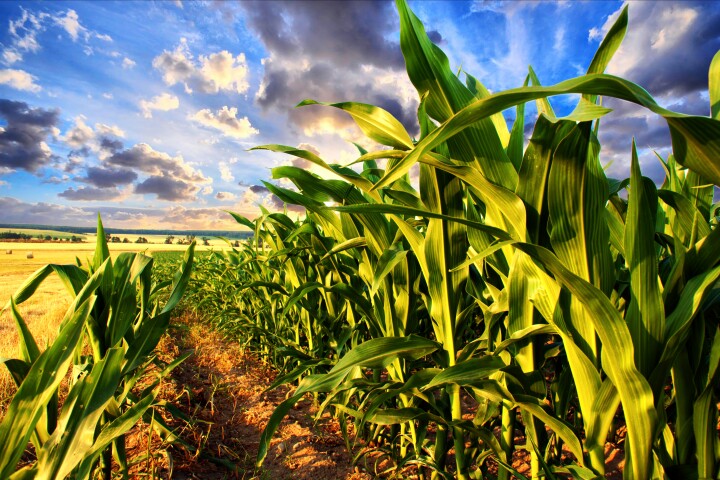 With nearly half the world's soil degraded, growing enough food to feed a global population is getting increasingly difficult and costly. Scientists believe they've got one solution, and it's already all around us: Arbuscular mycorrhizal fungi.
 -
 The James Webb Space Telescope has spotted complex organic molecules, which usually form in smoke, in the very distant universe. With help from a galactic gravitational anomaly, the telescope could see the molecules from 12 billion light-years away.
 -
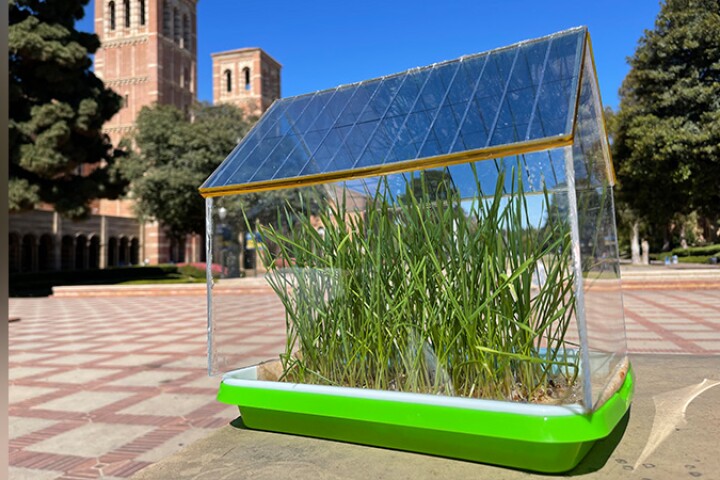 Solar farms and agriculture are competing for land. UCLA Scientists have now tested a way to combine the two by placing semi-transparent solar cells on the glass roofs of greenhouses, finding that they actually improve the growth of plants inside.
 -
 The 2021 Nobel Prize in Chemistry has been awarded to Benjamin List and David MacMillan, for their work developing a new class of catalyst. The technique is based on small organic molecules and has been instrumental in pharmaceutical research since.
 -
 The company behind the Smart Herb Garden we reviewed back in 2014 has launched a new indoor garden on Kickstarter. The Click & Grow 25 system promises to grow "substantial amounts of greens for everyday use, without becoming a time-consuming hobby."
 -
 As a storage solution for renewable energy, scientists see great potential in what are known as redox flow batteries. A new design from Linköping University is a decidedly green version of this, being the first made from all-natural materials.
 -
 A new review article, from a team of material scientists, is suggesting a leather-like material made from mushroom-derived biomass has the potential to be cheaper, and more environmentally sustainable, than animal leather or its plastic derivations.
 -
 In a first, perovskite and organic solar cells have been tested in space. Not only did they perform well, but they’re much thinner and lighter than the silicon cells currently used and were even able to absorb diffuse light reflected back from Earth.
 -
 Earth is a famously watery planet, but where exactly it all came from is a mystery. Now researchers have suggested a new origin story, by showing that water and petroleum can form inside clouds of organic matter, at high temperatures and pressure.
 -
 A new type of experimental proton battery is built with entirely organic components, making it much more environmentally friendly than most. On top of that, it can also be charged in a matter of minutes and can function at very low temperatures.
 -
 Not everyone has access to enough land for growing veggies, making indoor garden devices quite attractive prospects for those looking for year-round fresh produce. The latest is a multi-tier setup called the Cell One.
Load More