
Northern Lights
-
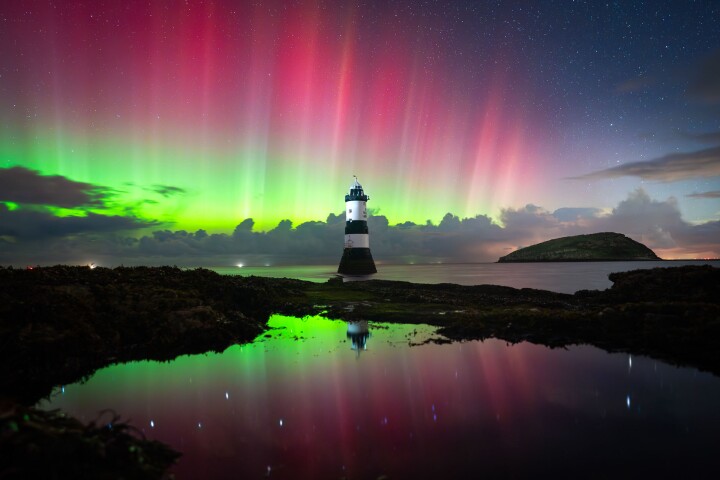 In good news for aurora photographers, the Sun is approaching the most active period of the solar cycle. As such, the stunning light shows in the 2023 Northern Lights Photographer of the Year collection are particularly vibrant.
 -
 The recently opened Glass Resort at Snowman World in Rovaniemi, Lapland, Finland, hosts a series of glass-roofed cabins, providing the ideal spot to snuggle up and enjoy the night skies and, if you're lucky, the aurora borealis.
 -
 These days, there are some pretty special places to sit back and take in the nature's most spectacular light show. Among those near Iceland's capital of Reykjavík is the Panorama Glass Lodge that gives guests a glimpse of the aurora borealis across a shimmering fjord.
 -
 Few natural light shows come more spectacular than the legendary Northern Lights. For the first time, scientists in Japan have now directly observed its inner mechanics, confirming once and for all a long-held hypothesis and furthering our understanding of one of the world's great natural wonders.
 -
 If you want to see the Northern Lights, there are hotels or even igloo villages you can stay at. For something different, though, how about jumping in a tiny sled-pod and being towed by snowmobile to the middle of nowhere, where you can marvel at the spectacle with virtually no-one else around?
 -
 The northern lights are more than one of nature's most awe inspiring sights, they are an electromagnetic phenomenon that can adversely affect power grids and communications and navigation systems. Researchers from the University of Oslo have flown a rocket through the lights to take a closer look.
 -
 Astronomers are scratching their heads over mysterious plumes that have been sighted in the atmosphere of Mars. First seen by amateur astronomers using Earthbound telescopes, the plumes are at an altitude much higher than that of any clouds yet seen on the Red Planet, and may not even be clouds.
 -
 Architecture firm Waterstudio and developers Dutch Docklands have been given the go-ahead to construct a floating luxury hotel near Tromsø, Norway. The Krystall hotel will feature a glass roof, so guests can enjoy the Aurora Borealis from their beds.
 -
 While the use of geothermal energy and recycled materials would normally be starting points for Gizmag's look at a new holiday destination like the ION Adventure Hotel, there's one element here that stands well above the pack – location.
 -
 Designed by schmidt hammer lassen, the titanium-clad Cathedral of the Northern Lights has opened some 500 km (311 miles) within the Arcitc Circle.
 -
 The Icehotel in Jukkasjärvi, Sweden has once again opened its doors for a spectacular twenty-third season.
 -
 ScienceA new camera called NORUSCA II has produced the first-ever hyperspectral images of the aurora borealis (or northern lights) and may have uncovered a previously unknown atmospheric phenomenon.
Load More