
Galaxy
-
 Astronomers have produced the largest 3D map of the universe, including an interactive VR video. In the process, they’ve uncovered some tantalizing hints that our understanding of physics, including the ultimate fate of the cosmos, could be wrong.
 -
 We’ve all regretted taking too long to make a move, but at least it wasn't 3 billion years. That’s how long the sexual tension has been building between two slow-dancing supermassive black holes, whose eventual congress could rock the entire universe.
 -
 NASA has officially selected a new mission – the Ultraviolet Explorer, or UVEX. By scanning the skies in UV light, it will be able to study the hottest objects and fleeting events like supernovae, and create a detailed new map of the cosmos.
 -
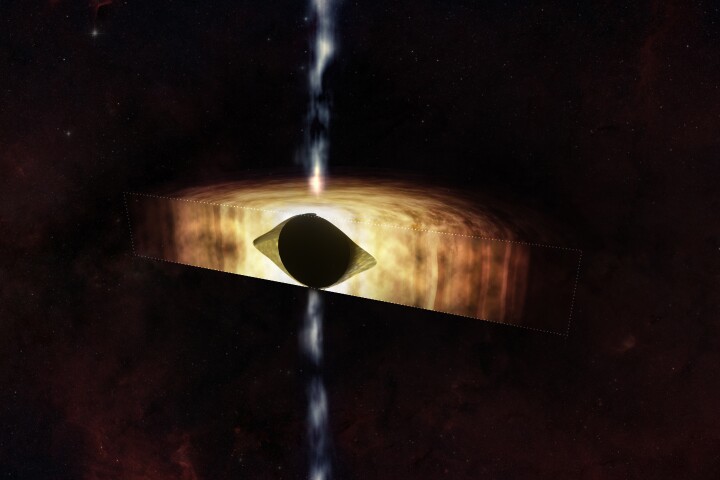 A supermassive monster lurks at the center of our galaxy, and astronomers have now discovered that it’s spinning so fast it’s warping the very fabric of spacetime into a football shape.
 -
 Astronomers have mapped out half the universe in X-ray light, using a space telescope called eROSITA. The new map, which contains almost a million X-ray sources, is the basis of dozens of new scientific papers, with many more to come.
 -
 Astronomers have discovered the most distant – and therefore earliest – known black hole. Hiding in a galaxy called GN-z11, this black hole is bigger than should be possible given the age of the universe.
 -
 Astronomers have discovered a colossal cosmic structure that’s so big it threatens our entire understanding of the universe. The Big Ring spans about 3% of the radius of the observable universe – and it might be part of an ever bigger structure.
 -
 It’s not often that space throws something entirely new at you, but in 2019 astronomers discovered a completely unknown phenomenon they called odd radio circles (ORCs). Now, more data may have revealed just how these rare objects form.
 -
 Space is one of the most versatile and photogenic subjects, and this year was no different. From a sunrise captured by the International Space Station to the most distant star ever observed, here are some of the best space photographs taken in 2023.
 -
 You’d never notice one star in the galaxy that wasn’t from around here. Astronomers have now found that a star right near the supermassive black hole at the center of the Milky Way likely originated in a smaller galaxy that ours devoured.
 -
 Phosphorus – a key ingredient for life as we know it – was thought to be relatively rare in space. But now, astronomers have detected a surprising amount of the stuff on the fringes of the galaxy, suggesting life may be more common in the cosmos.
 -
 One of the biggest cosmological mysteries centers on a discrepancy in how fast the universe is expanding. A new study comes to an intriguing solution by applying a modified theory of gravity and an unsettling “supervoid” that our galaxy resides in.
Load More