
Electrons
-
 Scientists have confirmed the existence of a strange new form of magnetism. Hiding right under our noses, the team says that “altermagnetism” can be found in everyday materials and could have major technological uses.
 -
 Scientists at ETH Zurich have discovered a new type of magnetism. Experiments show that an artificially produced material becomes magnetic through a mechanism that hasn’t been seen before.
 -
 Scientists have found that a “superatomic” material is the fastest and most efficient semiconductor ever. Taking advantage of a tortoise-and-hare mechanism, the new material can transport energy much faster than silicon.
 -
 Everybody’s favorite wonder material, graphene, continues to surprise. MIT physicists have discovered yet another brand new electronic state hiding in this overachieving little material – something they give the bizarre name of “ferro-valleytricity.”
 -
 The Royal Swedish Academy of Science has awarded the 2023 Nobel Prize in Physics to Pierre Agostini, Ferenc Krausz and Anne L'Huillier for work that's "given humanity new tools for exploring the world of electrons inside atoms and molecules."
 -
 While studying a material that could help unlock the secrets of superconductors, scientists have accidentally discovered a “demon” particle that was first theorized almost 70 years ago, but had never been experimentally confirmed.
 -
 A brand new form of silicon might help extend its use into the future. Engineers at North Carolina State University have discovered a material called Q-silicon, with new properties that could have important uses in quantum computers and spintronics.
 -
 Water is usually something you’d want to keep away from electronic circuits, but engineers in Germany have now developed a new concept for water-based switches that are much faster than current semiconductor materials.
 -
 A new solar cell packs a record voltage and (arguably) a record efficiency for its kind. The tandem solar cell uses two layers of perovskite that tap into different wavelengths of light, plus a special surface treatment reduces wasted energy.
 -
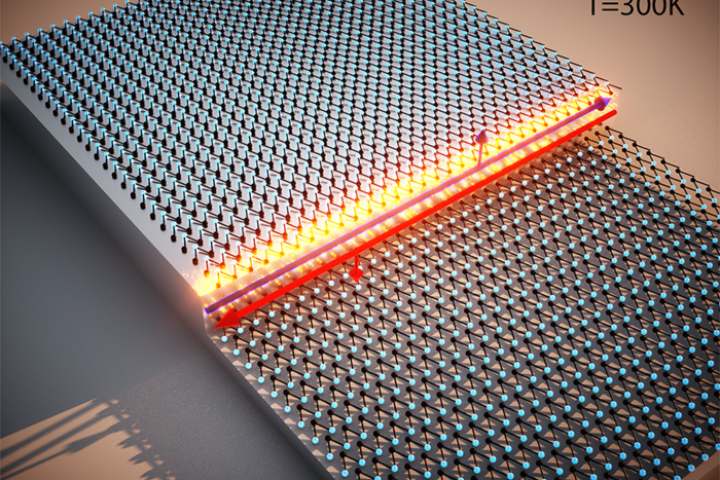 Many quantum effects can only be produced at extremely cold temperatures, which limits how useful they would be in real-world tech. Now, Princeton researchers have demonstrated a strange quantum state taking place in a material at room temperature.
 -
 Movements at the particle scale happen extremely quickly, which makes it hard to see what’s going on in there. Now engineers have developed an “attoclock” that can take snapshots of electrons in increments as small as quintillionths of a second.
 -
 Researchers at MIT have observed “electron whirlpools” for the first time. The bizarre behavior arises when electricity flows as a fluid, which could make for more efficient electronics.
Load More