
Dark Matter
-
 Black holes are famous for gobbling up everything – but could they ever be swallowed whole? A new study suggests stars could capture very small black holes. There might even be a way to find them, and if so, they could help us understand dark matter.
 -
 One of the biggest cosmological mysteries centers on a discrepancy in how fast the universe is expanding. A new study comes to an intriguing solution by applying a modified theory of gravity and an unsettling “supervoid” that our galaxy resides in.
 -
 ESA has released the first five images from its Euclid space telescope that reveal unprecedented high-resolution pictures that cover large areas of the sky in a single shot, demonstrating its capabilities for its upcoming dark matter survey.
 -
 Our solar system officially houses eight planets, but some scientists say there could be a ninth hiding on the fringes. Now, a new study has found the oddities could be explained by modified theories of gravity, an alternative idea to dark matter.
 -
 If a new study holds water it might be the JWST's most important discovery ever. Three bright objects in the distant universe could be the first candidate “dark stars,” hypothetical celestial objects powered by the annihilation of dark matter.
 -
 Astronomers have put together one of the most comprehensive maps of all the matter in the universe. The huge undertaking hints at a slightly smoother universe than we thought, suggesting that something might be missing from our models.
 -
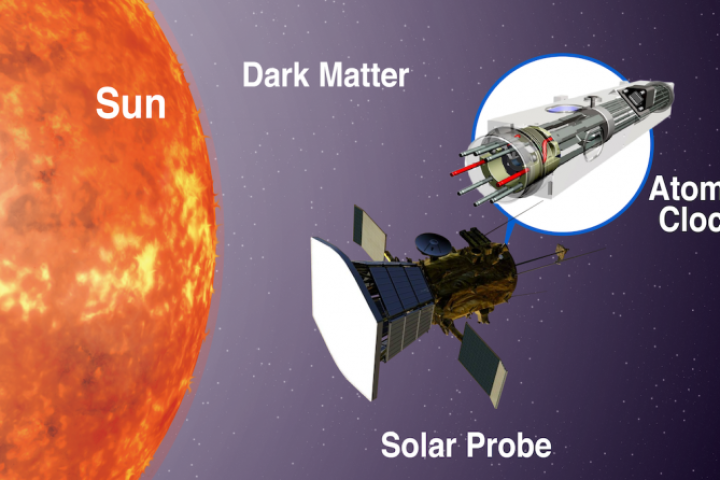 Dark matter remains elusive despite decades of searching. Now physicists have proposed a new experiment that would try to find signals by sending atomic clocks to where dark matter should be at its most dense – right near the Sun.
 -
 Astrophysicists have observed puzzling behavior in star clusters that defies our current understanding of gravity at cosmic scales. Intriguingly, the observations fit with an alternative theory of gravity that could negate the need for dark matter.
 -
 Despite making up 85% of the total mass in the universe, dark matter eludes detection. A new study proposes a unique way to look for it using the Earth’s atmosphere as a giant detector for dark matter particles streaming through the air like meteors.
 -
 The first dark matter detector in the Southern Hemisphere has been officially opened. The Stawell Underground Physics Laboratory (SUPL) is built in a disused gold mine in Australia, giving it a unique position on the globe for detecting dark matter.
 -
 This month marks the 10th anniversary of the discovery of the Higgs boson. But what exactly is this particle, and why is it so important? What has it taught us in the last decade – and more importantly, what could it teach us in the next decade?
 -
 The world’s most sensitive dark matter detector is ready to tackle one of the most perplexing mysteries of the universe. Over 50 times more sensitive than others, LUX-ZEPLIN lurks quietly a mile underground, waiting for these hypothetical particles.
Load More