
Cosmic
-
 Astronomers have produced the largest 3D map of the universe, including an interactive VR video. In the process, they’ve uncovered some tantalizing hints that our understanding of physics, including the ultimate fate of the cosmos, could be wrong.
 -
 Astronomers have discovered a colossal cosmic structure that’s so big it threatens our entire understanding of the universe. The Big Ring spans about 3% of the radius of the observable universe – and it might be part of an ever bigger structure.
 -
 Researchers have found that deep space travel can cause long-lasting erectile dysfunction. With crewed space missions planned for the near future, the findings highlight the importance of considering astronauts’ sexual health.
 -
 Earth has been blasted by the second strongest ultrahigh-energy cosmic ray ever observed. While its origins remain unknown, astrophysicists are pointing the finger at the Local Void, a fundamentally empty area of the cosmos next to the Milky Way.
 -
 On the largest scales possible, the universe resembles a web of light spun by an inconceivably large spider. Now, astronomers have detected very faint light from these cosmic web filaments in the deep, dark, distant universe.
 -
 GPS doesn’t work as well inside buildings, underground or underwater. Now engineers in Japan have developed and tested an alternative technology that uses cosmic rays to track movement beneath a building with precision of a few meters.
 -
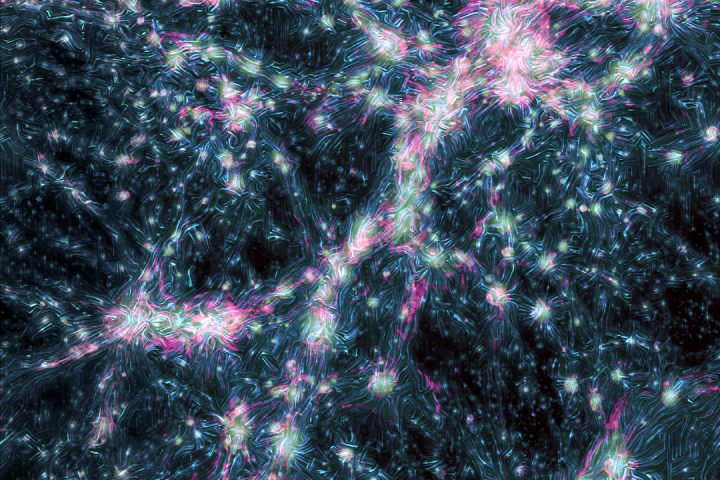 If you could zoom way out to look at the universe at its largest scale, you’d see that it’s made up of a colossal cosmic web. Now, astronomers have detected shockwaves moving through this web, providing new insights into large-scale magnetic fields.
 -
 The movements of the Sun, Moon and stars have long been used to keep track of time, and now engineers from the University of Tokyo have proposed a new way to use the cosmos to precisely track time, using showers of particles from cosmic rays.
 -
 Progress on quantum computers may soon stall. Cosmic rays streaming to Earth can interfere with the integrity of information in quantum computers, and now an MIT team has shown just how vulnerable they are and what it might take to protect them.
 -
 Headlines lately have been screaming about how scientists in Antarctica have discovered evidence of a parallel universe where time runs backwards. While we seriously wish that was true, a new study has put forward a more realistic explanation.
 -
 A big challenge humanity faces in venturing off Earth and into deep space is how to tackle the dangers of cosmic radiation. A team has now discovered a drug treatment that could not only prevent cognitive deficits caused by this radiation, but actually repair damage in the brain after exposure.
 -
 Cosmic rays are raining down over Earth every day, but you’d never know unless you had the right tools. Those tools mostly take the form of bulky, expensive lab equipment, but thanks to an MIT team, you can now build your own detector for US$100 – small enough to take on a plane or the subway.
Load More