
Caltech
-
 It might sound like something out of the X-men but it came from a lab in California: mutant newts that grew perfect limbs after defective appendages were cut off. The findings help science get one step closer to understanding how regeneration works.
 -
 If you want to gather climate-change data from the deep ocean, why not hitch a ride with an organism that's going down there anyways? That's the thinking which led to the creation of "biohybrid jellyfish" which pack two speed-boosting technologies.
 -
 We only have to look up at the Moon to see the remains of a cataclysmic collision between two early planets, billions of years ago. Evidence may also be beneath our feet, as scientists suggest the remains of that ancient planet lurk near Earth’s core.
 -
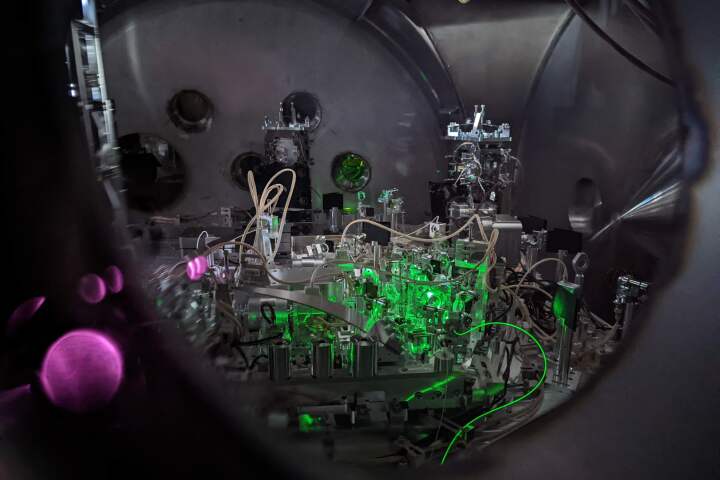 Gravitational wave facilities measure spacetime distortions down to 10 quadrillionths of a hair – small enough for interference from particles popping in and out of existence. Now LIGO has pushed beyond this quantum limit by “squeezing” laser light.
 -
 Scientists from Caltech and WHOI have found evidence that Earth’s core is leaking. High levels of a particular isotope of helium were found in lava flows in Canada, which the team proposes originated in the planet’s core.
 -
 On the largest scales possible, the universe resembles a web of light spun by an inconceivably large spider. Now, astronomers have detected very faint light from these cosmic web filaments in the deep, dark, distant universe.
 -
 Caltech scientists have developed a new hybrid vaccine that combines mRNA and protein nanoparticles. In mouse tests, the prototype produced five times more antibodies than existing COVID-19 vaccines, and could be used against a range of diseases.
 -
 The ingredients in stars are usually pretty evenly mixed throughout, but now astronomers have discovered a bizarre star with two distinct faces, each made of a different element, which defies explanation.
 -
 The very fabric of spacetime is constantly warping on unimaginably tiny scales, as ripples from past cataclysms wash over us. Astrophysicists have now detected a background sea of gravitational waves, using a galaxy-scale detector of dead stars.
 -
 Robots often struggle to adapt to changing conditions. Now engineers at Caltech have designed a new robot that can roll around on four wheels, flip them into rotors to fly, or transform for six other types of motion.
 -
 Scientists have created models of human embryos by programming stem cells. The models give a glimpse into a key stage of development that can reveal new insights into genetic disorders and preventing failure in early pregnancy.
 -
 Researchers have developed a wearable, noninvasive sensor that monitors for a biomarker of inflammation in the wearer’s sweat. They say the device could be used at home by people with chronic inflammatory diseases.
Load More