
Argonne National Laboratory
-
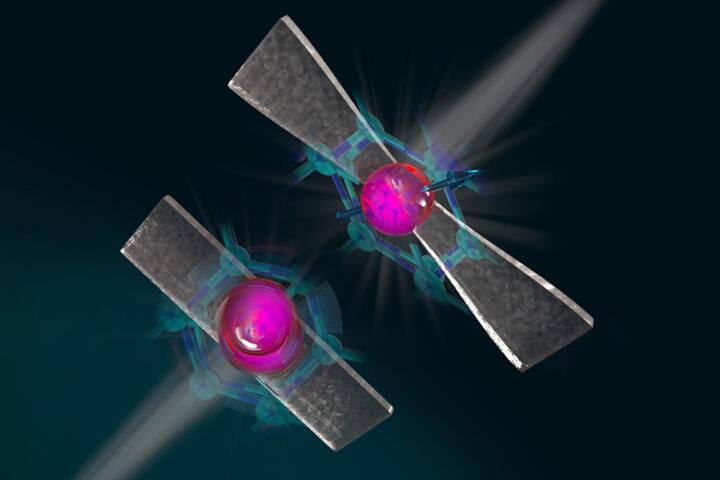 Researchers are claiming a breakthrough in quantum communications, thanks to a new diamond-stretching technique they say greatly increases the temperatures at which qubits remain entangled, while also making them microwave-controllable.
 -
 Scientists have demonstrated a new electrode material that could facilitate much faster charging for lithium batteries, and one that forms in a rather unusual way – through the charging process itself.
 -
 Water can take on far more forms than many people give it credit for, and now scientists have recreated a particularly bizarre one in the lab – a “hot black ice” that may exist deep inside planets like Uranus and Neptune.
 -
 The lithium-ion batteries at the heart of our transport future don't last forever, and researchers expect a massive influx of depleted units in the coming decade. A new breakthrough, however, could streamline our efforts to recycle them.
 -
 Scientists in the US have introduced a new player to the world of 2D materials in the form of an ultra-thin, ultra-strong material they've dubbed borophane, which they see one day finding use in advanced forms of electronics.
 -
 Owing to its abundance and low cost, lead is an alternative battery material with plenty of appeal, and scientists have just demonstrated how it can form the basis of a new anode that offers far greater storage capacity than graphite.
 -
 Researchers at the US Dept of Energy's Argonne National Laboratory have discovered a new catalyst that can convert carbon dioxide and water into ethanol with "very high energy efficiency, high selectivity for the desired final product and low cost."
 -
 The US Department of Energy (DOE) has announced and detailed a blueprint for a national quantum internet that would be super-fast and nigh on unhackable. The document describes four priority research areas, and five major milestones on the path.
 -
 Despite advances in new battery designs, good old lithium-ion batteries are still the frontrunner. There’s plenty of room for improvement though, and now researchers have identified a new cathode coating that could make them safer and longer lasting.
 -
 A newly developed nanodevice could give efforts to treat Alzheimer's a real shot in the arm, by capturing harmful peptides thought to lead to the disease and clearing them away before they aggregate into harmful plaques.
 -
 Scientists are working on a new process to produce a pair of radioisotopes of the element scandium (Sc).
 -
 "Broken nanodiamonds are forever," or so says a team of scientists at Argonne National Laboratory. By combining broken nanodiamonds with molybdenum disulfide layers, they've produced a self-generating, very-low-friction dry lubricant with hundreds of applications that lasts practically forever.
Load More