
Arduino
-
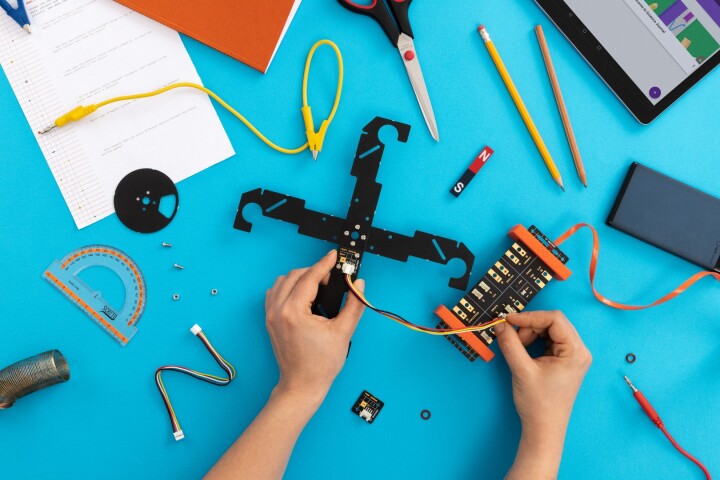 Open source hardware and software company Arduino has teamed up with Google to develop and launch the Arduino Science Kit Physics Lab. Designed for students aged 11 to 14, the kit helps kids experiment with forces, motion, magnetism and conductivity.
 -
 The Arduino Nano has been at the heart of many projects over the years, including the captivating Edgytokei clock, a six-legged stinger and the retro-tastic Synth Bike. Now the Nano is getting a bunch of baby brothers in the shape of the Nano Family maker boards.
 -
 Most home robots aren’t particularly customizable. Now robotics startup Ohbot has unveiled its newest creation Picoh, a blank slate of a robot that can be programmed to do basically whatever you want it to do.
 -
 Back in 2013, Udoo launched on Kickstarter with a new mini computer that promised four times the power of a Raspberry Pi and all the functionality of an Arduino. Now the team is back with a powerful maker board called the Bolt that's pitched as "ideal for AI, Computer Vision, AR, VR and IoT."
 -
 We've seen a number of frankly bizarre time-keepers over the years. Architect and hobby tinkerer Ekaggrat Singh Kalsi joins that strange clock party with the Edgytokei, where dancing mechanical arms show hand positions on a clock face ... except there's no clock face.
 -
 Thecorpora has launched an Indiegogo campaign to get the Q.bo One robot into the hands of kids, educators, developers and robot enthusiasts. The open source desktop bot is described as easy to build, simple to program and easy to hack.
 -
 Price is a problem for consumer robot arms, so they generally aren’t worth it for interested tinkerers. Ufactory has unveiled new consumer-level robot arms, the uArm Swift and Swift Pro, that are aimed at being cheap enough to splash out on, even if all it does is stir your coffee for you.
 -
 We’ve played a lot of video games in our time, but Objects In Space is the first we’ve had to start one with a key. With huge panels of LEDs, buttons and switches, the game deliberately slows down the pace of space dogfights and tasks the player with micromanaging their ship’s systems.
 -
 We've seen machines playing ping pong before, but artist Mark Wheeler has got ping pong playing machines. He's harnessed the game's metronomic regularity, or lack thereof, and created a sound system with a tempo that's set by the back and forth of a rally.
 -
 When one Texas high school player suffered a concussion, he was inspired to develop a more protective helmet and shoulder pads, inspired by nature.
 -
 ScienceYou've probably never heard of huanglongbing – unless, of course, you're a citrus farmer. Then you'd know that it's another name for a blight caused by the Asian citrus psyllid. To fight it, researchers have decided to appeal to the bug's romantic side by playing males a very special sound.
 -
 ScienceArtificial electronic eggs called "EggDuinos" are getting plopped in the nests of three critically endangered vulture species, in order to study their habitats.
Load More