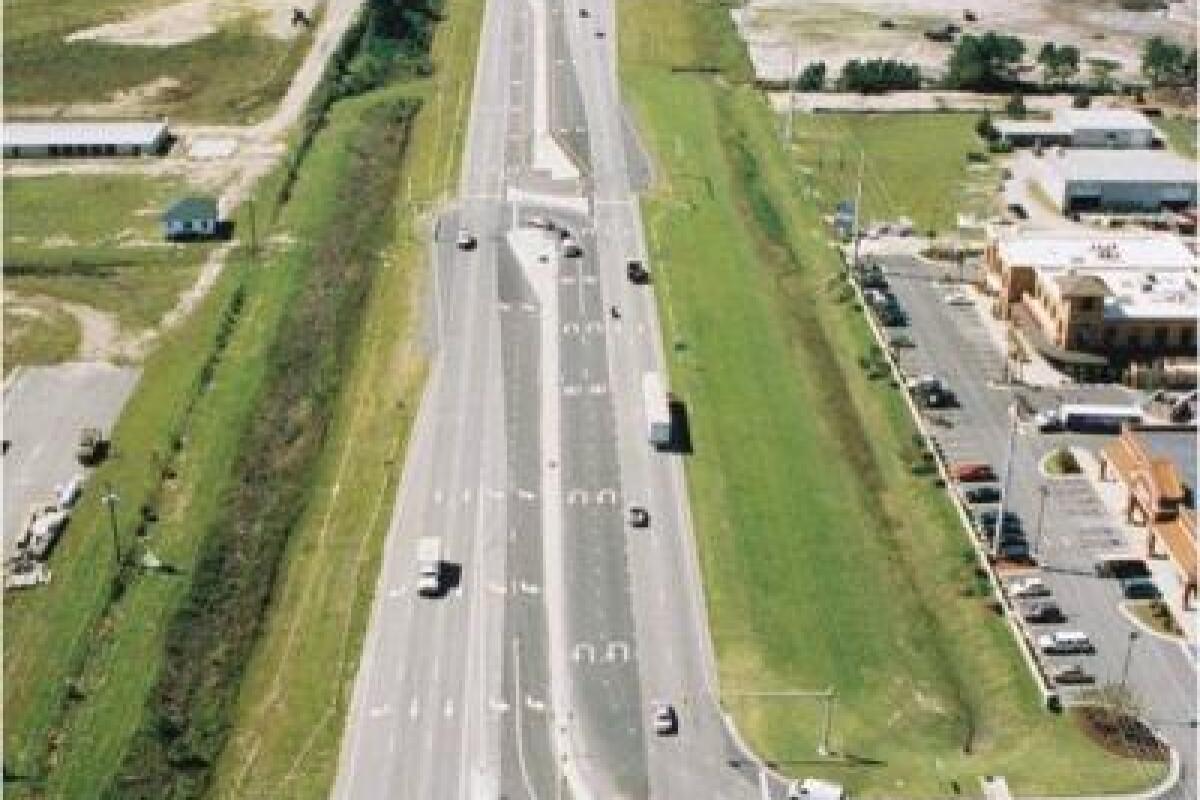



No left turn. That is the simple concept behind the Superstreet traffic design which promises significantly faster travel times, plus a drastic reduction in auto-collisions and injuries. These superstreets are ground level streets – not raised freeways or highways – that allow for greater volume of thru-traffic by re-routing traffic from side streets that would normally be trying to get across the main road. While the idea has been around in urban transport modeling textbooks for over 20 years, researchers from the North Carolina State University have been the first to test the concept in the real world and the results are promising.
The central concept to the superstreet design is a thoroughfare, a stream of constantly moving traffic that follows a main arterial road. Drivers wanting to cross the thoroughfare or to turn left are first required to make a right turn, joining the main stream of traffic. A little way down the superstreet they then make a U-turn after which they can continue on along the thoroughfare if they had been trying to turn left or they can turn right into the side street if this was their planned route. While this may seem time-consuming, the study shows that it actually results in a significant time savings since drivers are not stuck waiting to make left-hand turns or for traffic from cross-streets to go across the thoroughfare.
"The study shows a 20 percent overall reduction in travel time compared to similar intersections that use conventional traffic designs," Dr Joe Hummer, professor of civil, construction and environmental engineering at NC State and one of the researchers who conducted the study said. "We also found that superstreet intersections experience an average of 46 percent fewer reported automobile collisions – and 63 percent fewer collisions that result in personal injury."
The researchers assessed travel time at superstreet intersections as the amount of time it takes a vehicle to pass through an intersection from the moment it reaches the intersection – whether traveling left, right or straight ahead. The travel-time data were collected from three superstreets located in eastern and central North Carolina, all of which have traffic signals. The superstreet collision data were collected from 13 superstreets located across North Carolina, none of which have traffic signals.
A Paper on the travel time research will be presented on January 24 at the Transportation Research Board Annual Meeting in Washington D.C. The Paper is co-authored by Hummer, former NC State graduate students Rebecca Haley and Sarah Ott, and three researchers from NC State's Institute for Transportation Research and Education: Robert Foyle, associate director; Christopher Cunningham, senior research associate; and Bastian Schroeder, research associate. The collision research was part of an overarching report of the study submitted to the North Carolina Department of Transportation (NCDOT) last month, and is the subject of a forthcoming paper. The study was funded by NCDOT.