The rotation of a supermassive black hole (SBH) has been definitively measured for the first time by combining x-ray data obtained by the x-ray space telescopes XMM-Newton (soft x-rays) and NuSTAR (hard x-rays). The SBH at the center of a galaxy called NGC 1365 was found to be spinning at 84 percent of the maximum speed allowed by general relativity – or roughly speaking, the edge of the black hole is rotating at 84 percent of the speed of light.
Supermassive black holes are the largest known objects of their type, with masses millions or billions times the mass of our sun. It is believed that all most, if not all, galaxies contain an SBH at their center. SBHs are surrounded by an accretion disk of dust and gas, which represents matter falling into the black hole.
Most black holes spin, or more precisely, have angular momentum. As the galaxy is rotating about the SBH, the infalling matter brings angular momentum along with it. This angular momentum causes the spacetime surrounding the SBH to rotate, an effect called frame dragging. There is a maximum rate at which the spacetime can rotate – the linear speed of the frame dragging must be less than the speed of light, roughly speaking. It is not clear, however, what we should expect for the angular momentum of an SBH – we don't even know how they are formed, or why there is one at the center of galaxies.
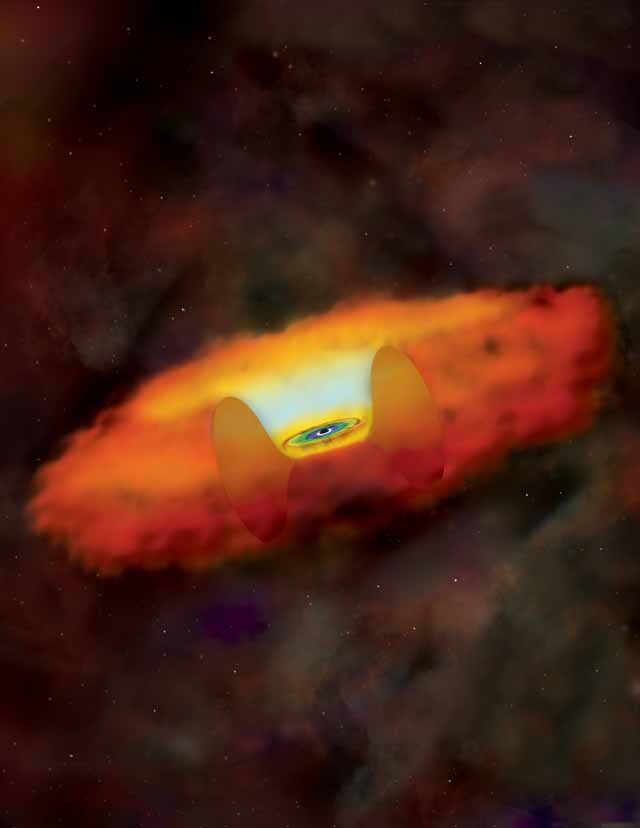
Fortunately, scientists have developed a way of measuring the spin of an SBH. Near the SBH, the accretion disk is very hot (as seen above), and emits a large amount of x-rays. In particular, x-rays associated with excited iron atoms are easily seen. Their appearance, however, is odd. They are broadened over a wide range of energy, and their distribution holds clues as to the rate at which the SBH is spinning.
The iron x-rays are generated by fluorescence near the inner edge of the accretion disk. This means that the source of the iron x-rays is moving rapidly around the SBH, so the spectrum of the iron x-rays is spread out by the general relativistic equivalent of the Doppler effect.

The structural features of the iron x-ray spectrum now allows us to determine the rotational speed of the SBH. The intensity varies with x-ray energy between the limits of five and fifty kiloelectron volts (keV). X-ray observations using space telescopes that, like the ESA's XXM-Newton, are sensitive to soft x-rays (1-10 keV) revealed the broadening, but this limited data agreed with several explanations, so that the rotation of the SBH could not be determined from those measurements.
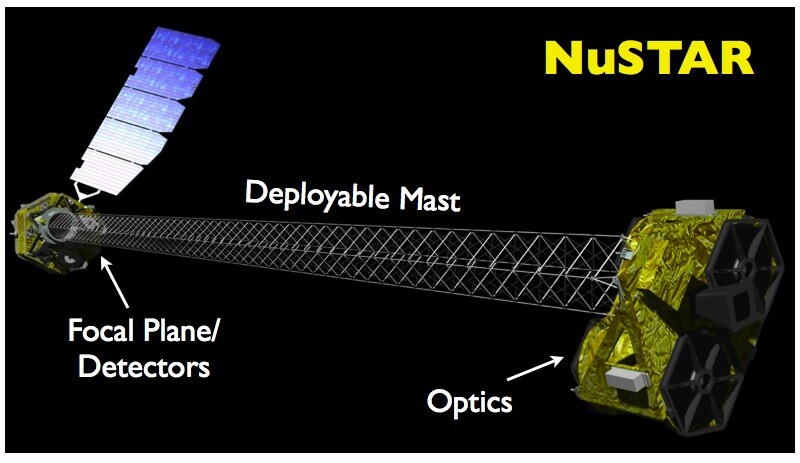
NASA's NuSTAR (Nuclear Spectroscopic Telescope ARray) is an x-ray space telescope launched into orbit in mid-2012. Being sensitive to energies from six to 79 keV, it images objects that generate x-rays at larger energies than do the earlier generation of x-ray space telescopes.
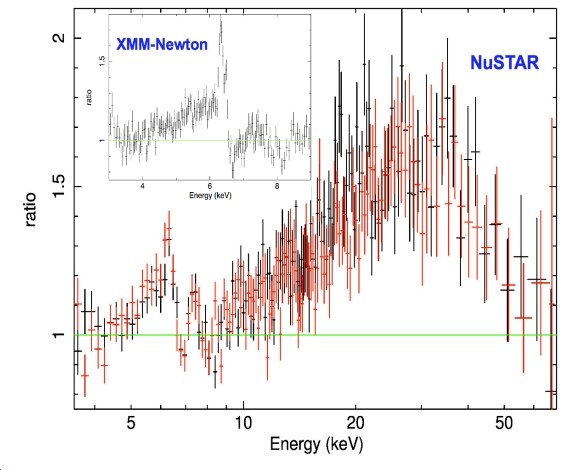
An international team used NuSTAR to take a spectrum of the hard x-rays associated with the fluorescence of the iron atoms. This new information showed unambiguously that the alternate models to explain the line broadening were false, and allowed the astronomers to fix the angular momentum of the NGC 1365 SBH to be at least 84 percent of the maximum possible value, which is the speed of light.
The astronomers say the findings will help to shed light on how black holes and galaxies evolve.
Source: NASA/JPL