Last September we covered a story about a pressure-sensitive artificial skin developed at Stanford University that is so sensitive it can "feel" the weight of a butterfly. As part of a goal to create what she calls "super skin," Stanford researcher Zhenan Bao is now giving the artificial skin the ability to detect chemical and biological molecules. Not only that, she has also developed a new, stretchable solar cell that can be used to power the skin, opening up the possibility of an artificial skin for robots that can be used to power them and enable them to detect dangerous chemicals or diagnose medical conditions with a touch.
The touch-sensitive flexible organic transistor previously developed by the Stanford researchers forms the foundation of the new artificial skin. It consists of a highly elastic rubber layer that is molded onto a matrix of microscopic inverted pyramids. This rubber film is sandwiched between two parallel electrodes, which register compressions and rebounds as electrical signals of various strengths.
By altering the shape and density of the pyramids, the sensitivity of the material can be tweaked to more closely mimic the different sensitivities of skin on different parts of the body. Existing samples range from several hundred thousand to 25 million pyramids per square centimeter, corresponding to the desired level of sensitivity. Bao has also replaced some of the materials in earlier versions of the transistor with biodegradable materials so it is now more eco-friendly.
Chemical and biological molecule detection
To enhance the skin and give it the ability to sense a particular biological or chemical molecule, it needs to be coated with another molecule that will bind with the biological or chemical molecules when they come in contact. "Depending on what kind of material we put on the sensors and how we modify the semiconducting material in the transistor, we can adjust the sensors to sense chemicals or biological material," Bao said.
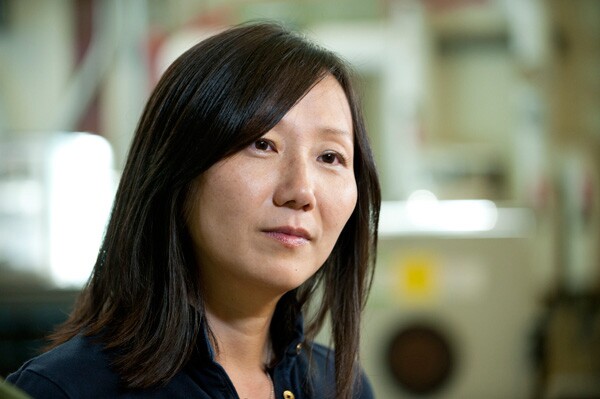
The researchers have already had success with the concept by detecting a certain kind of DNA and they're now working on using the technique to detect proteins with an eye on medical diagnostics applications.
"For any particular disease, there are usually one or more specific proteins associated with it – called biomarkers – that are akin to a 'smoking gun,' and detecting those protein biomarkers will allow us to diagnose the disease," Bao said.
By adjusting aspects of the transistor structure, the super skin could also be modified to detect chemical substances in either liquid or vapor.
Stretchable solar cell
To allow the sensors to be lighter and more mobile, the researchers are looking to do away with the need for batteries or an electrical outlet by using stretchable solar cells. These cells are made of an accordion-like wavy microstructure that is covered with a liquid metal electrode that conforms to the surface in both its relaxed and stretched states. The cells can be stretched up to 30 percent beyond their original length and snap back, all the while generating enough electricity to enable the sensors to transmit their data to a computer for processing.The solar cells can also be designed to stretch along two axes, which would allow it to be used in fabric for clothing. Its ability to bond to curved surfaces without cracking or wrinkling also makes it useful for a wide range of applications, such as car exteriors, lenses, and buildings.
Bao says the super skin could provide robots and other devices with capabilities beyond those of human skin.
"You can imagine a robot hand that can be used to touch some liquid and detect certain markers or a certain protein that is associated with some kind of disease and the robot will be able to effectively say, 'Oh, this person has that disease,'" she said. "Or the robot might touch the sweat from somebody and be able to say, 'Oh, this person is drunk.'"
A research paper by Bao, describing the Stanford team's stretchable solar cells, will appear in an upcoming issue of Advanced Materials.