Help us keep Gizmag reader-friendly

Scientists turn light into a tractor beam

By

January 28, 2013

A team led by the University of St. Andrews has turned a laser into a tractor beam that wo...

A team led by the University of St. Andrews has turned a laser into a tractor beam that works on the microscopic level

Image Gallery (3 images)

From The Skylark of Space to Star Wars, no self-respecting science fiction spaceship would break orbit without a tractor beam on board. We’re still a long way from locking on to errant shuttlecraft, but a team led by Dr. Tomas Cizmar, Research Fellow in the School of Medicine at the University of St. Andrews, Scotland, has turned a laser into a tractor beam that works on the microscopic level.

Tractor beams are one of those things that seem on the far edge of what’s possible. The idea of a beam of energy streaming out that pulls things in is counter-intuitive, but scientists have been developing things that work like tractor beams since the 1960s and light manipulation has been tried since the 1970s.

In recent years, several ways of imitating the fictional tractor beam have been investigated, including optical vortices, optical tweezers, Bessel beams and optical pipelines. Developed in association with the Institute of Scientific Instruments (ISI) in the Czech Republic, the St. Andrews team claims that its tractor beam is different in that it’s the first time that a light beam has been made to draw objects toward the light source.

Though the tractor beam only works under very specific conditions on a microscopic scale, it involves a principle that’s been known for centuries, since Johannes Kepler first deduced that it was the pressure of light that pushed comet tails outward from the sun. This light pressure has already been harnessed for solar sails and attitude controls for satellites, but the St. Andrews team has found a way to turn this pressure into a negative force.
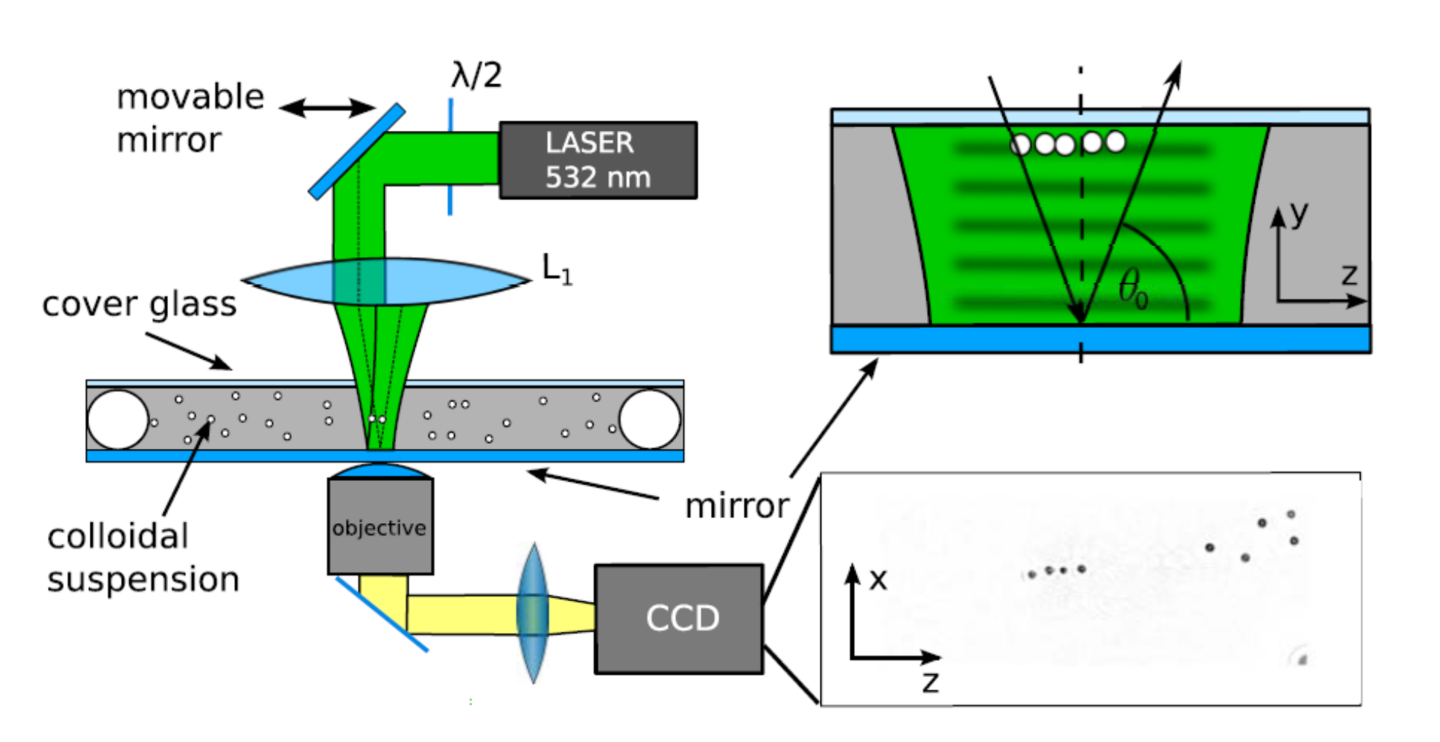
Schematic of the tractor beam experiment

This negative force is produced in a laboratory set up by a mixture of very specific properties of light and the object being moved. In the St. Andrews experiment, a Gaussian beam (a light beam where the profile is described by a Gaussian mathematical formula) is generated by a VERDI V5 laser. This beam is directed through a lens and then passes through a suspension of dielectric spheres set between two coverslips.

The bottom slip is a half-silvered reflecting mirror that reflects part of the beam back to the source. The incoming and reflecting beams interfere with one another and produce a standing wave. Based on the properties of the spheres and their location, the standing wave shapes in such a way that the light force pushes the spheres back toward the laser source.

Putting it simply, the standing wave at a particular spot near the light source interacts with spheres of a particular size and mass in such a way that the light waves push in the wrong direction. It’s a bit like a dinghy moored at a pier where the current is moving away from the pier, but produces eddies that push the dinghy back into the pier.

The team sees a number of applications for the tractor beam in biomedical photonics and other disciplines, such as the simple and inexpensive optical sorting of macromolecules, organelles or cells.

The findings of the team were published in Nature Photonics.

Source: University of St. Andrews

About the Author
David Szondy David Szondy is a freelance writer based in Monroe, Washington. An award-winning playwright, he has contributed to Charged and iQ magazine and is the author of the website Tales of Future Past.   All articles by David Szondy
8 Comments

Soooo still a push not pull. Cool idea though. Perhaps the laser can be aimed at particular planets to reflect back into the beam and create a standing wave. Booya tractor beam!

charizzardd
28th January, 2013 @ 07:37 am PST

Thank you scientists! We can "attract" an object with laser if you put a mirror behind it. We kind of knew that already... put a mirror behind the object and then push it from behind with lasers.

GoodLife03
28th January, 2013 @ 08:57 am PST

That's Star Trek. Star Wars did not have tractor beams or for that matter shields or transporters.

Evan Pearce
28th January, 2013 @ 08:53 pm PST

@Evan,

I'm sure when Han Solo, while in the Millenium Falcon, was chasing/being chased by that TIE Fighter, he said: What's that Planet?, or something like that.

When they realized it was the Death Star is was too late and guess what, they were caught in it's Tractor Beam.

And in case you meant Star Trek, they have a tractor beam too.

Am I wrong?

Seth Kazzim
29th January, 2013 @ 03:38 am PST

Seth, you are correct, the Death Star in Star Wars did indeed have a tractor beam. In any case, I fail to see why anyone would cull out one movie from the author's list when the discussion was regarding Science Fiction movies as a genre. I like the article, because it shows where science is moving, I posted this article on my Facebook page because I find it intriguing to imagine a future where these technologies exist as everyday work items and our great great great grand children will look back and wonder how we ever made do without them :)

John A Vonesh
29th January, 2013 @ 09:02 am PST

In Star Wars Episode V: The Empire Strikes Back; The Rebel base on Ice Planet Hoth is protected from imperial bombardment by a force field (shield).

Fusiontek
29th January, 2013 @ 04:19 pm PST

can one upscale this, wow, awesome.

If done on Microscale how bout Megascale

Stephen N Russell
29th January, 2013 @ 05:37 pm PST

This Sort of Tractor beam isn’t too practical for large objects. The Keshe Foundation has developed a practical tractor beam, as well as antigravity and free energy technology using a different Physics that posits that magnetic fields are the basic building blocks of matter and force. They gave their technology to Iran 3 years ago and they have developed antigravity and tractor beams which Keshe claims is how the Iranians were able to bring down the U.S. stealth drone. Now the Keshe foundation is sharing their technology with any country that wants it.

Herbert Dorsey
29th January, 2013 @ 05:44 pm PST
Post a Comment

Login with your gizmag account:

Or Login with Facebook:


Related Articles

Just enter your friends and your email address into the form below

For multiple addresses, separate each with a comma


Privacy is safe with us because we have a strict privacy policy.

Looking for something? Search our 22,685 articles