



Researchers at Stanford University have developed a new algorithm suitable for brain-implantable prosthetic systems, or “neuroprosthetics,” which increases the effectiveness of mind-controlled computer cursor movement to a degree that approaches the speed, accuracy and natural movement offered by a real arm.
When a paralyzed person imagines themselves moving a limb, the part of the brain which controls that movement still produces some activity. The Stanford-developed ReFIT (or Recalibrated Feedback Intention-Trained Kalman filter) algorithm harnesses this with a silicon chip which is implanted into the brain of the subject and records action potentials, before sending the data back to a computer. The frequency with which the nerve impulses are produced provides the computer with information on the direction and speed of the user’s desired movement.
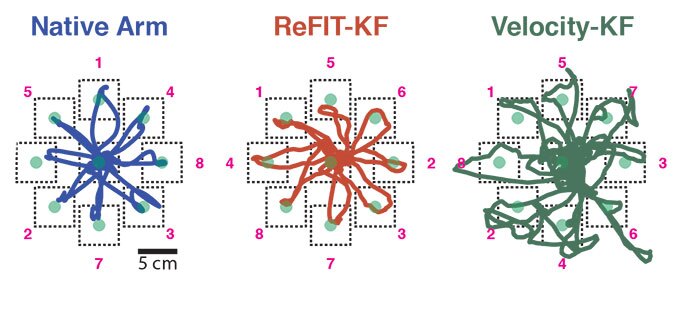
Able-bodied rhesus monkeys were tasked with using the ReFIT (or Recalibrated Feedback Intention-Trained Kalman filter) algorithm to mentally direct a mouse cursor to an onscreen dot, and then hold it for half a second. Testing showed that ReFIT performed far better than previous algorithms, and allowed the monkeys to reach their target twice as quickly as before – offering an impressive 75 to 85 percent of the speed of real arms.
“This paper reports very exciting innovations in closed-loop decoding for brain-machine interfaces. These innovations should lead to a significant boost in the control of neuroprosthetic devices and increase the clinical viability of this technology,” said Jose Carmena, associate professor of electrical engineering and neuroscience at the University of California Berkeley.
The Stanford team approached the challenge of neuroprosthetics from a new angle compared to previous efforts, with the ReFIT algorithm designed to focus on reading small groups of neurons, rather than the usual method of interpreting individual neurons. This led to an increase in longevity for ReFIT, up from the usual limit of around a year for previous similar systems, to over four years of successful operation.
The FDA has approved clinical human trials of ReFIT, and the Stanford team is currently focusing on improving cursor movement yet further. However, the creation of mind controlled robotic limbs has also not been ruled out for the future – an intriguing prospect indeed.
The results of the study were published November 18 in the journal Nature Neuroscience.
The video below contrasts the ReFIT algorithm with a previous generation algorithm.
Source: Stanford University