

Radio-controlled car runs on soda can rings
By Ben Coxworth
20:24 April 19, 2011

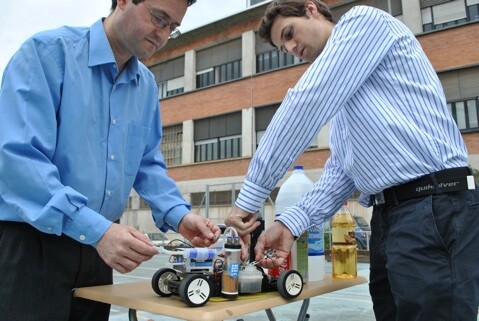
Spanish researchers have created the dAlh2Orean, a radio-controlled model car that creates hydrogen fuel from pop can pull rings and other waste aluminum
(Photos courtesy UPC)
As anyone who has seen Back to the Future will remember, the movie ended with Doc Brown fueling the time-traveling DeLorean's "Mr. Fusion" reactor with household waste. Well, a student and a professor from the School of Industrial and Aeronautic Engineering at Barcelona's Universitat Politècnica de Catalunya (UPC) have taken a step towards making that scenario a reality by adapting a radio-controlled model car to run on hydrogen fuel derived from waste aluminum and water. In a nod to the movie, they have named the car the dAlh2Orean ... as in, d-aluminum-water-rean.
The car was created as the final project of engineering student Aleix Llovet, whose work was supervised by Prof. Xavier Salueña. It's also part of UPC's Aluminium project, which is aimed at the development of actual passenger-carrying microcars that use recycled aluminum as fuel.
The first step in creating fuel for the dAlh2Orean involves combining waste aluminum with a sodium hydroxide catalyst. The reaction produces hydrogen, which is passed through a vinegar and water filter to remove hydroxides. It then goes through a silica gel filter, to remove moisture and boost its performance. Finally it goes into a fuel cell, where it provides enough power to run the car for about 40 minutes, sending it to a top speed of 30 km/h (18.6 mph).
Llovet and Salueña state that their patented system produces no carbon dioxide, and that its other byproducts can be reused – aluminum hydroxide created in the aluminum-sodium hydroxide reaction can be converted into alumina (which can then be made into aluminum), while salt can be harvested from the vinegar-water filtration medium.
The two researchers are now looking into the feasibility of scaling the system up for use in real automobiles. Readers who simply like the idea of a hydrogen-powered r/c model car can already buy one, in the form of Horizon Fuel Cell Technologies' H-Racer 2.0, or Corgi's H2GO.

Of course this totally ignores the huge amounts of energy required to refine aluminum. Approximately 1 kg of aluminum uses 15 kilowatt-hours of electricity. And that doesn't even include the amount of energy required to extract the aluminum from the ore.
Using aluminum as an energy carrier is very very inefficient. Recycling aluminum is a far better use, since it requires 95% less energy to recycle aluminum than to mine and refine it.
Yes, this is a fine science experiment, but I don't want to see it scaled up because it's very wasteful.
Acorn, it said WASTE ALUMINUM. Are you going to argue that ALL aluminum is recycled? I think not.
@Eletruk - We're anxiously awaiting your better design! Not sure where you get the idea they plan to mine and refine aluminum from this... you do see the old can tabs right? Or you could also simply read the article before posting comments. This is a great idea, using RECYCLED aluminum to power a vehicle.
Cool concept, clever name, looking forward to the cleaner future!
Pure academic dilettantism.
The future is the use of electricity directly.
@Eletruk Do you know if there's anywhere online to read about the recycle process for aluminium please?
Ian Colley.
What I think of when I read "soda can rings" are the plastic things which hold a 6-pack together. The opener tabs haven't been ring-shaped for 25~30 years, ever since the type which is made to stay with the can was invented.
Why not use solar electricity to split Urea H4co to H & use this, spliting voltage is .39 volts.
U also get double the amount of H.
U can even pee into the cell & it works!!?.
No recycling required. Cheers John M
Sodium Hydroxide is a catalyst? Sodium Hydroxide is a reactant, it is also known as Lye and caustic soda although not very dangerous it can burn your skin just like an acid. If you have waste zinc, i.e. old battery case then you can use Hydrochloric acid, Muriatic acid to do the same thing i.e. generate Hydrogen.
while it's easy to criticize, I think it shows great talent! We need these kind of ideas to help us find new sources of energy. And, Mr. J. Bell did a great job on that video. Pehaps he'll move on to a major movie someday....
It is a cool lab experiment. But you would use far less electricity recycling the aluminum, and generating the hydrogen by the electrolysis of water.
Zinc is the better metal for this. It is much easier to refine in the first place. There are far more sources in the slag heaps of other metal mining. The recovery refining of the zinc salt after electrolysis will be much less expensive than with aluminum. One reason that the aluminum "pull rings" would be better than the can itself is that the alloying metals added to make the aluminum extrudeable and anodizeable as is required for a beverage can can contaminate the electrolysis reaction. The pull rings are less alloyed. BTW, zinc-air batteries are already available on the retail market although they are for hearing aids and the like, not for model cars.
I've known you could make hydrogen (for floaty balloons) from aluminum and acid since I was a kid (a long time ago). I'm no chemist, but I'm pretty sure you have to replenish the acid too, so it's not just aluminum you have to replace.
@Eletruk, it may be inefficient to mine for more aluminum for this type of engine, but considering how much waste aluminum there already is in landfills and just litter, there isn't really a problem with finding aluminum to use as a fuel source.
genius!!!! hats offf to u guyz!!! we have to agree its a much cleaner no doubt !!! wish u all the very best for future endeavours!!!!
Like Bob, as a kid in 1946 I used a beer bottle filled with caustic soda and water mix and dropped a few aluminum fence staples straightened into the bottle. I popped a balloon over the bottle and collected the gas and behold "a floaty balloon". Best stay away from chemicals for fuel if we can. Its not really "clean"
@Kalvin Lee, if you can gather all the aluminium already in "landfills and just litter", it will still be more energy efficient to use it as a metal. Then, with the energy saved in mining and refining of the aluminium... you can charge batteries to power the vehicle. Period.
My point is, if you bother to separate the aluminium from the rest of the waste, use it as a structural material. Don't just burn it!
Or Login with Facebook:
Related Articles
Just enter your friends and your email address into the form below
For multiple addresses, separate each with a comma
Privacy is safe with us because we have a strict privacy policy.
Explore Gizmag


very ingenious..can,t wait for scale-up news of success.