The Sun is a bit over 4.5 billion years old, leading many to think of all stars as billions of years in age. Astronomers have now demonstrated that isn't always the case. Using high-resolution millimeter and submillimeter imaging telescope arrays, John Tobin of the National Radio Astronomy Observatory (NRAO) and his collaborators have now discovered an infant star whose age is measured in thousands, rather than billions, of years. While at present the protostar has only about a fifth of the Sun's mass, projections point to the eventual formation of a stellar system broadly similar to our Sun and its planets.
Before there is a star, there is a molecular cloud that, finding itself a bit denser than its surroundings, begins to collapse under the force of its own gravity. Protostars are those collapsing clouds which derive their luminosity from the release of the gravitational potential energy of infalling matter as the core of a protostar is not yet hot enough to support nuclear fusion. In a very early protostar, most of the mass in the system is still in the dust and gas envelope surrounding the protostar as it has not yet had sufficient time to concentrate most of the mass of the cloud.
John Tobin of the National Radio Astronomy Observatory and his collaborators have found and thoroughly characterized the protostar L1527 IRS, the least developed infant star currently known. L1527's envelope contains about one solar mass of gas and dust and is about 0.16 light years (ly) in radius. This region has an average density some 10,000 times larger than normal interstellar matter, which is about the lowest density we can achieve in an extremely high vacuum system.
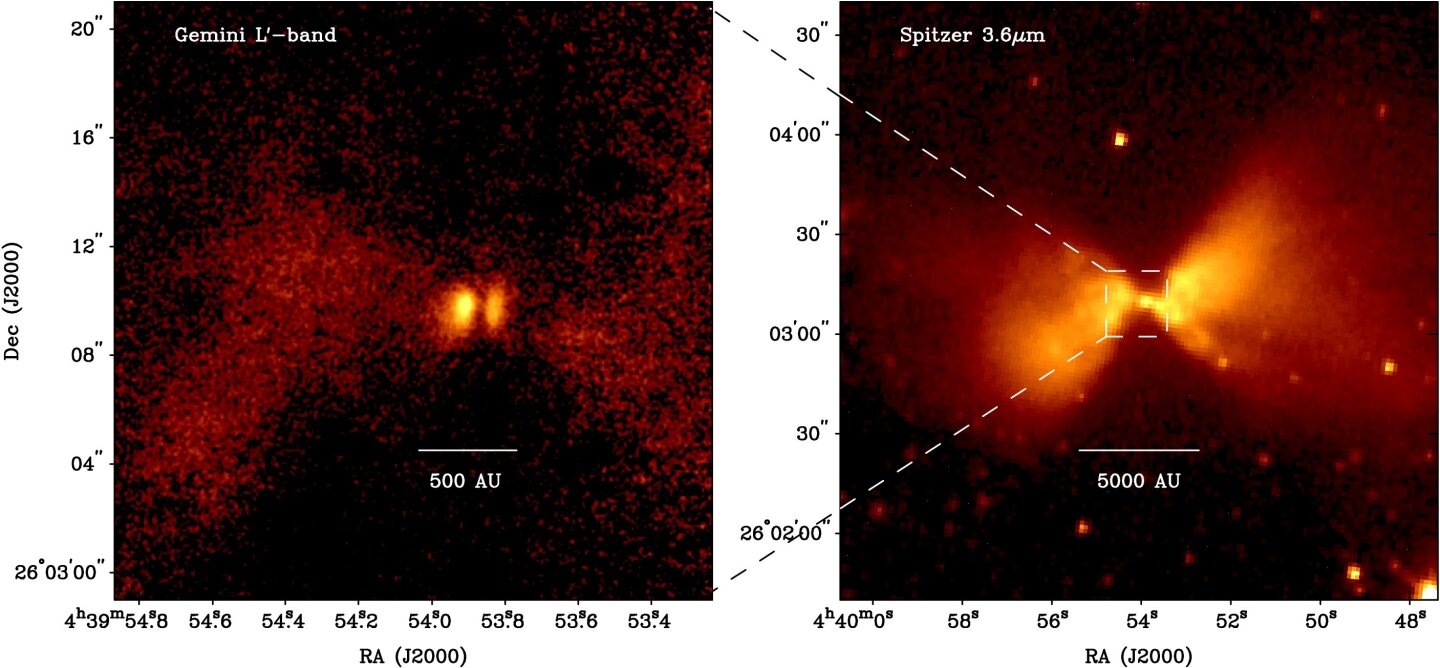
As the matter falls toward the protostar, it spins faster and joins with the protoplanetary disk (sometimes called the accretion disk, because it is the body on which the infalling matter accumulates). L1527's protoplanetary disk is about 180 astronomical units in diameter, which is roughly twice the distance from the Sun to Eris, the outermost of the known dwarf planets. The disk currently contains about seven times more matter than required to construct all planets in our Solar System.
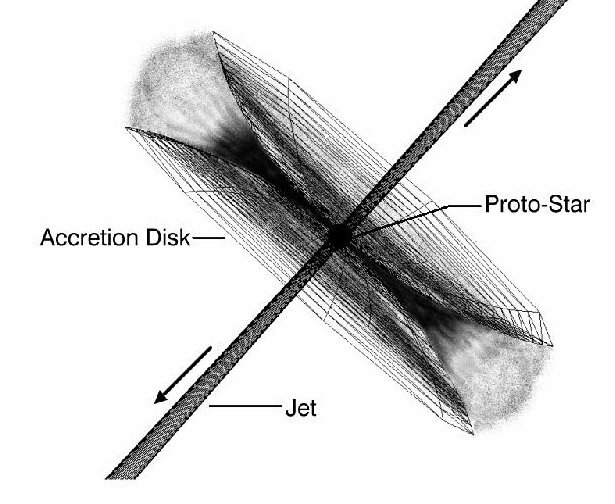
The interaction of infalling gas and dust from the envelope and the rapidly rotating protoplanetary disk causes a secondary effect of jets of gas and dust moving out from the region of the protostar along the axis of the disk. The protostar is hiding behind the disk, but at this point in its development is probably giving off ultraviolet radiation, powered by the gravitational potential energy of the infalling matter.
The matter in the protoplanetary disk is moving in a Keplerian pattern, that is, the disk's orbital period as a function of radius from the protostar varies as expected for a large, rotationally supported disk. Having measured the orbital velocities as a function of radius, Tobin and his collaborators were able to work backward using Newton's law of gravitation to determine that the protostar has a mass of about 0.19 solar masses.
It is particularly difficult to determine how long the protostar has been evolving, but it is a good bet that it started collapsing less than about 300,000 years ago, with at least one bit of evidence suggesting that L1527 has only been around for a tenth that time. The protostar lifetimes depend on models for their early development, so perhaps contradictory lifetimes for so undeveloped a protostar is not an unreasonable result – after all, we haven't seen such an object before.
One way to estimate the age of L1527 is to measure the rate at which mass is currently accreting on the protostar, and assume that rate has been constant since the initial formation of the protostar. The accretion rate (determined by assuming that the energy of the protostar system comes from the gravitational energy of the infalling matter) is about 0.66 millionths of a solar mass per year, so to build up a protostar with 0.2 solar mass requires about 300,000 years. However, there are suggestions that the early stages of accretion are faster than the later stages, and also that the accretion rate is very often erratic, with sizable bursts of mass increase, so the age may be somewhat less.
Another way to estimate the age of the L1527 protostar is to notice that its jets have traveled a distance of 0.4-0.5 ly over the age of the protostar. Given their observed velocity of motion, the jets started moving about 30,000 years ago.
Both approaches to estimate the age of the protostar are hampered by lack of data about how typical early protostars evolve. Scheduled protostar studies by Tobin using the recently activated Atacama Large Millimeter/Submillimeter Array should help clear up the remaining mysteries.