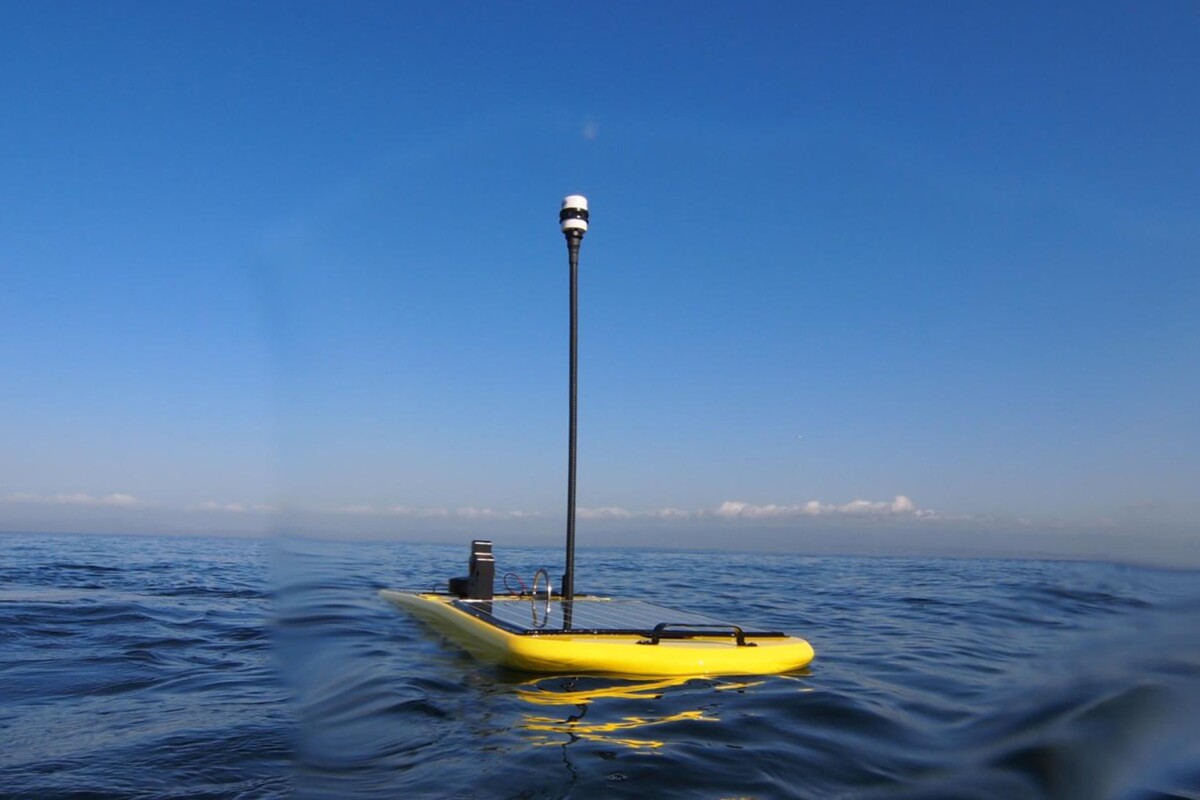



It may sound like the premise for the latest Pixar movie, but it's actually happening - four small autonomous aquatic robots have embarked on a 60,000-kilometer (37,000-mile) journey across the Pacific ocean. The Wave Gliders, built by California-based Liquid Robotics, left San Francisco last Thursday. All four will travel together to Hawaii, at which point they will split into two pairs - one of those pairs will proceed to Australia, with the other heading for Japan. Called PacX (for "Pacific Crossing"), the project will constitute the longest voyage ever completed by an unmanned ocean vessel.
Each Wave Glider consists of a surface-floating unmanned boat, tethered to an underwater winged platform. The motion of the waves causes these wings to paddle the boat forward, while solar cells on the deck of the boat provide power to its sensors and transmitters. These sensors will measure oceanographic data such as salinity, water temperature, wave characteristics, weather conditions, water fluorescence, and dissolved oxygen. GPS and a heading sensor will also help the four craft to orient themselves.
A basic version of the gathered data will be streamed by satellite onto Google Earth's Ocean Showcase, where it can be accessed by anyone. Scientists who have registered with Liquid Robotics by submitting a research abstract will be able to access more detailed information. The company will be assessing the merits all of those abstracts, with the groups that submitted the top five receiving six months' use of a Wave Glider - to buy one would cost around US$200,000.

"Liquid Robotics has made this investment to not only demonstrate the endurance of Wave Gliders, but more importantly, to ignite everyone's imagination on what can be discovered and explored when the ocean is networked with sensors," the company states on its website. "We encourage everyone who has a passion for the ocean to participate in the journey."
Source: IEEE Spectrum