The often free audio recording apps that come pre-loaded on many smartphones are great for grabbing an impromptu interview, capturing all your innermost thoughts while out and about, or making sure you don't lose that killer riff whenever and wherever inspiration may strike. What isn't great is the quality of the audio. Add to that a distinct lack of features and you might be tempted to look in the direction of dedicated portable devices for all your sound recording needs. Having spent a week or so in the company of the Olympus LS-100 Multi-Track Linear PCM recorder, I can confirm that you really do get what you pay for.
Released earlier this year, Olympus says that the LS-100 has been designed specifically with musicians, broadcasters, journalists and audio enthusiasts in mind. For the former, there's a built-in instrument tuner, a metronome and a multi-track recording function with included editing features. All users are promised top notch audio quality, up to 24-bit/96 kHz Linear PCM WAV format recording is available, and the unit can even record direct to MP3 format at up to 320 kbps.
I recently managed to don the hats of three of the target user groups by introducing my guitars to the LS-100, shoving it under the noses of company reps at Europe's largest consumer technology show, and getting my high fidelity audio buff groove on. As is customary, let's start with ...
What's in the Box?
- LS-100 Multi-Track Linear PCM recorder
- Carry strap
- Carrying case
- USB cable
- USB conversion connector
- LI-50B Li-ion battery (which promises up to 12.5 hours of continuous use)
- USB AC adapter
- Printed user manual

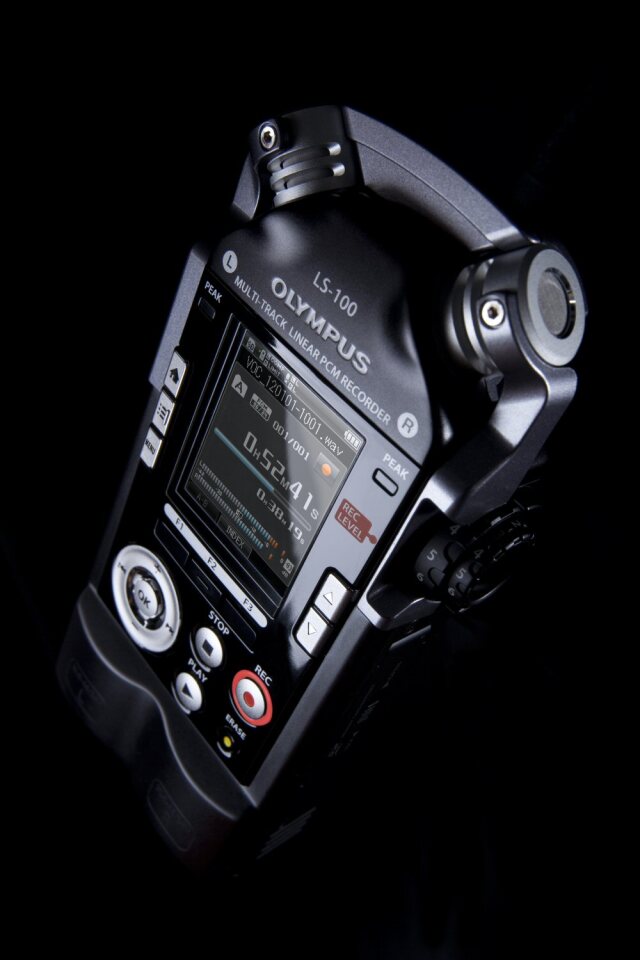
To the top of the 3.25 x 2.75 x 1.31-inch (159 x 70 x 33.5-mm), 9.8-ounce (280-g) LS-100 sit two internal 90-degree directional stereo condenser microphones that are resistant to sound pressure of up to 140 decibels, making the device a capable recording companion for the capture of loud music at a rock concert. There are also two XLR/Phone combo inputs on the bottom, which can provide 48/24-volts of phantom power to run either dynamic or condenser microphones or other devices.
Olympus says that the built-in microphones benefit from a low vibration structure and have been aligned similarly to human ears for a more realistic stereo sound recording, allowing for differences in sound pressure and time delay at each capsule. Users can also adjust the level of microphone sensitivity (low, middle and high for built-in microphones and Hi-Lo for XLR) to suit environment and situation.
The left side is home to 3.5 mm ear and mic inputs, a mini-USB port, the power/hold button, a volume wheel for monitoring or playback via the built-in speaker or plugged-in earphones, and phantom power for left and right XLR/Phone ports. The right side hosts the battery compartment and SD card slot (to supplement the 4 GB of internal memory), and the reassuringly stiff dual dials which offer independent control of the left and right recording levels.

Front and center is a 2-inch (42 x 34.5 mm) LED-backlit color LCD screen, flanked on the left by Home, List and Menu buttons, Up and Down buttons on the right and three Function buttons underneath. There's a jog dial bottom left and Record/Playback controls to the right, along with a file erase button. The upper face also sports useful Peak level lamps for a welcome visual prompt to reduce the input level when distortion threatens to spoil a recording. The rear of the device is where you'll find the 23 mm round dynamic mono speaker with a rated output of 8 ohms/480mW and a tripod mount screw hole.
Sound quality is everything
The LS-100's better-than-commercial-grade-CD-quality uncompressed Linear PCM recording and high bit rate direct-to-MP3 audio compression capabilities are complemented by Broadcast WAV Format (BWF), enabling additional metadata (such as time stamps and track markers) to be saved along with the file. The audio and system circuitry are separated to minimize sound degradation, and Soeren Werner (European Product Manager for Audio Systems at Olympus) reports a "S/N ratio of 84 dB according to our testing, which most other devices do not realize."
The audio can be further massaged by applying Limiters and Compressors to the signal, which reduces clipping and improves sound quality, and there's a lowcut filter to eliminate low-frequency sound (such as air conditioners or projectors) at 100 Hz or 300 Hz.
Recording can be set to automatically start when the source sound reaches a certain level and auto stop when the sound falls below that setting. Additionally, users are able to record over the top of the original recording while also monitoring the original sound, and a handy pre-recording function captures audio from two seconds before the record button is pressed.
The LS-100 is also an 8-track portable recording studio, capable of two-channel simultaneous recording, eight-channel playback and bouncing down. Each of the tracks has its own volume and panning controls (no EQ or onboard effects, though). Olympus says that up to 999 projects can be recorded at a fixed 44.1 kHz/16-bit recording quality.

The recorder's Tuner function features a calibration mode which allows for adjustment of the reference tone by 1 Hz increments in the range of 435 Hz to 445 Hz, a chromatic mode that checks the instrument pitch against the reference tone to gauge correct tuning, and guitar and bass modes for electric instruments. The onboard Metronome function can be applied in two different modes – on its own to help you keep time while you practice, or while in synchronous recording. Users can adjust tempo, rhythm pattern, sound and volume.
The Lissajous function detects and displays the phase difference between the left and right external microphones to cater for optimum positioning.
OK ... but how did it perform?
The portable recorder's mixture of metal and hard plastic body lends a feeling of solid construction and durability, but its size can be both a blessing and a curse. It's a little too large to be considered pocket-friendly and even seasoned PR reps at IFA 2012 made comments about its rather imposing presence, which may be a stumbling block if the person you're interviewing is already a little nervous about speaking into a recording device. I have to say, though, that I had no such issues and the recorder seemed to lend a very welcome air of professionalism to the proceedings.
The LS-100 is quite quick to start up from cold, taking a fraction of the time of the much-used Zoom H4n. Actually jumping into recording mode is not quite as nippy. Other recorders I have used can begin recording by just pressing the record button. With the LS-100, however, it's a little more complicated than that. The default mode shown on the display after switching on is the Recorder mode, which is handy, but then you need to confirm this selection and then choose one of five folders in which to store your new recording. After that you can press the REC button.

Even then, this doesn't actually start the recording, but allows you to check the input levels using the left and right audio channel meters on the LCD display (Olympus advises that the input levels do not exceed -6 dB). Only when the flashing record button is pressed again does the recording proper begin. I also found it useful to verify the input source after switch on, and check other settings like recording quality and file format. If you're in a rush, then this isn't ideal – a quick record feature using a default setup would be beneficial. It's a minor quirk, though, and one you quickly become accustomed to.
The color LCD screen is dimmed after a few seconds by default to conserve power (the actual amount of time can be set in the settings menu). This is great for saving battery but not so good for recording, as once the display goes off you can no longer monitor recording settings and have to put your faith in those Peak indicators instead. When the display is off, pressing the stop button to end a recording doesn't, in fact, do that. The initial press turns on the screen's backlight, which means that you have to press the stop button again to bring your recording session to a close.
For these reasons I actually chose to have the display always on, although I should mention that even at the brightest setting, it's of little or no use in direct sunlight.
Just me and my guitar
For my first recording quality test, I sat in front of the recorder with my acoustic guitar Robert Johnson style and picked away to my heart's content while the LS-100 capably cut down on the sounds of passing traffic, the pooch running up and down the stairs and the neighbor doing some DIY. Both metronome and tuner functions were very welcome inclusions and, if the subsequent comparisons with my own dedicated tuning device were anything to go by, the latter was pitch perfect, too.

I've grappled with a good many portable recorders over the years and can't remember ever being quite as impressed by the recording quality as I was after the first test run of the LS-100.
The device captured my vocal and harmonica performances (using both the built-in and external microphones) with equally impressive presence and clarity, although if you lean toward the use of such things as digital effects or vocal processing aids, then these will need to be added to the signal before the audio reaches the recorder (or later via production software on a computer).
This also proved to be the first of many encounters with the Erase button, which can be used to delete single or multiple files, or even part of a file. The recorder is capable of encoding WAV files to MP3, too, although it did take quite some time when I tried it with a 15-minute PCM source file at 44.1 kHz/16-bit quality (making me wish that I'd chosen a shorter piece for my test conversion). Also, so long as the source files have been recorded in the correct PCM 44.1 kHz/16 bit/128 kbps/stereo format, users can bypass the computer/laptop optical drive altogether and hook up the LS-100 to an external CD writer to burn recorded audio direct to CD.
A professional studio in your pocket
These days musicians can slam down ideas for a song using a smartphone, but if you want something to show the band that doesn't sound like it's been recorded in a busy public toilet, a dedicated recorder is a wise choice. The LS-100 doesn't just come with a Recorder function, but also sports a Multi-Track mode, something I was keen to sample.
The instructions simply state that an electric guitar (or other instrument) can be plugged directly into the left XLR/Phone combo port but that results in something way too clean for my tastes, so I plugged my electric guitar into my amp and the line-out from that into the LS-100. While the Recorder mode does cater for overdubbing, the Multi-Track function puts eight separate audio tracks at your disposal. But as with the former, getting started is not as simple as just pushing a start button.

First you have to create a new project. After checking inputs, quality and levels you can start to lay down your tracks. Once you're satisfied with what you've captured, you can then check the recorded tracks and adjust volume or panning (you can also adjust the octave of the source sound in multi-track mode, which is handy if you don't have a bass guitar kicking around).
The LS-100 supports bouncing down, where several tracks can be mixed into a spare single blank track (drums or rhythm guitars for instance), to free up otherwise used tracks for more recordings. At the end of the creative process, you can send your new Top 20 candidate to fellow band members for input (although probably not by email as the file will likely be too large), hand it over to your label for review, or create a finished CD direct from the LS-100.
As with the Recorder mode, I was pretty impressed by the home/studio recording capabilities and excellent audio quality, but there were a few odd quirks to contend with. The instrument input signal is only reproduced in the left speaker of monitoring headphones while recording, but is split into two mono channels (left and right) when played back.
I couldn't find a way to use the Metronome function in Multi-Track mode, which seemed a bit strange given its gearing toward musicians. Olympus Europe's Werner told me that bringing the Metronome into play while in Multi-Track mode can be done but involves going through "many sub menus and the easiest way is to put it on a function button, then it can easily be activated in the multi-track mode."
This would seem an opportune moment to mention the UI. I'm afraid that I didn't find the screens and menus for settings and selections to be particularly intuitive. The device does offer voice guidance, which will help you get familiar with its operation or use the device when you can't see the menus or buttons, but getting the best from this device involves an awful lot of poking around in sub-menus and tweaking settings regularly. At the end of the day though, the resulting sound quality is well worth any effort in setting aside a bit of time to get totally au fait with its operation.
A Berlin adventure
In addition to being pitched at musicians, the LS-100 is also being aimed at journalists and broadcasters, and I got the opportunity to test the unit's performance among bustling booths and packed press conferences at IFA 2012.
At my first press conference, I used both my smartphone and the LS-100 to record a CEO outlining his vision for the company's future. The recording on the my smartphone was often distorted, it picked up the numerous sounds made by those around me, and the voice of the CEO was often lost in the background. The LS-100, on the other hand, brought the speaker's voice to the fore, did an excellent job of ignoring the rustling, key tapping, fidgeting and general chit-chat of those around me, and coped really well with the PA system. I opted to leave my smartphone in my pocket for other press conferences and used the LS-100 exclusively.
As you might expect, I also got many opportunities for one-on-one interviews with company reps. All of the interviews took place in bustling booths crammed with gadget fans. The background noise was incredible, yet the LS-100 managed to focus the recording on the voice in front of the built-in microphones. The surrounding din can still be heard during playback, but the interviewee's voice rings out loud and clear. Nice.
In conclusion...
Getting to grips with all that the LS-100 has to offer might take a bit of time and effort – even though I've been using portable multi-tracks and hand-held recorders for some years now, I still found myself heading online for some tips and vids a little more often than I expected (unfortunately the user manual is not much help in this regard) – but I think you'll find the end results will prove well worth it. The onboard microphones are excellent, the audio recording quality is among the best I've come across, and the opportunities for user tweaking are plentiful.
At US$399 it's a good deal more costly than many of its rivals, but if your deciding factor is the quality of audio then the Olympus LS-100 Multi-Track Linear PCM recorder is well worth checking out.
One closing point ... some early reviews of the LS-100 noted slight latency problems (about 200ms) which meant that when monitoring recordings, there was a small but significant out of phase issue. Olympus has subsequently fixed this with a firmware update issued at the end of June.
Product page: LS-100