


The Arctic North end of Russia is believed to hold as much as a quarter of all the world's oil deposits - an utterly monstrous economic prize, hidden in one of the toughest and least hospitable environments on the planet. Getting to this prize, and then transporting it back to refineries, is a monolithic task that requires one of the most awe-inspiring pieces of machinery man has ever built - the nuclear icebreaker. Purpose-built to the point of being almost unseaworthy on the open waves, these goliaths smash their way through 3-meter (10-foot) thick ice crusts to create viable pathways for other vessels - but fascinating new technologies could mean the days of the dedicated icebreaker are numbered.
Making hay in the Arctic

Where there's a well, there's a way. An oil well, that is. Black gold. Texas tea. And some of the world's richest reserves of the stuff are buried beneath the beds of the Berents sea, North of Russia and well into the Arctic Circle. It's estimated that this area holds somewhere around a quarter of all the oil reserves in the world.
But it's an area that gets no sun at all for at least one day every year, and which is so cold that the sea itself freezes over with 2-meter (6.5-foot) thick ice for more than two thirds of the year. When it's not frozen over, there's 12-meter (40 foot) waves to deal with. It's one of the world's most extreme environments; inhospitable doesn't even begin to cover it.

Here's a satellite photo of the top left corner of that map, showing just how much ice we're talking about in wintertime.

Getting resources like oil and natural gas out of the earth - and safely back to shore - would be prohibitively expensive, if the prize wasn't worthwhile. Where these sorts of quantities of fossil fuels are concerned, however, all bets are off and just about any expense can be justified.
... and the expense we'd like to take a look at today is the nuclear-powered icebreaker - a vessel whose sole task is to smash its way through packed sea ice and clear a path for other ships to follow in.
It's a specialist job that boats have been designed to tackle since the 1830s - and it's interesting to note that while today's enormous icebreakers generally use nuclear power to generate the immense thrust needed to power through the ice fields, in other ways the design hasn't changed too much for nearly 200 years.

How icebreakers work
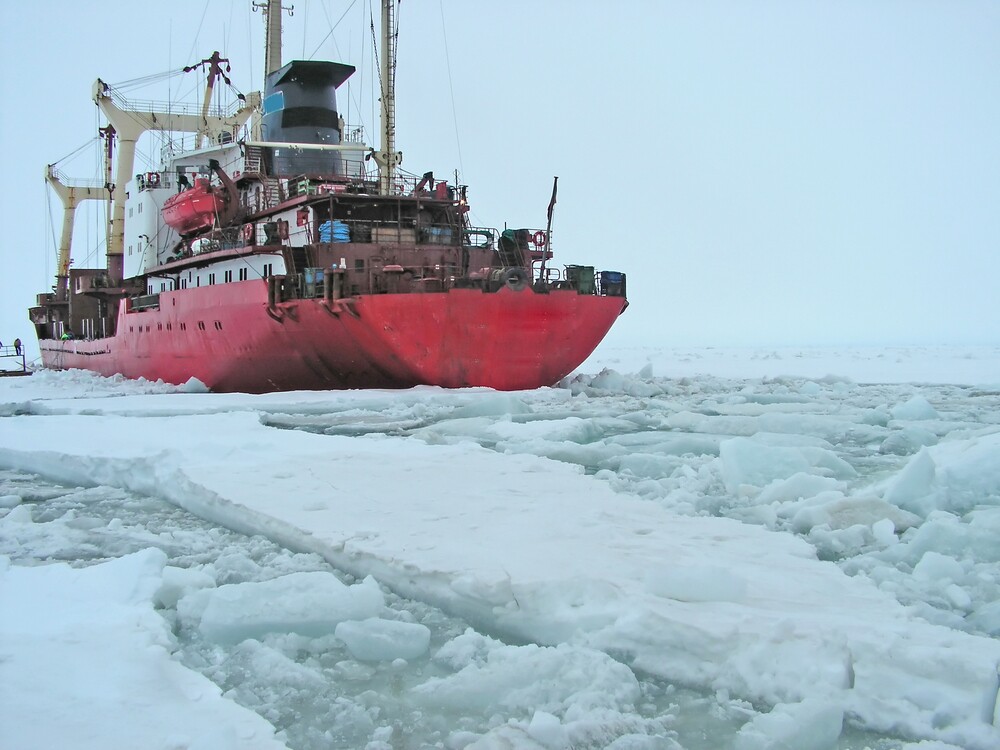
So, let's take a look at how they work. For starters, where a regular ship has a pointed bow to slice through the waves, an icebreaker's bow is a much smoother shape, almost like the back of a spoon. When the ship hits ice, the smooth bow causes the front end of the ship to ride up on top of the ice, so the vessel's immense weight can then crush it from above.It's a truly extraordinary sight in motion.
The hull is shaped to push the crushed ice out of the way of the ship's propulsion system, where it could cause significant damage. The hull is strengthened and reinforced to deal with the additional stress it has to handle, and it's also coated with a low-friction solution that makes it easier to glide over the ice rather than catching or grabbing as it rides over.
The final main element to an icebreaker is enormous power - and for this, it's worth taking a look at the greatest icebreaker ever to ride the White Sea: Russia's NS 50 Let Pobedy (50 лет Победы, which translates to 50 Years of Victory).

The 50 Let Pobedy is 159 meters long (524 ft) and weighs 23,439 metric tons (25,837 tons). That's peanuts next to the massive tankers and container ships it clears a path for, but it makes it the largest icebreaker in the world.
Nuclear Power - the only practical choice for Arctic icebreakers
In order to constantly provide enough power to shove that bulk up over mile after mile of ice, the 50 Let Pobedy (let's just call it the Victory) runs a pair of nuclear reactors that generate a combined 55.2 megawatts (74,000 horsepower), which hits the water through three electric propulsion motors.Why nuclear? Well, to put it simply, the fuel demands of the task at hand would be outrageous using any other power source. Burning diesel, the Victory would use more than 100 tons (90.7 metric tons) of fuel a day, and have a severely restricted range as a result. But running on nuclear power, she burns less than half a kilo (1 pound) of uranium even on the toughest day, at constant full power across 2.8-meter (9.2-foot) thick ice.
With nuclear reactors on board, fuel stops become almost a thing of the past - a handy feature considering they work in extremely remote areas and have no other compelling reason to come in to port. In fact, the world record for endurance is held by one of Victory's older cousins, the Arktika, which stayed in service on the ice for 357 days without entering a port once.
In fact, the specific needs of icebreaking vessels make them one of the only cases where nuclear propulsion is economically practical - barring nuclear submarines, which take advantage of the fact that the reactors don't require oxygen to run. Nuclear reactors are more expensive to build than combustion engines, and enriched uranium doesn't come cheap - but at the end of the day, by virtue of sheer volume, the fuel costs end up being much, much lower than an equivalent diesel engine.
No, the main issue is insurance. Imagine trying to insure one of these things, given the catastrophic and lasting damage that could occur in the "unlikely event" of an accident. Luckily, so far, there has not been a major incident.
Icebreakers - almost unseaworthy outside their element
Icebreakers are an excellent example of a laser-focused vehicle. In the same way as a half-million dollar sports car can be a real pain around the speed humps and u-turns of the city, these goliaths of the Arctic are very poorly designed for operation outside their specific envelope.The key element here is that rounded bow. A shape best suited to riding up on ice shelves and crushing them from above, it causes the ships to roll from side to side in the waves when sailing on open water, making for a very seasick ride for the crew.
When the seas come up (remember those 12-meter waves we spoke about earlier?) the shape opens itself up to another problem - where a typical pointed bow can pierce through an oncoming wave, greatly reducing its effect on the boat, the rounded bow of an icebreaker lets the water slam into it at full force.
These are certainly not comfortable vessels on the open water. Even once on the ice, the crew has to deal with the constant jarring and shuddering of ice breaking beneath the boat, as well as the low, constant rumble it produces.
A relatively new development in engine design, however, might put dedicated icebreakers out of service for all but the thickest surfaces.

Double-acting reversible tankers - ships that go both ways
In the 1990s, a new class of propulsion device was designed. Previously, most ships had a fixed propeller system which could run either in forward or reverse, and some sort of rudder arrangement for steering, but the development of the azimuth thruster pod instantly changed the state of the game.These hardy propulsion pods hung under the ship's hull, housing a motor and propeller, with the ability to rotate each pod 360 degrees to provide thrust in any direction. This makes the ships much more maneuverable.

It turns out, the pods also have a special advantage in icebreaking applications. These "Azipod" propulsion units typically have their propellers facing forwards and operate in a pulling motion to take advantage of an untroubled stream of water. When you turn them 180 degrees and run the ship backwards, it turns out that the intense agitating power of the Azipods can actually help break ice from underneath.
In fact, ships running astern (backwards) with Azipods leading the way have proven to be significantly more efficient at breaking ice than ships with the same bow shape running with rear propulsion.
This means that you can build ships with an icebreaking bow and Azipods at the rear, and a regular wave piercing bow at the front - double-acting reversible ships that can efficiently drive forward in the open sea without any of the roll effect of a dedicated icebreaker, but that can turn tail and run butt-first if they run into sea ice and need to smash through it. They can perform both jobs with high efficiency, while carrying cargo.
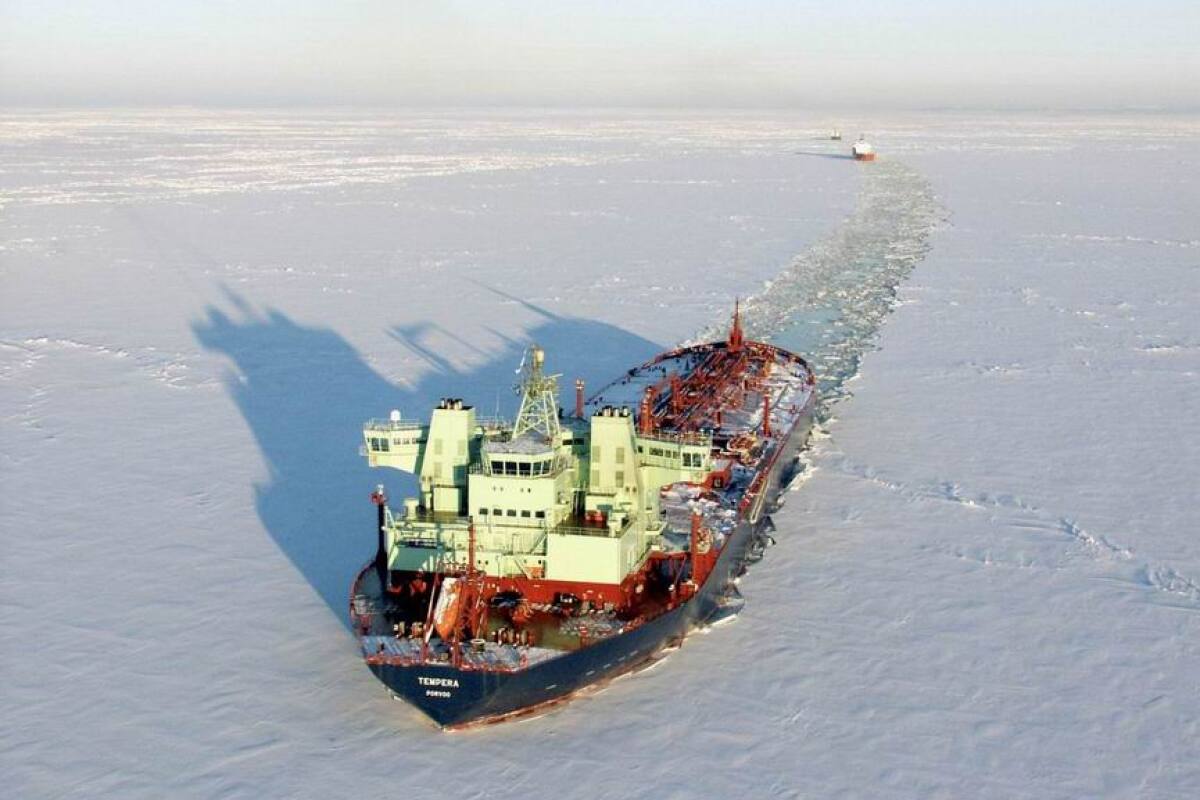
Here's an example, the MT Tempera - one of the first double acting cargo ships. Here she is running ahead in open water:

And backing up to break through the ice:

These double-acting ships, many of which are now in operation, more or less render the dedicated icebreakers obsolete where the ice is only a meter or a meter and a half thick - which opens up a lot of shipping routes. But the big boys like the 50 Let Pobedy are still needed when the going gets really tough with ice beyond 2 meters thick.
I hope you've enjoyed this quick overview - the icebreaker and double acting ship class is such an impressive answer for such a specific problem in such a harsh environment that we thought it was worth a feature.