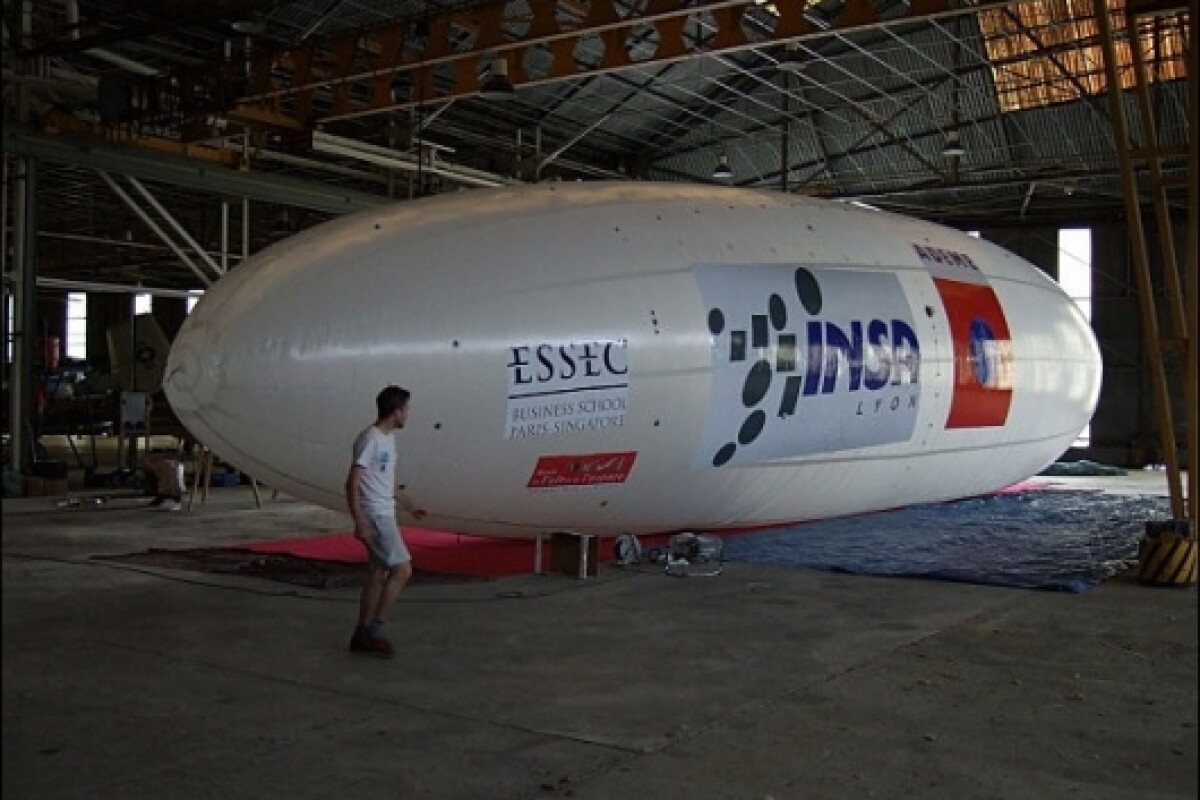



A group of French students are getting ready to fly across the English Channel in the world's first solar powered airship. One hundred years after Louis Blériot won the coveted Daily Mail prize of £1000 by being the first to traverse the watery expanse in his 3-cylinder, 25 horse-power XI monoplane, the Projet Sol'r team will take to the skies in Néphélios, a 22 meter long airship capable of cruising at 30-35kph. Gizmag recently talked to one of the project's founders, Arnaud Vaillant.
In the latter part of 2007, Thomas Raphael and Aloun Vangkeosay (engineering) and Arnaud Vaillant (business studies) started throwing ideas into a huge melting pot. They wanted to build a craft which would demonstrate that zero emission air travel is not only possible but can be graceful, fun and effective. In November 2007 they formed Projet Sol'r to realize that dream.
Interest in the project mushroomed and the three students soon found lots of others wanting to help out. Now more than 50 students and volunteers are involved in the building of the world's first solar powered airship, the Néphélios. The project's blog echoes the determination and commitment of the whole team: "Our team is dynamic, motivated and totally voluntary. We are driven by the desire to create a project for the future and for sustainable development but also to realize a dream: to fly pollution-free, with full autonomy and drawing all our energy needs from the air and sun."
Vaillant explained the project time frame: "We've been designing the ship for over a year and would have preferred to start building much sooner but didn't have the funds. Construction actually started in April 2009." On the materials used, he added: "The structure is made of carbon and aluminum, covered by a synthetic fabric coated with polyurethane for waterproofing."
Needing money
Whereas it can cost millions of Euros to produce aircraft, the budget for the construction of the 22 meter long Néphélios is only €150,000. Vaillant told Gizmag that the majority of the funding came from sponsorship: "We received funds from ADEME (the French Environment and Energy Management Agency) and from schools such as Institut National des Sciences Appliquées de Lyon and ESSEC (Ecole de Commerce) in exchange for publicity." Other sponsors include EPF (Ecole d'Ingénieurs), Ecole Nationale Supérieure d'Arts et Métiers and Ville de Vincennes.
Forty two photovoltaic panels, covering a 40 sq m area, are secured on top of the airship to provide the 2.4kW peak power needed for the electric motor to the rear of the nacelle. As take off and landing will require a bit more power than the solar panels can generate alone, onboard batteries will be used to provide the extra boost needed. A system controller regulates power generated by the panels and directs it to either the motor or to the batteries depending on need.
For a short spell in June, the airship went on display at the Salon du Bourget in Paris where the press were given the opportunity to look it over before it was moved to an airfield to the south east of Paris, Melun-Villaroche. Here it will be made ready for its flight across the English Channel in early September. Before that happens though, the volunteers need to prove that the airship can comfortably carry the nacelle, its equipment and pilot (who has been named as Bastien Lefrançois).
The engineers, students and volunteers are currently busy putting the nacelle together and readying the ship for its first test flight at the end of August. As you can see from the images in the gallery, there is still a lot of work to be done. The motor has to be fitted, the two propellers put in place, the controls installed and then everything connected and tested before it ever gets to take flight, slowly and gracefully floating in the air at an expected altitude of up to 500m.
Blow wind
Gizmag asked Vaillant about the biggest danger to the success of the mission - wind (which there tends to be quite a lot of across the English Channel). "We are very sensitive to wind, anything beyond 20kmh becomes very problematic." In ideal conditions the motor will help propel the ship at 40kph all out, but the pilot will aim for a cruising speed of about 30-35kph. If there's cloud rather than sun: "we fly a little slower," is the optimistic outlook of the team.
"We've had a lot of support from our schools, we finally secured the funding and journalists seem to be very interested in our project," said Vaillant. Projet Sol'r is confirmation that it is possible to: "fly in harmony with nature and that flying doesn't necessarily mean using big and noisy engines that use a lot of fuel."
"Innovation and desire to succeed can help us through the technical problems as well as the economical and environmental issues we are facing at the moment."
Keep track of events as they unfold
On the future of solar powered airship travel, Vaillant commented: "We're just at the beginning of this technology. I don't think that a 100 years ago Louis Blériot could have imagined the performance possibilities of the Rafale or the A380!"
The Gizmag Team wishes them the very best of luck. Keep up with the progress of the Néphélios and the project as a whole by visiting the website or the blog.