



When the last American astronauts blasted off from the Moon in 1972, it seemed as if they were leaving behind monuments that would stand for all time. On a lifeless, airless satellite there would never be any scavengers or souvenir hunters, no wind to bury or wear down the abandoned spacecraft and artifacts, and no air to corrode metal. Even the footprints would still be there millions of years from now. Or so everyone thought. Now, with more and more nations and private organizations planning manned and unmanned missions to the Moon, NASA is worried that the Apollo landing sites and others could be endangered by the next wave of lunar explorers. To prevent this, the space agency issued a set of guidelines that politely asks everybody to keep their distance.
NASA left a lot of hardware on the Moon during its first phase of lunar exploration. In addition to the six Apollo landing sites there are the remains of five Ranger probes that were deliberately crashed into the Moon, seven Surveyor soft landers, five S-IVB Apollo third-stage boosters that were used for seismic studies and six Lunar Module Ascent Stages that were crashed at the end of their missions, as was the complete Lunar Module from Apollo 10 and an assortment of orbiter probes that ended up impacting the surface.
That is a lot of hardware and it’s also a lot of history. NASA is worried that without some guidance and agreement irreplaceable relics of the Space Age, such as Neil Armstrong’s first footprint on the Moon could be lost and sites needlessly disturbed. More than that, many of these sites are still of great scientific interest with experiments still going on after more than forty years. The Apollo landing sites, for example contain laser reflectors for accurately measuring the distance between the Earth and the Moon. Also, the spacecraft and equipment left behind are a valuable experiment in the effects of prolonged exposure to the lunar environment. Though there’s no air on the Moon, there are extremes of temperature in the hundreds of degrees, micrometeorites, cosmic radiation and intense ultraviolet light. The last is particularly destructive. If some future astronaut does visit an Apollo site, he might think that someone has run off with the nylon American flag or the gold plastic foil that wrapped the Descent Stage. In fact, the UV rays from the Sun destroyed both years ago.
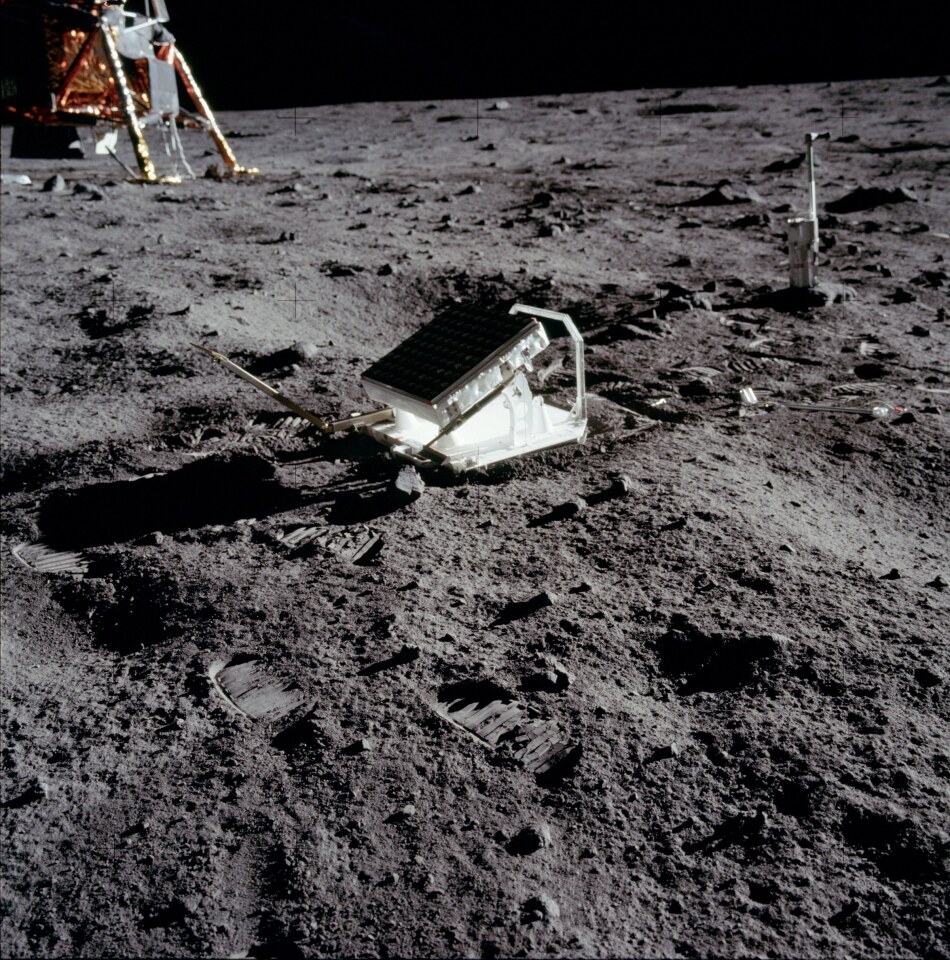
With both history and science at stake, NASA feels that it cannot ignore the possible threat posed by Moon new programs, no matter how well intentioned they are. The space agency therefore recently took the opportunity to announce that the Google Lunar X Prize committee is agreeing to abide by guidelines issued by NASA in 2011. These guidelines, which cover Apollo landing sites, impact areas, unmanned probes, experiments and footprints and rover tracks, are intended to protect historic sites, prevent interference with experiments and to ensure that American property rights are respected, since all the vehicles and gear still belong to the U.S. government.
Effectively, the guidelines boil down to steering clear of U.S. lunar sites whenever possible. Future landings are asked to remain two kilometers from historic sites (especially those of Apollo 11, the first manned landing site, and Apollo 17, the last Apollo manned landing site). They are also asked to remain half a kilometer away from impact sites. This exclusion zone doesn’t just include landings, but also any flyover paths that a landing spacecraft might take.
A matter of dust
The reason for this is dust. One advantage of being on the Moon is that there isn’t any air to suspend dust particles. Unfortunately, that also means that there’s no air to slow down even the tiniest particle. An impacting object or the blast from a landing rocket can kick up huge quantities of dust and hurl them with such velocity that they can go into orbit around the Moon or even escape entirely. This was shown during the Apollo 12 mission when the astronauts examined the Surveyor 3 lander, which NASA had sent a couple of years earlier to scout out landing sites. Despite being far off, the Lunar Module Intrepid created such a storm of dust that the Surveyor suffered a miniature artillery barrage.For similar reasons, rover operators are requested to keep speeds down in the vicinity of sites to prevent kicking up dust. Though rovers are requested to steer clear entirely from the Apollo 11 and 17 sites, they will be allowed within one to three meters of spacecraft and objects at the Apollo 12, 14 and 16 sites so long as they stay away from active experiments or places where soil samples were taken. The one thing NASA is emphatic about ensuring that any rovers in the area to move well away from the sites by the end of their missions. The last thing NASA wants is for a rover to “die” on site and start venting battery gases that contaminate the area.
A polite request
The important thing to remember about NASA’s guidelines is that they are exactly that - guidelines. The U.S. space agency has no power to enforce its rules on other organizations. Though there is a UN Outer Space Treaty to control how space explorers behave, not every nation is a signatory and the treaty is something of a Cold War statement of piety barring spacefaring nations from doing what they couldn’t do anyway, such as claiming whole planets. More to the point, the treaty may not apply to private organizations. Worse, it may not stand up to challenges based on precedents of salvage or maritime law. In other words, over half a century after Sputnik, space law is still a bit of a muddle. Because of these legal question marks, NASA is taking the softly, softly route of issuing guidelines and requesting politely that everyone else respects them. It would clearly be a great pity if these guidelines aren't followed, but only time will tell whether the site of humanity’s first visit to another world remains untouched.
Source: NASA