





Glass has a unique look - despite its clarity you can tell there is a material there by the way it reflects light, and that it isn't plastic or crystal. Glass, however, carries problems, like glare, fogging, and collects dirt. A group of MIT researchers has found a new way to create arrays of conical micron-scale surface nanotextures to produce glass that is self-cleaning, non-glare, and non-fogging. The researchers believe the nanotextured surface can be made at low enough cost to be applied to optical devices, the screens of smartphones and televisions, solar panels, car windshields and even windows in buildings.
While many other approaches toward self-cleaning, non-glare and non-fogging glass surfaces have been tried, including surface hairs, mimicking lotus leaf surfaces, using non-fogging nanosilica polymers and electrically charged self-dusting surfaces, the MIT group is the first to find a single surface modification that boasts these combined properties.
The surface pattern - consisting of an array of nanoscale cones that are five times as tall as their base width of 200 nanometers - is based on a new fabrication approach the MIT team developed using coating and etching techniques adapted from the semiconductor industry. Fabrication begins by coating a glass surface with several thin layers, including a photoresist layer, which is then illuminated with a grid pattern and etched away; successive etchings produce the conical shapes. The team has already applied for a patent on the process.
Although the arrays of pointed nanocones on the surface appear fragile when viewed microscopically, they should be resistant to a wide range of forces, ranging from impact by raindrops in a strong downpour or wind-driven pollen and grit, to direct poking with a finger. Further testing will be needed to demonstrate how well the nanotextured surfaces hold up over time in practical applications.
The nanotextured windows achieve their unique properties by effectively increasing the surface energy of water while at the same time trapping any light that would be reflected from the glass surface. The first effect is illustrated in the figure below. The left figure shows a drop of water spreading on a normal glass surface. Glass has a very large surface energy, while the surface energy of water is much smaller. As a result, to lower the total surface energy of the system, the water spreads out as widely as is possible (the extent is eventually limited by the rate of evaporation).
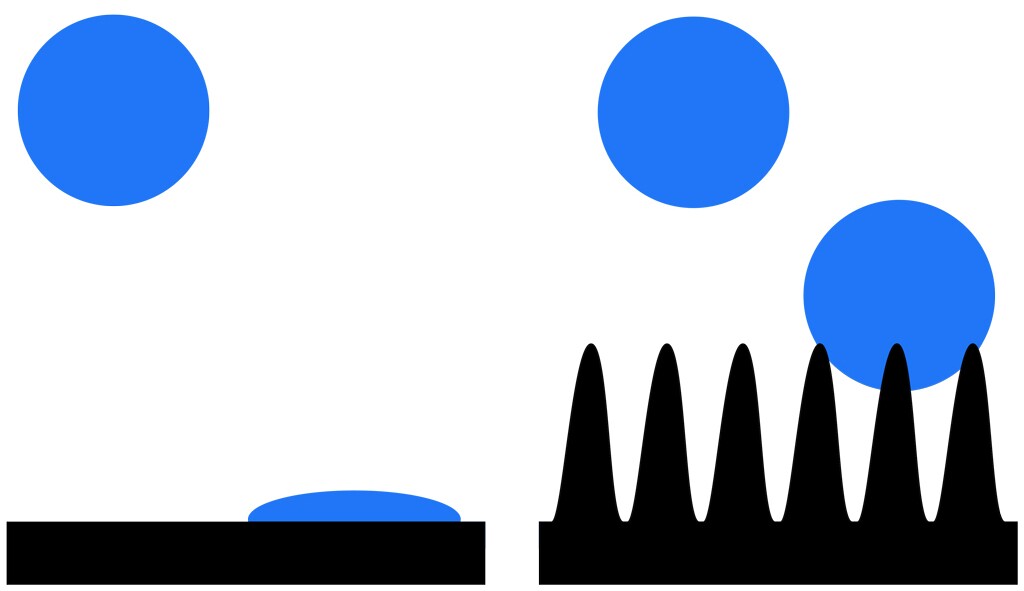
The figure on the right tells a different story. While the surface energies per area are still the same as for the flat surface, when the cone penetrates into the water drop, a large surface area of the glass is covered at the cost of a very small surface of the water. In effect, the surface energy of the glass surface is reduced by the ratio of these areas (about tenfold for the nanotextures used by MIT). As a result, it costs energy to push the water drop down onto the cones. In addition, the surface area of the water drop increases because it grows through displacement of the water by the cones, as well as becoming nonspherical owing to the downward force on the drop. The net effect is that the water drop is repelled by the nanotextured surface. While in contact with the surface, the water also picks up the dust on the glass, most of which is suspended near or above the upper parts of the cones because it cannot penetrate into the very small separations between cones.
This same nanotexture eliminates glare from a glass surface. In the left side of the figure below, a light ray is partially reflected from the glass surface (at this angle, about 6 percent of the light is reflected).
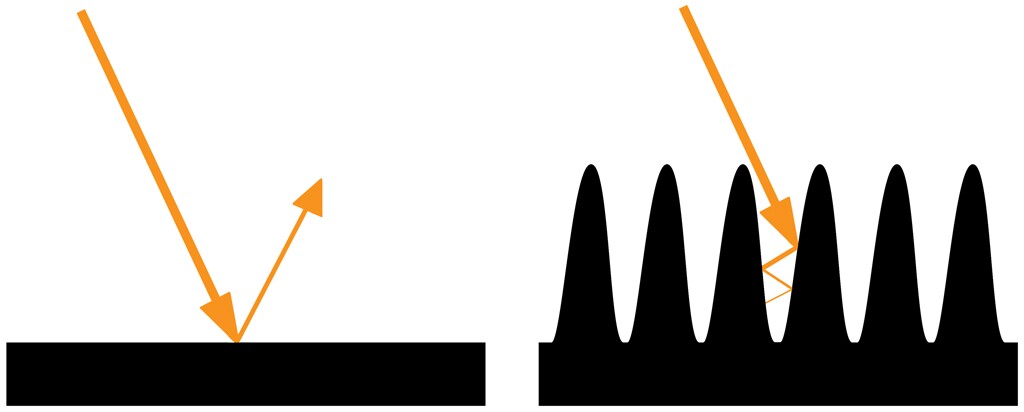
The right part of this image shows a light ray interacting with a nanotextured glass surface. Each reflection of the ray reduces the intensity of the reflected ray by about 6 percent, so the first bounce leaves a ray with 6 percent of the original intensity. The second bounce reflects only 0.36 percent, the third bounce 0.022 percent, and the fourth bounce only 0.0013 percent of the original intensity. The net result is that virtually no light is reflected from the nanotextured surface. Note that this explanation is oversimplified in that it uses ray optics - an approximation which is not valid at these size scales. The proper treatment of this type of surface includes scattering and interference effects, but gives much the same result.
Mechanical engineering graduate students Kyoo-Chul Park and Hyungryul Choi, who co-authored a paper describing the nanotextured surface along with former postdoc Chih-Hao Chang, chemical engineering professor Robert Cohen, and mechanical engineering professors Gareth McKinley and George Barbastathis, say that since it is the nanotextured surface's shape that produces the unique surface properties, it is possible that glass or transparent polymer films could be manufactured with such surface features simply by passing them through a pair of textured rollers while still partially molten. Such a process would add minimally to the cost of manufacture.
Among the many possible uses are smartphone and tablet screens that have no glare and are very easy to clean, non-fogging and self-cleaning windows in buildings and cars, and solar panel surfaces that will reflect no light and will generally remain dust-free in outdoor applications (thereby increasing power output by as much as 10-15 percent). An invention whose main effect is to reduce irritation and frustration at not being able to see properly - everyone wins!
The video below shows water droplets literally bouncing off the nanotextured glass surface.
Source: MITNews


