Highlights from the 2012 Beijing Motor Show
MORE TOP STORIES »
ON THE WATER

Mitsubishi reduces friction on ship hulls by blowing bubbles

By

21:29 January 23, 2012

The Mitsubishi Air Lubrication System (MALS) pumps air bubbles onto the bottom of a ship's...

The Mitsubishi Air Lubrication System (MALS) pumps air bubbles onto the bottom of a ship's hull to reduce friction

Image Gallery (3 images)

In February last year, Mitsubishi Heavy Industries (MHI) and transport company Nippon Yusen Kaisha (NYK) announced plans to investigate the effectiveness of a system intended to reduce the frictional resistance between a vessel's bottom and the seawater using a layer of air bubbles. Now MHI has coupled the Mitsubishi Air Lubrication System (MALS) with a high-efficiency ship hull in the conceptual design for a container ship that the company claims would offer a reduction in CO2 emissions of 35 percent compared to conventional container carrier designs.

To verify the CO2 reduction efficiency of MALS, MHI has installed it on the "YAMATAI," a module carrier operated by an NYK subsidiary. A module carrier was chosen as the first permanent installation of the system because they have a shallow-draft hull that generates relatively low water pressure, which minimizes the amount of electricity required by an air blower to supply air to the vessel's bottom. Additionally, the flat, wide bottom is able to better retain the supplied air under the vessel's bottom.

With MHI expecting to see a reduction in CO2 emissions of around 10 percent on the YAMATAI thanks to MALS, the company is already looking ahead to the second application of the technology with the completion of the conceptual design of the "MALS-14000CS," a New Panamax size 14,000 TEU (twenty-foot equivalent) container vessel. New Panamax refers to the size limit of ships that will be able to travel through the Panama Canal after the completion of its planned expansion in 2014 - specifically, ships with an overall length of 366 m (1,200 ft), width of 48.8 m (160 ft) and tropical freshwater draft of 15.2 m (49.8 ft).

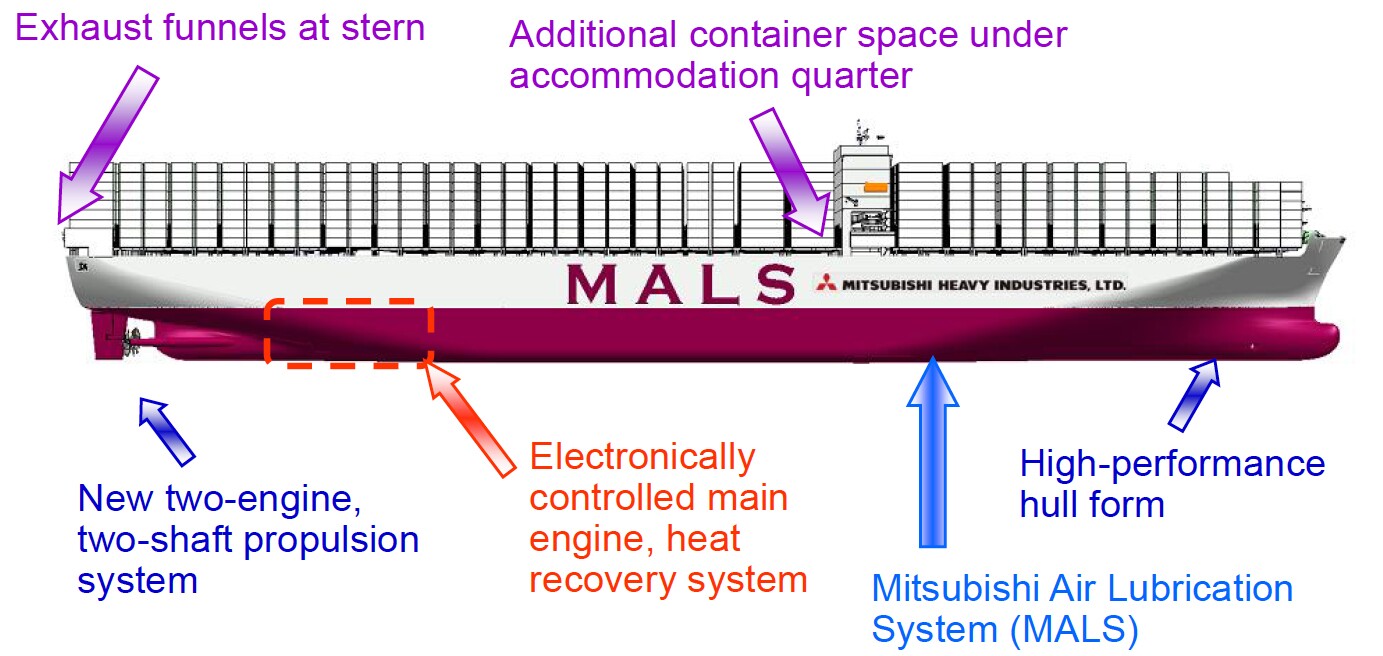
Like the YAMATAI, MHI expects the MALS-14000CS will realize a 10 percent reduction in CO2 emissions through the MALS. However, thanks to additional design features, MHI expects an overall cut in CO2 emissions of 35 percent. These include a new high-performance hull form that places the bridge relatively forward, exhaust funnels at the stern, and additional container space under the accommodation quarter. MHI says this design, coupled with a two-engine, two-shaft propulsion system, will provide a reduction in CO2 emissions of 24 percent, while the electronically controlled diesel engine and waste heat recovery system will provide another five percent.

Other environmentally friendly features include a Sox scrubber to remove sulfur oxide from flue gas, and a ballast water treatment system.
This isn't the first time a layer of air has been proposed as a way to reduce the friction between a ship's hull and the water. While MALS creates a layer of air bubbles by pumping air to the vessel's bottom, researchers are also looking at developing superhydrophobic surfaces modeled on the water fern salvinia molesta, which is able to remain completely dry when submerged by trapping a layer of air on the surface of its leaves using tiny hairs. Combining MALS with such a surface would mean the air wouldn't need to be pumped continually to the bottom of the vessel.

In the meantime, Wired has reported that grain conglomerate Archer Daniels Midland has ordered three dry bulk carriers that will be built with MALS.

Source: MHI

Tags
User Comments (18)
 

WOW, why didn't ANYONE think of this earlier. Its so obvious...

comment Michael Mantion - January 23, 2012 @ 10:09 pm PST

o the things that are posable like I say, your imagination is your only limation. now replace the deisel with electric.

comment Joe Tomicki - January 24, 2012 @ 01:24 am PST

re; Joe Tomicki

How are you going to get the electricity, unicorn farts?

............................................................................................................................

Just as an aside the bubbles will also reduce the stress on the screws as the bubbles will absorb energy from any cavitation.

comment Slowburn - January 24, 2012 @ 04:40 am PST

Replace the diesel with nuclear power. Now that'll cut CO2 emissions. Then you don't need MALS, although you might gain some extra speed!

comment Lourie Höll - January 24, 2012 @ 05:45 am PST

Great. I wonder if they have considered a non-uniform hull surface? Air trapped in the valleys of such surface could reduce the running surface area by, let's say 50%.

comment Mirmillion - January 24, 2012 @ 07:17 am PST

Saving fuel is a goodness thing but the whole carbon thing has been proven to be a fraud.

comment Slowburn - January 24, 2012 @ 09:05 am PST

Why doesn't it sink?

comment richardcobbs4 - January 24, 2012 @ 10:49 am PST

Methane bubbles in the water has been known to reduce the density of the water and sink heavily loaded ships. I wonder if this system would have the same effect. I'm guessing not but I'm not sure.

comment Rustin Haase - January 24, 2012 @ 11:20 am PST

i believe the russians have been using this technology for years on their torpedos.

as an aside, i noticed that this new ship, for all of its advances, uses an old school propeller/rudder configuration. i'm surprised they didn't go with azipods instead.

comment toolman65 - January 24, 2012 @ 12:45 pm PST

It seems it would make more sense to lengthen the ship so the draft decreases, decreasing the cross sectional surface area of the ship submerged in the water. Kite power sounds interesting as well.

comment Johnson Chad - January 24, 2012 @ 01:15 pm PST

re; Rustin Haase

The column of methane with some water in it is entirely different from a thin layer of bubbles providing lubrication between the hull and sea.

comment Slowburn - January 24, 2012 @ 02:47 pm PST

as toolman65 has mentioned, this technology is old.

http://en.wikipedia.org/wiki/VA-111_Shkval

comment Vladimir Popov - January 24, 2012 @ 04:12 pm PST

This was my idea. Planned to develop it when I win Gold Lotto. Now I am gonna have to concentrate on my space ship. Might buy more tickets to speed up the plans..

comment Ronnie - January 24, 2012 @ 11:10 pm PST

Nuclear tweak- if the thing was so safe it could just pushit without all that friction. Only I can't see the result of leasing pushers and outsourcing the maint. Where is that logic? It is good though. But the slightest of tweaks could improve efficiency.

comment Shawn Powell - January 25, 2012 @ 12:15 am PST

re; Mirmillion

You would most likely get turbulence that adds to the drag.

comment Slowburn - January 25, 2012 @ 08:23 am PST

I met the man who invented the thrusters used in shipping 30+ years ago. He mentioned this use of bubbles back then.

comment tomt - January 25, 2012 @ 11:40 am PST

This idea has been around for decades and decades. It's been used in stepped hulls of high speed powerboats and floatplanes.

comment Mike Barnett - January 25, 2012 @ 12:41 pm PST

See Prototype GHOST military watercraft claims a world's first right here on gizmag.

http://www.gizmag.com/ghost-super-cavitating-military-boat/21137/

Ronnie, yes buy more lotto tickets that's the key to every successful inventor. Here is an idea for your space ship, spray water on the outside of it so it can go through the atmosphere with less energy ; )

comment katgod - January 25, 2012 @ 10:20 pm PST
Post a Comment

Login with your gizmag account:


Or Login with Facebook:


Related Articles Email this article to a friend

Just enter your friends and your email address into the form below

For multiple addresses, separate each with a comma


Privacy is safe with us because we have a strict privacy policy.

Looking for something? Search our 18,139 articles