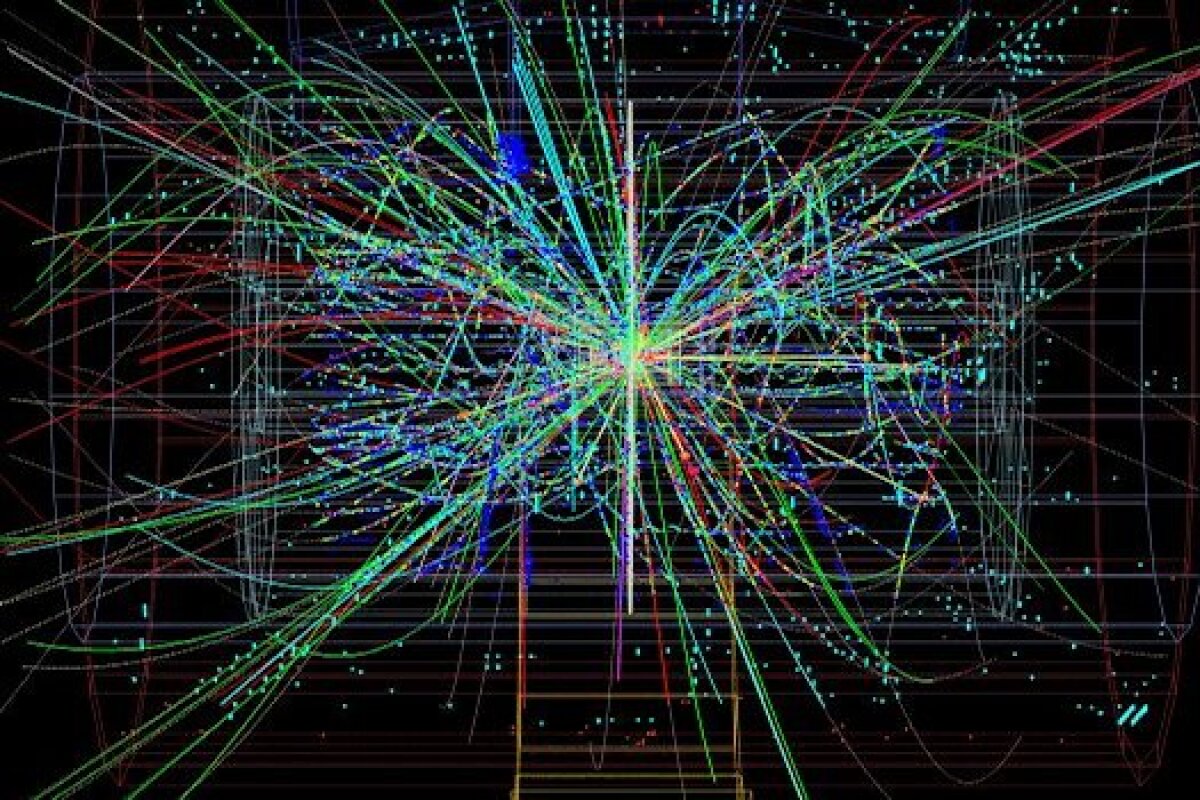



In September, the Large Hadron Collider (LHC) was being tuned to enable it to study proton-lead nucleus collisions for a data run next year. Eventually it ran and data was collected on the collisions for a period of four hours. When the data was analyzed, it revealed that some particle pairs produced in the collision were traveling in the same direction – a highly unusual situation. Although the data is not sufficient for certainty, the consensus appears to favor this as evidence for production of a color-glass condensate, a new form of exotic matter that has so far only existed as a theory.
The data analysis from the short proton-lead collision run at the LHC revealed an unexpected behavior. Normally (nearly universally), pairs of particles produced in the aftermath of collisions travel in opposite directions. However, in the LHC proton-lead collisions, particle pairs sometimes traveled in a common direction, far too many of them to be explained by conventional dynamics.
Making matters more mysterious was the observation that apparently unrelated particles located apart from one another in the detector also had a tendency to travel in a common direction, a result which MIT physics professor Gunther Roland called "somewhat unusual." The phenomenon has been dubbed the “ridge” because the parallel correlations produce a long, raised edge in certain types of data summary graphs.
Production of exotic phases of matter in high-energy collisions is perhaps best known in terms of the quark-gluon plasma. In normal matter, protons and neutrons are made of three quarks held together by gluons. When enough energy is supplied – such as when heavy nuclei such as gold or lead are collided – the protons and neutrons literally melt, producing the quark-gluon plasma.

This plasma has the properties of a nearly frictionless liquid which is so dense that it can sweep particles in front of it like a wave, which would cause some portion of the particle pairs to travel in the same direction, rather than in opposite directions. However, the LHC's proton-lead collisions did not have quite enough energy to form a quark-gluon plasma, so this is not likely to explain the results.
This leads us to the theoretical notion of a color-glass condensate. When particles travel at very high speeds, relativistic effects should cause them to accumulate large numbers of gluons that flatten out into a sheet upon which they are essentially fixed in position during the collision, as time dilation slows their motion. This theoretical gluon state is called a color-glass condensate. Gluons in a color-glass condensate would be strongly interacting, so it is likely that quantum entanglement may also have a role in explaining the unusual aspects of very-high-energy proton-lead collisions.
Several weeks of additional data on proton-lead collisions will be collected early in 2013. Analysis of the extra data may settle the matter of what is causing particle pairs to radiate so strangely. Whether the answer is formation of a color-glass condensate, or something even stranger, there is little question that the answer provide a major step in our understanding of exotic matter.
Source: LHC
Update: In response to a reader comment, this story was updated on Nov. 29, 2012, to replace references to "color-gluon" with "color-glass."