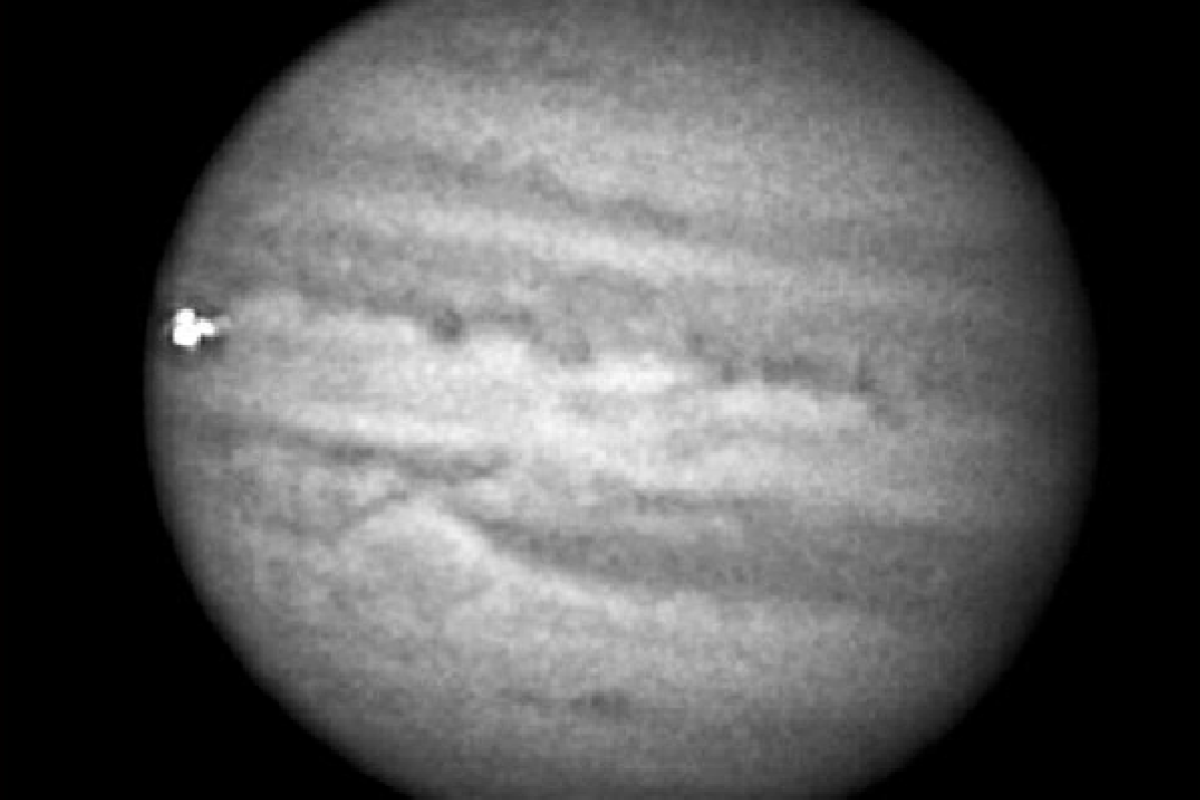



Jupiter is a major player in protecting the Earth from impact events, and has been for billions of years. Between comets and asteroids impacting on Jupiter and being flung into the Sun or out of the Solar System entirely, Jupiter's enormous gravitational field has removed the greater proportion of debris left-over from the formation of the Solar System. Jupiter has again been caught in the act of attracting and eating dangerous space rocks—this time in simultaneous observations by two amateur astronomers.
During the Late Heavy Bombardment (or LHB, about 3.8 to 4.1 billion years ago), the impact rate on the Earth and Moon was about ten thousand times higher than it is now. The early asteroid belt contained about 100 times more mass than it does today, but this early belt was disrupted as the outer planets slowly migrated out to their present orbits, throwing enormous numbers of large and small asteroids into the inner Solar System. This is probably why life in the form of bacteria only got a foothold after the LHB ended. Whatever ecology did exist during the LHB was pretty well destroyed every few hundred years.
The impact rate has been reasonably steady since the end of the LHB, the lower rate having been caused by Jupiter migrating slowly outward until it reached its present orbit. The kinetic energy and momentum it lost was largely transferred to the asteroids, most of which were no longer a factor in the Solar System at that point. To be sure, we still receive an extinction-level impact (a 15-km or 9.3-mile asteroid) about every 100 million years, a civilization killer (a 2 km or 1.2-mile asteroid) every half million years or so, and Tunguska/Meteor Crater rocks (50-100 m or 165-330 ft) a few times per millennium, but things could be a lot worse. Jupiter continues to sweep any material within its huge gravitational grasp mostly out of harms way. (It occasionally sends a destabilized rock or comet in our general direction, but generally does more good than harm.)

We first saw Jupiter in the act of sweeping away dangerous material in 1979, when a series of Voyager I images of Jupiter showed a streak of light that lasted only a very short period. (Images of all the Jovian impacts appear in the Image Gallery for this article.) The streak showed structure consistent with an asteroid entering the Jovian atmosphere and then exploding when it reached dense enough material. There wasn't enough information from Voyager's archaic (from our point of view) instrumentation to determine a size or impact velocity—only that an asteroid had hit the surface of Jupiter.
The next certain Jovian impact in 1994 was also the most impressive. The collision of Comet Shoemaker-Levy 9, or rather 21 visible fragments of this comet ranging in size from about 2 km (1.2 miles) to a few hundred meters (1000 feet). The largest of the impacts had an energy equivalent to six million megatons, which left a dark scar on Jupiter's surface almost the size of the Earth that persisted for many months.
Since 1994 there have been observations of four asteroid impacts, or rather of three and the scar from an unseen impact. All of these have occurred since 2009, owing to the rapid advance in amateur astronomical equipment, as each of these was initially discovered by amateurs. In 2009, Australian Anthony Wesley noticed the dark scar of an asteroid impact near the south pole of Jupiter, and caught it with a webcam attached to a large, but not unusual, amateur telescope. Later study of the impact point by the Hubble Space Telescope provided convincing evidence that the impactor had been an asteroid and not a comet. The Shoemaker-Levy 9 impact observations were instrumental in their analysis.
There followed two smaller impacts in 2010, and the latest September 10, 2012 impact. The June 3, 2010 impact event was again discovered and photographed by Anthony Wesley, who apparently makes a habit of being prepared for luck. This impact was too small to form a scar, but from analysis of the brightness it appears that the impactor was perhaps 8-13 meters (26-43 feet) in size. On August 20 of that same year, three Japanese amateurs co-observed a new impact flash just north of Jupiter's northern equatorial belt. This impact also did not leave a scar, and was a bit less bright then the June impact, probably about ten meters (32 feet) in size.
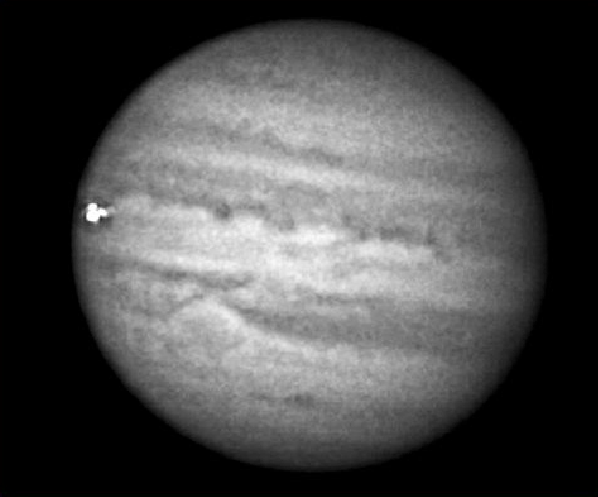
The current impact event was seen very early in the morning on September 10, 2012 independently by two amateur astronomers. Dan Petersen of Racine, Wisconsin saw the flash visually, and promptly posted his observation online in an attempt to find confirmation. (A single visual observation of a transient event is unlikely to be accepted by the astronomical community.) George Hall of Dallas, Texas had serendipitously been taking a video of Jupiter at the time of Petersen's observation, and checked his frames for that interval. Sure enough, he had taken a clear video of the impact event. The picture above is a still from that video, and the video itself can be accessed at the link at the end of this article.
Again no scar was formed on the surface. However, astronomer Mike Wong of the University of California at Berkeley has performed an analysis of the impact flash, and finds that the total impact energy was roughly 0.14 petajoules, the equivalent of 30 kilotons. As the typical impact velocity on Jupiter is larger than that on Earth (owing to Jupiter's greater gravity), the size of the impactor was about five meters (16 feet) in diameter.
The Jovian impact observations of the past three years are significant. They provide information on the composition and structure of Jupiter's atmosphere as well as helping us put limits on the density of smaller space rocks in the Solar System: a subject which is of considerable interest for our future as well as the future of our local efforts in space travel and utilization.
Perhaps more significant, though, is the recognition by the professional astronomical community that amateur astronomers are now well enough equipped to study serious astronomical events, and that they are willing to put in the time to continuously observe high-value targets, a process which simply cannot be carried out by professionals as there aren't enough people or facilities.
The target need not be planetary impacts. Other targets could include transient lunar phenomena (poorly-established flashes, gases, and other odd phenomena), occultations (when an asteroid passes in front of a star), transient atmospheric phenomena, and even nova and supernova patrols. A movement toward organizing perpetual watches of astronomical bodies appears to be a timely one. All that is necessary is for an enterprising group of astronomers to collect behind a set of goals. Data you can't expect to get any other way is simply invaluable.
Source: Space.com