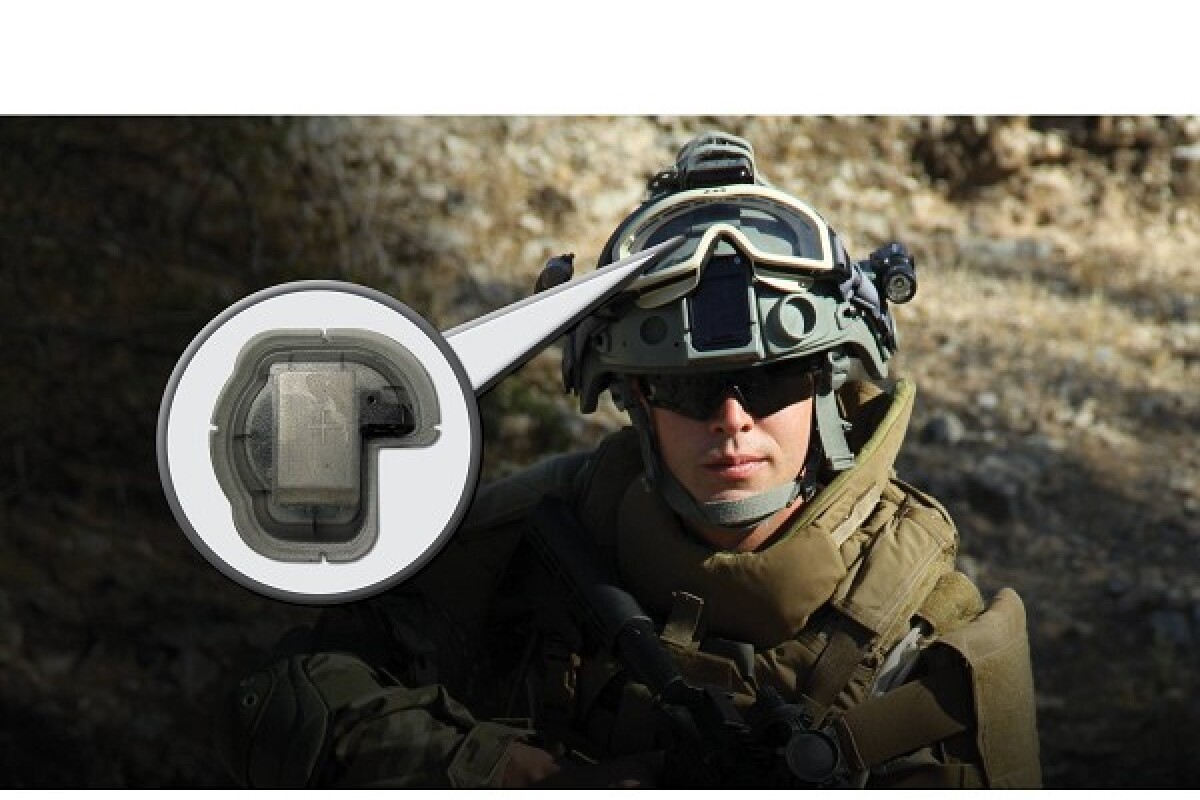


The problem with head injuries is that people who receive them often don’t realize how serious they actually are, until it’s too late. That’s why BAE Systems developed the Headborne Energy Analysis and Diagnostic System (HEADS) helmet sensor back in 2008. Used by the US Army and Marine Corps, the sensor is mounted inside soldiers’ helmets, and indicates when it has received concussive force sufficient to cause a traumatic brain injury (TBI). Last week at the Farnborough International Air Show, BAE announced the launch of the second generation of HEADS sensors.
“Diagnosing mild to moderate combat-related TBIs can be challenging. For example, following an explosion from a roadside bomb, soldiers will sometimes continue with their mission, unaware that the concussion from the blast may have lingering effects,” said Joe Coltman, VP of BAE’s Personnel Protection Systems business. “With the Generation II HEADS sensor, even if the injury isn’t obvious, the sensor is equipped with a programmable color LED light that can be set to activate during a blast event, providing immediate notification of a possible combat-related TBI which should be checked out by medical personnel.”
The sensors are also equipped with an RF transmitter, the signal of which will be picked up by receivers when the soldier returns to their base. If a soldier has sustained a harmful blow, the signal from his sensor will alert base officials to the situation.
The Generation II HEADS sensor doesn’t simply record the fact that a blast occurred, but also indicates the impact direction, magnitude, duration, blast pressures, angular and linear accelerations, plus the exact times of single or multiple blast events. This data can be downloaded through a USB or wireless connection, for analysis by medical teams.
Delivery of the new HEADS sensors is scheduled to begin next April.