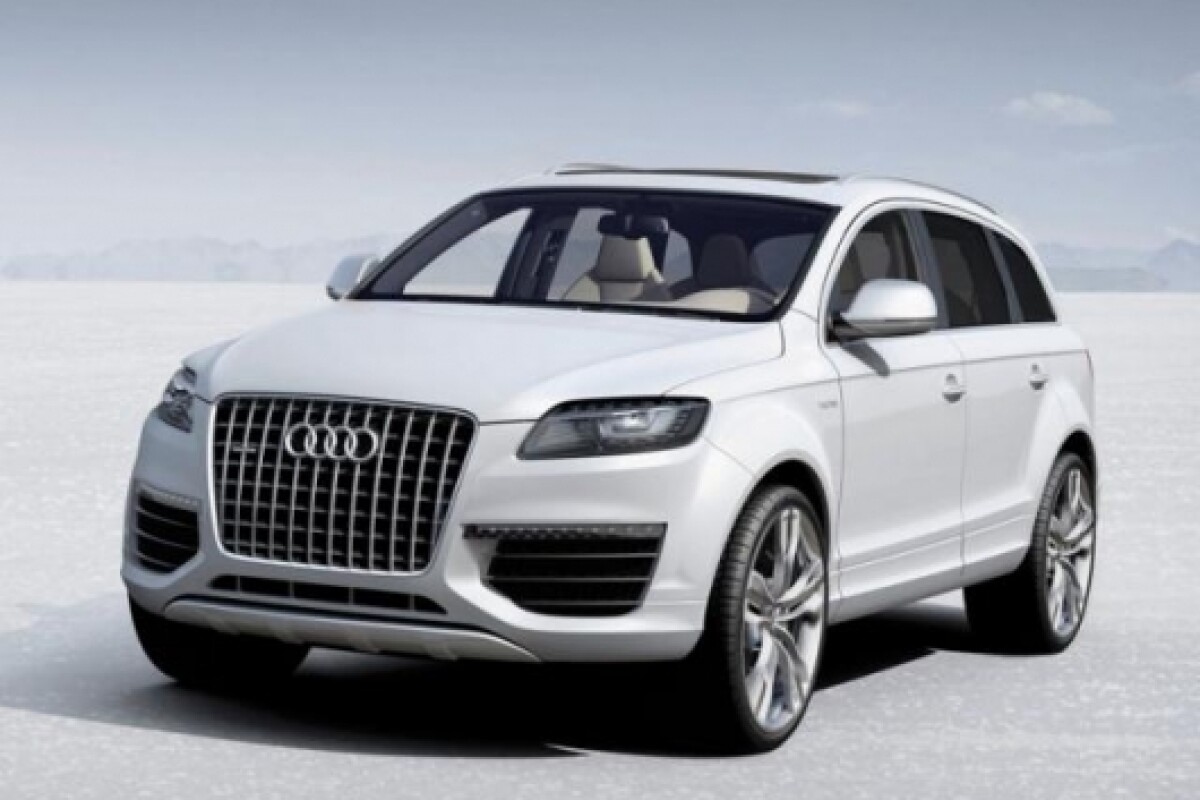



January 10, 2007 While we love concept cars, and we’re enamoured with futuristic power train technologies, but we must admit that one of the most alluring vehicles at the Detroit (NAIAS) Motor Show was the diesel-engined, production-ready Audi Q7 V12 TDI. It’s now nearly two decades since Audi invented the TDI engine, so it’s nice to see the technology being presented it in an all-new high-tech, range-topping guise. Derived from the company’s all-conquering race car which won everything it entered in 2006, including the Le Mans 24 hour, the now production-ready version of V12 TDI engine produces 368 kW/500 bhp and 1,000Nm of torque.
The Audi Q7 V12 TDI raises the bar in the burgeoning sports utility vehicle segment. A time of just 5.5 seconds for the dash from zero to 100 km/h and an electronically governed top speed of 250 km/h give the high-performance SUV sports car calibre. The majestic V12 TDI power unit with its capacity of six litres endows the high-performance Audi Q7 SUV with sports car credentials. It is the harbinger of a wide-scale model initiative, as Audi seeks to make major inroads into the US market with its diesel models – courtesy of a new emission control technology which cuts emissions drastically. The engine limits its consumption to an average of just 11.9 litres/100 km.
Last year, Audi demonstrated the dynamic potential of diesel power in most memorable fashion on race tracks around the world. The V12 TDI in the R10 sports prototype unleashed in excess of 650 bhp and left its petrol-engined competitors in its wake in each of the eight races it competed in. Highlights of this winning streak included its triumph at the gruelling Le Mans 24 Hours as well as its victories in the LMP1 category of the American Le Mans Series.
The trend towards diesel engines is gathering strength all the time in the United States too. Audi is firmly convinced that the TDI engine represents the powerful and economical alternative for the future of motoring, and is therefore preparing a model drive to bolster this trend.
When working on the road-going version of the V12 TDI, which will be built in its Györ plant in Hungary, Audi drew on all of the know-how that underpins the racing engine. The range-topping diesel is the new flagship model in the Audi range of V engines, spanning petrol and diesel units with 6, 8 and 10 cylinders.
The V12 TDI's cylinders actually sweep a greater volume than the racing engine, which has a capacity of 5.5 litres. Its 5,934 cc are produced by a bore of 83.0 millimetres and a stroke of 91.4 mm, the same dimensions as the six-cylinder 3.0 TDI. The two banks of cylinders are positioned opposite one another with an offset of 17 millimetres. Measuring just 684 mm long, the V12 diesel has an extremely compact design. Indeed, its compact size was one of the key prerequisites for integrating the V12 into the Audi Q7.
The V12 TDI features the same 90 mm spacing between cylinders as the other models in the V engine series. However, the cylinder banks are placed at an angle of 60 degrees to one another instead of the customary 90 degrees. This particular V12 configuration suppresses all of the inertial forces and mass moments which would otherwise cause vibrations. Consequently, the engine's smoothness is flawless in every regard.
The V12 TDI's crankcase is made from a mixture of cast iron and vermicular graphite – Audi already uses this high-tech material, known as GJV-450, in the manufacture of the V6 TDI and V8 TDI. GJV-450, which is produced using a patented casting method, is around 40 percent more rigid than cast iron and twice as resistant to fatigue.
This enabled the development team to make the walls thinner, paving the way for a potential weight-saving of around 15 percent compared to conventional cast iron.
The crankshaft is forged from chrome-molybdenum alloy steel and is mounted with the aid of an extremely rigid main bearing bridge made from nodular cast iron. The forged connecting rods are cracked, and the pistons are made from aluminium.
The two cylinder heads each comprise three main elements. The bottom section, incorporating the intake and exhaust ports and through which the coolant flows, is made from a low-pressure die-cast aluminium alloy that has a high-strength, lightweight construction. The top section, which conducts the oil, is pressure-cast. The cylinder head is crowned by a reinforcing ladder-type frame which holds the two camshafts.
The valves are actuated by four camshafts acting via low-friction roller-type cam followers, the compression ratio is 16.0:1. The map-controlled swirl variation of the combustion air deployed in the V6 and V8 TDI models has been retained. With this system, one of the intake ports for each cylinder is either opened or closed by means of an electrically operated flap, depending on the engine's operating point. Intermediate flap positions are also possible. This allows the swirl to be adjusted for optimum exhaust emissions combined with high power delivery.
As is customary on V engines from Audi, the maintenance-free chain drive is fitted in a space-saving location on the rear face of the engine. The developers devised a new layout for the V12 TDI, however. The crankshaft's sprocket wheel meshes with an intermediate gear which in turn drives the camshafts by means of two simplex chains. Two additional chains drive the oil pump as well as both high-pressure pumps for the common-rail injection system.
The injection technology featured in the V12 TDI is every bit as revolutionary. The high-pressure pumps both form part of the common-rail system supplied by system specialist Bosch. The twin plunger pumps are capable of building up pressures as high as 2,000 bar in the rails, considerably more than the previous usual maximum of, at most, 1,600 bar.
The piezoelectric injectors with their eight-hole nozzles have also undergone a thorough reworking. The tiniest quantities of diesel fuel are injected into the combustion chambers through their eight-hole nozzles, whose diameter has now been reduced to a mere 0.12 milli–metres. The high pressure produces an optimum spray pattern inside the combustion chamber, which makes for a faster, more homogeneous and, as a result, more acoustically refined ignition process. What's more, the improved combustion efficiency increases power output whilst reducing both fuel consumption and pollutant emissions.
The latest generation of inline injectors employs the piezo effect: piezo crystals expand slightly when an electrical voltage is applied to them. Over 300 piezo discs are packed into each of the V12 TDI injectors, which transmit the minimal expansion to the valve needle directly (inline) without the need for any form of transmission mechanism between the two. Each actuation takes just a few milliseconds – by comparison, a wink of the eye lasts 100 ms.
The fuel pressure and quantity can be adjusted according to requirements; the number of injection phases per power stroke can be varied up to a maximum of five with the piezoelectric technology in the V12 TDI. Main injection can be accompanied by both pilot and post-injection phases. Pilot injection lessens the harshness of the combustion sound, which is particularly noticeable at low engine loads. The delayed post-injection of fuel serves to increase the temperature of the exhaust gas – this allows any particulate residue to be burned off in order to regenerate the two particulate filters which are included as standard.
Attached to the outside of the engine's V are the two turbochargers which each supply compressed air to one bank of cylinders. Their variable vane geometry ensures that the full exhaust flow is directed through the turbine at all times – the turbochargers offer fast response even at low rev speeds and attain a high degree of efficiency.
Both turbochargers generate up to 2.6 bar of absolute boost pressure and therefore have a vital role to play in achieving the formidable peak torque of 1,000 Nm which the new V12 TDI constantly has on tap between 1,750 rpm and 3,000 rpm. The diesel's 368 kW/500 bhp equates to a specific output of 62.0 kW/84.3 bhp per litre.
The temperature of the compressed air is reduced by two large intercoolers. The V12 comes with a double-flow exhaust system featuring two particulate filters. The intake system is similarly structured – for each bank of cylinders there is an air cleaner followed immediately by a hot-film air mass meter. Two control units operating based on the master-slave principle orchestrate proceedings inside the engine.
The Audi Q7 V12 TDI already complies with the Euro 5 emissions standard, which is due to come into force in mid-2010 and will make especially tough demands in terms of reducing nitrogen oxides. It was with this in mind that the Audi engineers devoted particular attention not only to the new common-rail system and its high-precision fuel metering, but also to the exhaust gas recirculation system.
At partial throttle, up to 50 percent of the exhaust gases are fed back into the intake air in order to reduce NOx emissions. The extensive recirculation system incorporates a water cooler which reduces the temperature of the exhaust gases sharply.
The awesome V12 TDI directs its power as standard to a fast-action, smooth-shifting new six-speed tiptronic transmission. From here, the forces flow to a quattro driveline, which splits the drive power 40:60 between the front and rear wheels under normal driving conditions. This results in slightly tail-heavy, sporty handling characteristics, exceptional agility and exemplary steering precision.
To ensure that its phenomenal performance can be safely harnessed, the Audi Q7 V12 TDI is equipped with powerful, ventilated disc brakes. The ESP dynamic handling control system features a hill descent assist as well as a special off-road mode. The safety specification is rounded off by the pairs of front, side and head airbags in the interior.
An elaborate double-wishbone independent suspension has been used for each of the four wheels, while the majority of the axle components are made from aluminium. The adaptive air suspension, incorporating an electronically controlled damper system, comes as standard, creating a perfect synthesis of sporty handling on the one hand and silky ride comfort on the other. The body's ride height can be adjusted from its starting position of 180 mm above the ground up to the lift mode offering a whole 240 mm of ground clearance. The Audi Q7 V12 TDI study rides on 20-inch cast aluminium wheels.
The Audi Q7 V12 TDI is just as fascinating to look at as it is to drive. The principal feature which distinguishes it from its lesser-powered siblings is the contrasting paintwork of the underfloor panels at the front and rear. The striking, almost vertical single-frame radiator grille has a chromed finish and echoes the dynamic Audi S6 and Audi S8 models, which both head their respective ranges powered by V10 FSI engines. Flanking the grille are wide headlight units with visible light tubes.
The Audi Q7 styling has a thrilling air of elegance blended with dynamism, and displays both tremendous sportiness and the robustness of an accomplished off-road vehicle. The Audi Q7 cuts a powerful, elongated figure, boasting the sportiest proportions in its segment, with a length of 5,086 millimetres, a width of 1,983 mm and a height of 1,737 mm.
The high side panelling gives the vehicle's body a muscular feel, particularly in the way it contrasts with the flat, sporty styling of the window area. The dynamic line above the wheel arches, the powerfully contoured shoulder section and the flowing roof line combine with the standard-fit roof rails to emphasise the car's athletic looks. The distinctive tapering at the front end and the tail with its steeply angled D-pillars form the end markers of a distinctly coupé-like silhouette.
The Audi Q7 offers outstanding levels of spaciousness courtesy of a wheelbase measuring 3,002 mm. The three rows of seating accommodate up to seven people. The seats in the second row can be specified with fore-and-aft adjustment as an option and offer occupants a class-beating footwell length. Both of the rear rows of seats can be folded down flat, increasing load capacity to a maximum of 2,035 litres. The 5-seater version of the Audi Q7 offers 775 litres of load space in its luggage compartment, while the 6-seater version features individual second-row seats. The tailgate of the Audi Q7 V12 TDI opens and closes electrically at the push of a button.
The interior and cockpit area of the Audi Q7 create the impression of a light and airy expanse, flawless ergonomics and top quality. The standard-specification deluxe automatic air conditioning regulates heating and ventilation separately for the driver's and passenger's side, taking sunlight levels into account in the process. The Audi Q7 also comes equipped as standard with the MMI operating system which has already earned high praise in the A8 and A6 and can be expanded to include numerous additional functions.
A number of state-of-the-art driver assistance systems may be specified as an option. These include the radar-assisted "Audi side assist" for lane-changing manoeuvres, the "Audi parking system advanced" featuring both visual and acoustic guidance as well as a rearview camera, plus the latest-generation automatic proximity control system, Audi cruise control with braking guard, which is capable of braking the vehicle to a standstill if required.
The seats are upholstered in leather, and the front seats are heated. Carbon panels give added emphasis to the interior's sporting flair. And to ensure that drivers can enjoy supreme operating convenience there is a cruise control system, a driver information system and a multifunction steering wheel.
Audi already offers the Q7 with a choice of three engines: the 3.6 FSI has an output of 206 kW/280 bhp, the 4.2 FSI generates 257 kW/350 bhp and the 3.0 TDI delivers 171 kW/233 bhp. The eight-cylinder 4.2 TDI is due to be added to the model line-up in mid-2007.
The trend towards diesel engines is becoming ever more pronounced in the United States too. Audi, the inventor of the modern-day TDI, is going on the offensive in an effort to bolster this tendency. 2008 will see the arrival of the Q7 3.0 TDI in US showrooms. Thanks to the exceptionally low emissions resulting from its cutting-edge Bluetec technology, this engine is able to meet even the most stringent emissions limits.
In Europe, diesel-engined cars have been enjoying an inexorable rise in popularity for years now – in Germany, for instance, they accounted for over 45 percent of new car registrations in October 2006. Today's diesel engines are powerful, fast, efficient, smooth and dependable – virtues which Audi, in its capacity as a pioneer of diesel technology since 1989, has been instrumental in achieving.
The diesel market is also beginning to take off in the USA. In 2006, diesel-powered passenger cars and light trucks secured a market share of around 3.5 percent, and this figure is widely predicted to keep on rising. Firmly convinced that the TDI engine represents the powerful and economical alternative for the future of motoring, Audi is seeking to reinforce this trend: the Ingolstadt brand is embarking on its US diesel initiative.
The stringent legislation governing emissions represents a key criterion for all passenger car engines in the USA. The emission standard entitled US Tier II Bin 8, which is in force in 45 of the 50 US states, limits emissions of nitrogen oxides (NOx) to 0.20 grams per mile and particulate emissions to 0.02 g/mile. The LEVII standard, which is enforced in California and a number of states in the north-east, goes much further again, restricting emissions of nitrogen oxides to 0.07 g/mile and particulates to 0.01 g/mile.
The LEVII limits are simply beyond the capabilities of the emission control technologies required to meet the current Euro 4 standard in Europe.
This is why Audi has teamed up with Volkswagen and DaimlerChrysler to develop a revolutionary new technology – it is called Bluetec and denotes exceptionally clean-running diesel engines.
The Bluetec technology is built around a dedicated catalytic converter which goes under the abbreviation of SCR (Selective Catalytic Reduction) and is positioned downstream from the oxidation catalytic converter and the particulate filter. The second system component is an auxiliary tank containing an aqueous carbonyl diamide solution. The solution, which has been labelled "AdBlue", is injected into the exhaust system in small doses. Once in the hot flow of exhaust gases, it decomposes into ammonia which in turn breaks down the nitrogen oxides into nitrogen and water.
The "AdBlue" reducing agent is routinely topped up at the workshop each time the vehicle is serviced, without the customer having to lift a finger. Audi ensures that there is sufficient "AdBlue" to safely cover the distances between services. Additional benefits include the fact that "AdBlue" is biodegradable and the system's guaranteed effectiveness for the duration of the vehicle's service life.
The ultra-clean Bluetec diesel engines see Audi hold true to its tradition of always being at the cutting edge of diesel technology development. The Ingolstadt brand developed direct injection technology back in 1989 – since then, the fuel efficiency of diesel engines has been improved by around 30 percent on average. Compared to 1989 levels, the European emission standard Euro 4 heralds a 93 percent reduction in passenger car particulate emissions; long before the standard came into effect, Audi had already brought out models onto the market which complied with the stipulated limits, even without a particulate filter.
The Audi philosophy has always been to offer customers the best possible solution. And as the only good emissions are those which are not created in the first place, Audi engineers gave top priority to implementing internal engine measures that would further refine the combustion process.
The common-rail technology in the new Audi Q7 V12 TDI with an injection pressure that has now reached the 2,000 bar mark is, for the moment at least, the last link in a long chain of diesel developments.
Others include the four-valve-per-cylinder technology and the accompanying swirl and inlet ports for controlling the airflows, as well as the controlled and cooled system of exhaust gas recirculation; the latter of these innovations is of great importance for the future of diesel engines at Audi.
The growing trend towards diesel power which is emerging in the US has been prompted by a number of developments. The sharp increase in energy prices has raised public awareness of the importance of making economical use of resources.
The infrastructure of filling stations stocking diesel fuel for passenger cars is growing, at the same time increasing availability of the low-sulphur diesel fuel (containing less than 50 ppm sulphur) that is one of the fundamental requirements for using Bluetec technology and particulate filters. Irrespective of this, Audi is promoting the development of sophisticated synthetic fuels derived from biomass or natural gas, which by their nature contain considerably fewer pollutants.
The Q7 3.0 TDI will be the first model from Audi to showcase the all-new, ultra-clean Bluetec technology when it is launched in the US in late 2008. Further models are set to follow. And other countries apart from the United States have voiced an interest in the new, extra-green diesel engines, including Japan, China and, not least, the Europeans.