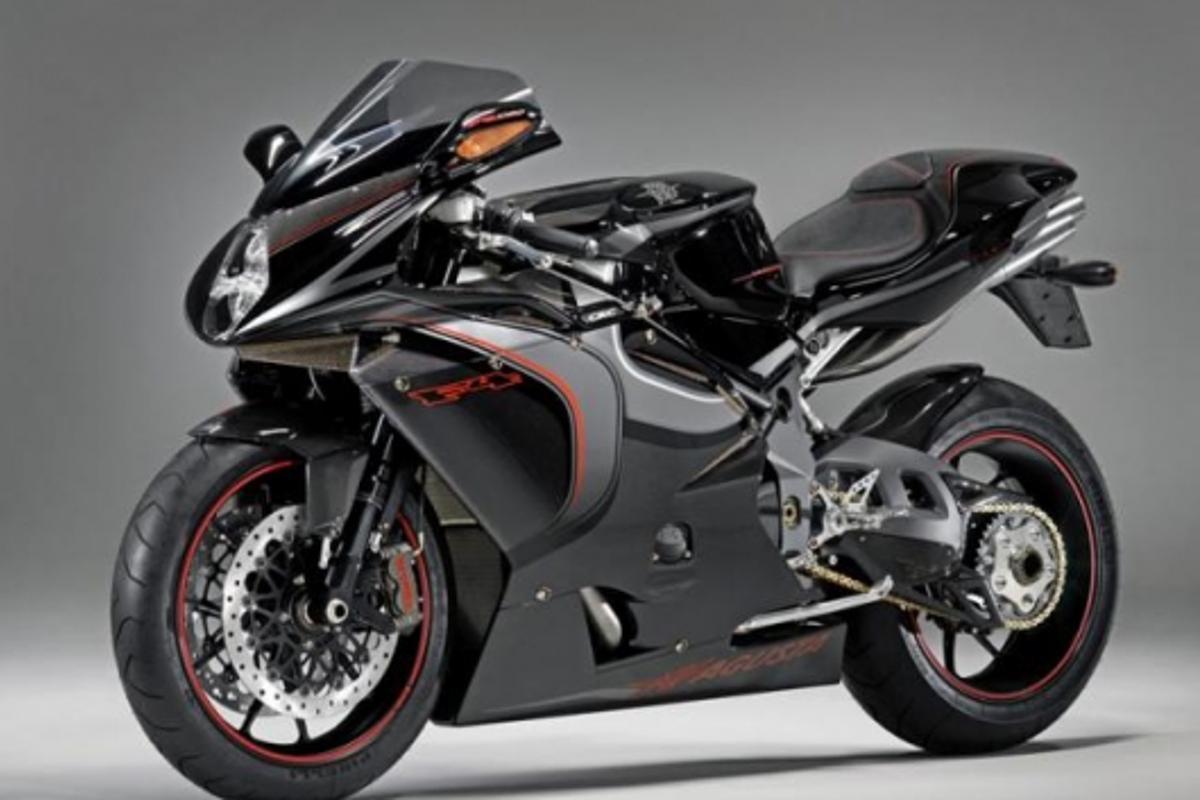



November 14, 2006 “I decided to put my name to this bike as I originally dreamed of it for myself”. This is how Claudio Castiglioni, the Managing Director referred to the new F4 that now carries his initials “CC”. The boss of MV did what any of us might well have done and gave in to his inner instincts, gave in to the temptation to create a motorbike, not just to meet strategic market needs, but to create something really special, something truly magnificent - just for the sake of it. To create the F4CC project, he obviously utilised everything at his disposal; exclusive materials and the latest technology to attain the utmost in performance. The new F4 CC was released overnight in Milan at EICMA and as predicted several weeks ago, it will be the most exclusive and fastest production motorcycle on the planet, fittingly restoring the name MV Agusta to the pinnacle of roadbike technology. Only 100 units of the hand-built MV F4 CC will be produced and price will be in the region of 100,000 euros. The unit will come with superb accessories including a Trussardi leather jacket and a Girard Perregaux watch made exclusively for the 100 proud owners. The figures for the new MV speak for themselves: the top speed of this Italian sculpture is 315 kph (195 mph), auto-limited by MV Agusta in deference to the lack of available tyres for speeds beyond that.
Unique in its genre, sculptured by Castiglioni’s friend Massimo Tamburini, made with luxurious design and high cost components from deep inside the MV closet, right in that corner where the embryo start to develop: the MV AGUSTA racing department. This model however will never see a race track in earnest due to the size of its engine. What is important is the uniqueness of the F4CC project and the name that it carries. It doesn’t matter if the ignition keys are never turned in the lock, if the bike rests on a stand in someone’s home or if it only does the occasional mile or two to “give it a run”.
What does matter for a true enthusiast is to possess just one of the 100 models made and treat it as if it were a priceless painting worth millions. This was part of Claudio Castiglioni’s dream. This is why the F4CC will be presented with a specially boxed certificate of origin and why the delivery of each machine will be something very special - more a ceremony.
Each machine will have a platinum plate at the top of the steering column bearing the model number from 1 – 100. The F4CC titanium exhausts and engine management unit together have the task of taming the power of the 1078 cc engine yet making it “sing” even sweeter when unleashing all of its 200 CV. The F4CC doesn’t just want to entice with its looks - it wants to out-perform everything else.
The deliberate contrast between painted areas and bare carbon-fibre, between the fairing, the tank and the tail create a piece of modern architecture. Only in the prestige sector of the automotive field can such exclusive design be found. Red lines emphasis the “CC” on the fairing as does the F4 signature. There is however much more. The instrument panel has customised graphics and the all-black Alcantara saddle uses different fabrics on the top and side areas.
90% of the components are made as one-off items including the fork feet, the upper steering plate, the steering damper, the brake and clutch fluid reservoir, the gear change and brake levers, the footpegs and the side stand. As you can see, the MV F4CC uses special materials built by CRC (Centro Ricerce Cagiva) just about everywhere. The fairing is 100% carbon-fibre and the tailor made filler cap comes from the aero industry. All the protective meshes at the intake ducts and outlets at the tail are made from titanium. The same applies to the lower radiator and the four racing exhausts that form the classic organ pipe arrangement.
The F4 CC is at the absolute top of the F4 hierarchy. The main differences between it and the more “commercial” F4R can be summed up as follows: - over 90% of the components are individually tailor made; - brake and clutch levers that “fold” at the tip in the event of a fall; - 1078 cc engine; - 200 CV maximum power with titanium racing exhaust system; - new timing system; - smaller alternator; - one-off mechanical type slipper clutch; - new forks interior set-up and mono shock absorber - Brembo Racing monoblock brakes; - kerb weight 187 kilos without fuel.
All 1000 cc engines like that in the F4R have been tuned more and more not just to provide better performance, but also to better use the dynamics of four cylinders working in unison. This is why MV increased the bore from 76 mm to 79 and left the stroke unchanged at 55 mm. Cubic capacity thus became 1078 cc – the maximum obtainable from this engine. This is where the MV Agusta racing department managed by Andea Goggi began to work. Their aim was to improve internal fluid dynamics by polishing ducts and working their magic on “chamfering the innards” to gain a few CV. The new combustion chamber geometry was part of an overall reworking of the heads where computer controlled equipment guaranteed work of the very highest order.
The pistons were made lighter than those in the 1000 and con-rod geometry was changed. The real difference however lies in the timing system that was made from different sized exotic materials for each and every element. The intake and exhaust valves are still radial (unique MV AGUSTA figure), but are now titanium and the intake valves are now bigger measuring 31 instead of 29 mm. With the wider bore, changes were also needed to the camshaft profile. On the other hand, the valve bowls (still steel) were decreased in size to lose a few grammes weight.
They were decreased from 28 to 26 mm but still have double springs. These bowls, along with the keepers, valve guides and valve seats are all made by Del West, the American market leader in this sector, and despite the exorbitant price of these components, they were perfect for a machine as exclusive as the F4CC. The weight saved by these higher working speed components led to improved engine “usability” not to mention the fact that they shaved 4 kilos off the weight of the F4CC engine as against the F4R. Other components that contributed to weight savings were the magnesium timing, gearbox, clutch, blow-by and alternator covers.
The alternator cover in particular made a significant difference to the scales given that it alone made a difference of about 2 kilos in comparison to the one fitted to the F4R.
Size, obviously makes a difference so the new smaller version meant modifications had to be made to the upper block due to the shape of the new alternator and new hose connections. The fuel feed system included bigger throttle bodies that went to 48 mm as against the 46 mm ones fitted to the F4R. Like the F4 1000 Tamburini, the key to the F4CC engine performance lies with the revolutionary, patented Torque Shift System (TSS). The end result is again an engine without parallel.
Like its 2007 “R” sister, the F4CC fully complies with Euro 3 standards with the following components: lambda probe, catalyser and one-piece exhaust system. The Engine Brake System (EBS) must also be mentioned. This acts as a torque limiter under deceleration. This system was first launched with the F4 1000 series. The F4CC also features a mechanical type slipper clutch with ramps and roller bearings. It is a one-off item of equipment.
Not one item is made using traditional industrial methods and this has an obvious effect on the price of the F4CC. All the frame peripheral components were tailor made. This includes the fork feet, the footpegs (shim adjustable and “filed down” to reduce weight), the upper steering column plate and levers. Every item has been carefully designed then hand built using techniques that the racing department has applied over the years.
The F4 frame is made from chrome molybdenum that, while being very light, offers the rigidity that any Superbike putting out more than 200 CV must have. This frame is used widely in the F4 range and remains unchanged on the F4CC. The swing arm and frame plates are superlight magnesium and the choice of a mono arm demonstrates not only how solid this unit is, but the sight of one side of the rear wheel being completely “exposed” further underlines the fact that this is a 100,000 euro MV Agusta.
In the suspension department, race experience counts more than ever. It is experience on the track that leads to evolution in suspension systems where improvements take place step-by-step. Flashes of inspiration however are never discounted. Even if everything looks the same from the outside, you can feel the difference when you try the F4CC or you can see the difference when the forks and “mono-arm” are X-rayed. Suspension solutions are the result of extensive research and close collaboration with riders that always want to feel the bike “hands-on”.
They insist on no less than predictable, controllable reactions from the machine. All the components at the front are Marzocchi like the enormous 50 mm forks. These items provide solidity and strength under braking and cornering. The forks are carbon nitride treated to decrease friction but this effect also adds to the bike’s overall aggressive image. The one-off steering damper and racing mono shock absorber are both made by Sachs. The mono unit can be adjusted for rebound at high and low speeds. In effect, the F4CC is fitted with racing suspension.
The F4CC is fitted with 100% Brembo Racing brakes. This system is an exact copy of the one used on racing bikes that have two 310 X 6 mm discs up front with monoblock calipers housing 4 pistons and 2 pads. A single 220 mm disc looks after braking at the rear. The only difference between the “official” Brembo race brakes lies in the second dust cover fitted to road going F4CC version. This serves to reduce wear on the brakes that certainly will not be serviced as often as those on a pure racing version.
The forged aluminium Brembo Super Light “Y” spoked wheels come in a new colour and measure 3.50 x 17” and 6.00 x 17”. They are fitted with Pirelli Dragon Supercorsa Pro tyres measuring 120/70 and 190/55.