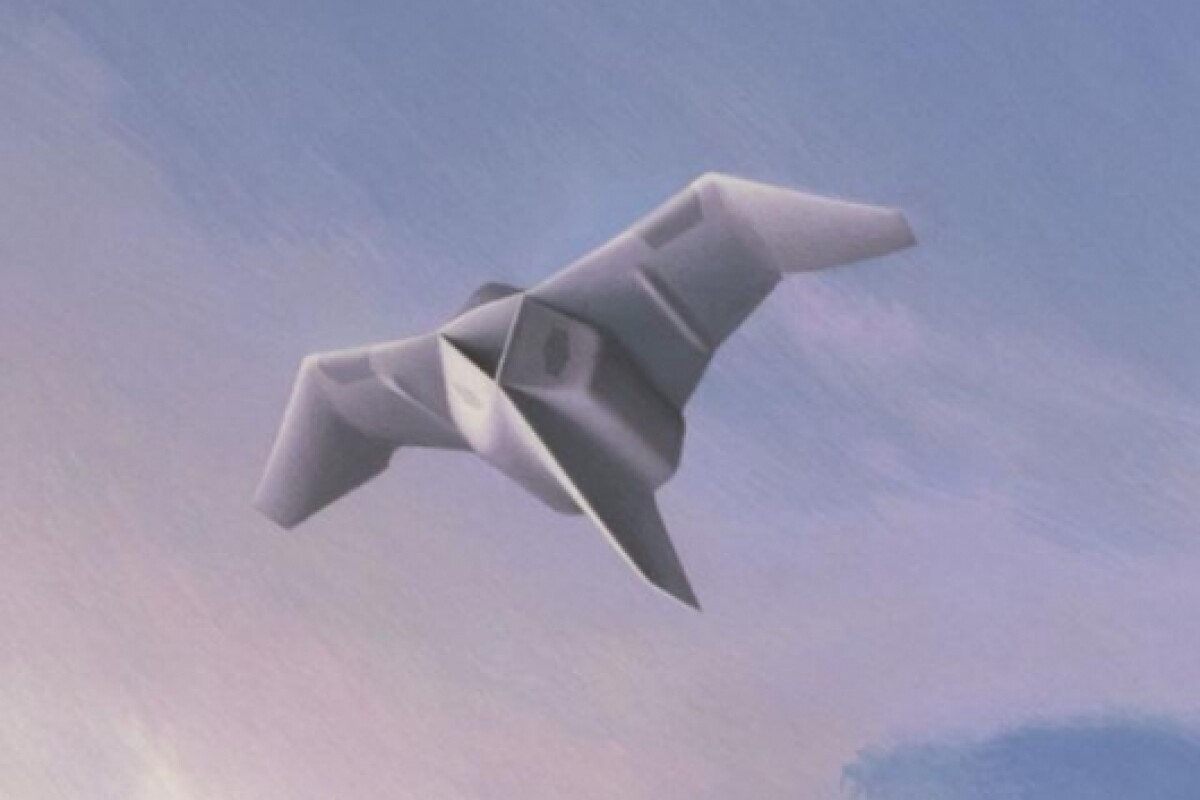



March 23, 2006 If, as the men-behaving badly magazines tell us, “he who dies with the best toys, wins” then the United States military will invariably triumph, and it will only be a matter of deciding which arm of the military has the best array of the ultimate gizmos. The Cormorant concept, should it be built, is likely to give the Navy a big leg up! The Cormorant is a submarine/sea-launched and recovered Multi-Purpose Unmanned Aerial Vehicle (MPUAV) - a unique concept to extend the capabilities of the newly modified OHIO-Class SSGN submarine as well as surface combatants such as the Littoral Combat Ship. It could enable renewable, organic air operations for long-range, survivable, all-weather reconnaissance, battle damage assessment, or specialized mission support (e.g., special forces re-supply) in a broad spectrum of operations. In particular, the combination of a stealthy SSGN submarine platform and a survivable MPUAV could introduce new capabilities to support future joint warfighting operations in high-threat scenarios.
DARPA began a Phase 0 feasibility study looking at an immersible MPUAV in 2003. In May 2005, the program moved into Phase 1 to conduct risk reduction demonstrations. A decision on future phases will be made once Phase 1 results are available.
The 16-month Phase 1 effort will address critical technical aspects of the overall MPUAV system concept. Key risk reduction demonstrations will include submerged docking tests using a full-scale, instrumented MPUAV mock-up/test article, and a mechanism placed on the sea floor to emulate the launch and recovery "saddle" that would be extended from a SSGN missile tube. A second test article will emulate the forward half of the MPUAV to be utilized for instrumented splashdown testing of structural loads. A remotely operated vehicle will be used to demonstrate the in-haul recovery cable/MPUAV tether hook-up event. Additionally, rapid starting of a representative turbofan engine using high-pressure gas will be demonstrated in a test fixture.
The current MPUAV concept envisions the immersible MPUAVs being housed and serviced in the ballistic missile launch tubes of the SSGN. They would be released from the submerged submarine and remain buoyant at the water’s surface until launched using two Tomahawk missile-derived solid rocket boosters. Upon mission completion, the turbofan engine-powered MPUAVs return to a designated retrieval point at sea, initiate engine shut down, and splash down to await recovery. During recovery, the submerged SSGN would deploy a remotely operated vehicle (ROV) to secure an in-haul cable from the SSGN to the recovery tether deployed by the MPUAV. The SSGN would then haul the MPUAV to its designated launch tube saddle mechanism, where it would be docked and retracted into the missile tube. The buoyant launch and recovery mode of the MPUAV would also allow it to be operated from surface ships. Access to various types of MPUAV launch and recovery platforms could provide increased operational and maintenance flexibility. Details of the MPUAV concept will be refined as Phase 1 proceeds.
The contractor for the MPUAV program is Lockheed Martin Aeronautics Company, teamed with General Dynamics Electric Boat, Lockheed Martin Perry Technologies, and Teledyne Turbine Engine Company. They received $7.1M in DARPA funding for Phase 1.