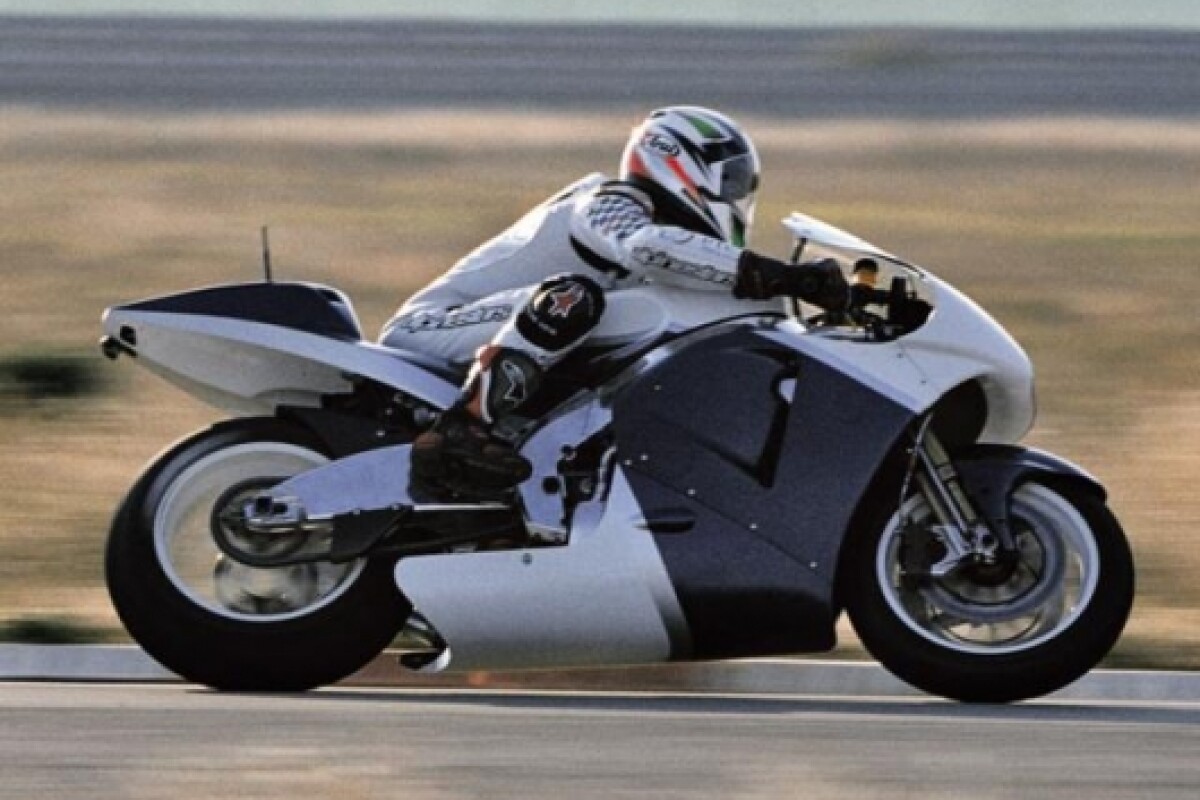



February 11, 2006 BMW Motorrad released a very interesting statement this week. The statement came with an accompanying image of a high powered motorcycle which BMW has developed to test a number of areas at the outer limits of motorcycle performance, encompassing research into lightweight construction, high performance aerodynamics and the “highly dynamic processes in engine and driving dynamics management under extreme conditions.” Examples of the latter include traction control systems which “will be introduced for powerful motorcycles in serial production in the years to come” according to BMW. BMW says the traction control and BMW’s Anti Lock Braking (ABS) system “will form part of an integrated concept to increase active safety.” BMW says that, “by conducting in-house development such as this, engineers benefit from the expertise derived from Formula 1 and BMW’s technology leadership in the field of electronics.”
As part of research activities on future regulation systems, a motorcycle test vehicle has been created under the umbrella of BMW Group research and technology. This vehicle has a very high engine output and lightweight construction technology and is designed to test highly dynamic processes in engine and driving dynamics management under extreme conditions.
BMW Head of Development Prof. Burkhard Göschel said that the choice of a motorcycle to study fundamental technological developments was due to the very interesting challenges relating to the special driving dynamics of motorcycles and their tilted position: “The dynamics of powerful motorcycles operating at the physical limits are among the most complex phenomena in the field at the current time. For our engineers this is a highly sophisticated and at the same time fascinating task.”
Additional considerations are the special motorcycle requirements in terms of lightweight construction and aerodynamics, which are also to be subjected to research at threshold level. The Director of BMW Motorrad, Dr. Herbert Diess, sees in these BMW research activities valuable impulses for serial development and emphasises: “Regulation systems for longitudinal dynamics such as drive-slip control will be introduced for powerful motorcycles in serial production in the years to come. In addition to ABS they will form part of an integrated concept to increase active safety.”
Engine management of the high-performance engine and the entire engine electronics system including hardware and software will form a key focus of the project. By conducting in-house development such as this, engineers benefit from the expertise derived from Formula 1 and BMW’s technology leadership in the field of electronics. Dr. Diess explains: “The close networking of all research and development activities with the BMW Group is a competitive advantage and a key element of the strategic orientation of our entire motorcycle development operation”.
The motorcycle has only been ridden on BMW’s own test circuits to date. However, in the foreseeable future it will also be tested on other closed-off circuits. Functional tests under the widest possible range of realistic conditions provide the best feedback on the interplay between engine, chassis and electronic components. The comparative data thus obtained serves to provide a comprehensive assessment of the capabilities of this technology research vehicle and of the development status of the components in question.