


February 2, 2006 UK-based RCV Engines is best known globally for its range of model aircraft engines but the unveiling yesterday of a prototype 125cc Rotating Cylinder Valve (RCV) scooter engine could put it on the map in a far more significant way. The RCV engine is ideally suited to sub-250cc applications such as motorcycles, scooters and power tools where it offers 100PS/litre performance and manufacturing costs akin to those of a two-stroke, with the emission levels and fuel consumption of a four-stroke. International demand for small motorcycle engines is massive with the Chinese, Indian and Indonesian markets accounting for 22 million small capacity engines annually – traditionally, these have been two-stroke engines but with the advent of exhaust emission regulations the bulk of production is now represented by larger, more expensive and less powerful 4-strokes. The RCV engine offers a particularly attractive solution for this large and growing market sector and also has application in chain saws, leaf blowers, strimmers and the emerging Unmanned Aerial Vehicle (UAV) market. Better still, RCV engines run well on alternative fuels such as kerosene and bio-fuels and significant further potential remains for this engine concept in areas such as variable valve timing, variable compression ratio and supercharging which could improve already impressive performance to new heights.
RCV Engines Ltd was formed with the objective of developing and exploiting its patented Rotating Cylinder Valve (RCV) engine technology. Based at its well-equipped R&D centre and manufacturing facility at Wimborne, UK, the company has already proven this new concept on a range of production model aircraft engines and other small engine applications. Current projects range in size up to a 125cc engine which has been developed for Taiwanese company Motive Power Industry (MPI).
Commenting the announcement of the new 125cc RCV engine which the company has developed for MPI, RCV Engines Ltd managing director, Eric Hill said:
"RCV technology is a highly significant innovation which aims to pave the way for a new generation of small, premium performance, more fuel-efficient and low emissions engines across a range of application sectors. Working with our development partners and licensees throughout the world, we aim to bring this technology to market in the form of advanced new products which enable consumers to benefit from its inherent advantages."
How the RCV engine concept works
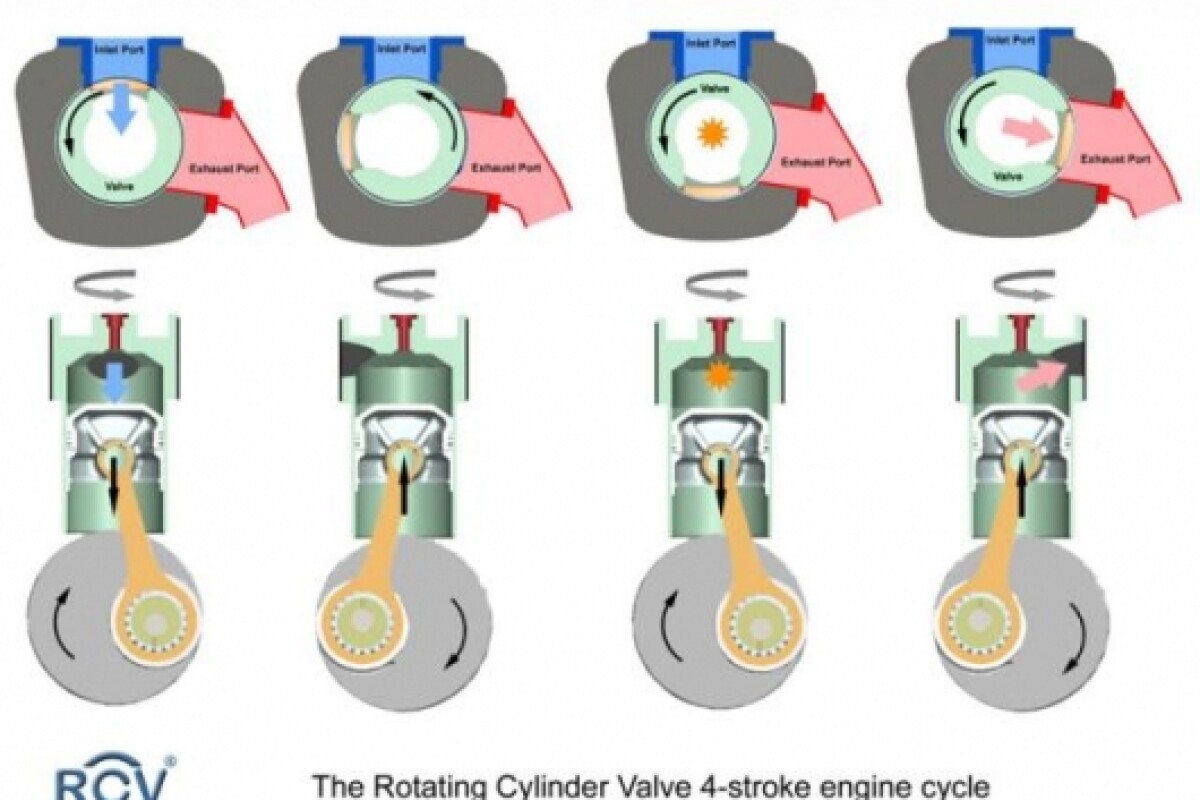
The ability of a reciprocating internal combustion engine to empty and fill its cylinder efficiently is fundamental to its successful operation. The RCV engine shares the same induction, compression, power and exhaust strokes as found in a conventional four-stroke engine, but its principal difference lies in the manner in which intake air and exhaust gases are respectively induced into and expelled from the cylinder. In a conventional engine gasses enter and leave the cylinder via poppet valves in the cylinder head which are operated via a mechanical valve train. While most of the major components of an RCV engine are identical to those of a conventional four stroke, the principal difference lies in the cylinder. This is mounted on bearings and rotates at exactly half of the crankshaft rotational speed and is driven from the crankshaft either via a gear train or toothed belt drive system similar to those used on other automotive engines. A single large cross-sectional area port and combustion chamber is combined within the cylinder, the entrance to which forms the rotating cylindrical valve together with the openings of the external intake and exhaust ports.
While the large valve area offered by this configuration is similar to that of the high performance sleeve-valve aircraft engines of previous decades, RCV technology overcomes the durability and cost limitations of its forerunners and offers a simple to manufacture, high performance and low emissions alternative to the conventional two- and four-stroke engine.
RCV Engines Ltd is actively pursuing development programmes with a number of clients, aiming to bring the advantages of its rotating cylinder valve engine technology to a wide range of consumer products powered by small internal combustion engines. The company’s strategy is in particular focused on the development of products of up to 250cc capacity in two market sectors: small motorcycles and scooters, and ‘forest and garden’ power tools such as chain saws and strimmers.
Despite the comparatively small size and low cost of individual products, the market for handheld forest and garden products is significant due to its sheer scale. In the United States alone, over 1.5 million leaf blowers, nearly three million chainsaws and six million strimmers/brushcutters were sold in 2004. In this growing and highly cost-driven market, roughly two thirds of deliveries are represented by consumer products and the balance, by heavy-duty equipment for the commercial market.
Until the 1990s forest and garden products were unregulated in terms of exhaust emissions but since this time, progressively tighter levels of regulation have been enforced by both the California Air Resources Board and the US Environmental Protection Agency. Small, piston-ported two strokes were formerly the power unit of choice for this industry. These offered advantages of high power to weight ratio, reliability and crucially for a cost-driven market, simple and low cost manufacture. Unfortunately they also tend to have the limitation of comparatively high fuel consumption and poor hydrocarbon and CO2 emissions.
RCV technology provides an ideal solution for hand-held equipment manufacturers aiming to replace two stroke units. It provides the inherent emissions advantages (both regulated and CO2) of a four stroke but offers a robustness, reliability and high power to weight ratio in a highly revving engine with a package size more typical of a two-stroke engine; all crucial advantages for hand-held equipment. Moreover it offers the potential for low-cost manufacture which is particularly attractive in this highly competitive and price-sensitive market.
Premium performance at low manufacturing cost
The RCV engine concept has been shown to offer the potential for both high performance and fuel economy, as well as for low emissions. While these are attractive attributes for prospective customers of products powered by RCV engines, it is important for manufacturers that these benefits can be delivered in a cost-effective manner. The results of a detailed study carried out by RCV Engines Ltd based upon manufacturing data provided by MPI, show that the projected performance/manufacturing cost trade-off of an RCV engine is significantly better than that of a range of existing successful products (see chart below). Based on this analysis there is a clear, near-linear relationship between performance and manufacturing cost for the existing production engines. However, the projected performance/cost trade-off of a similarly sized RCV engine is significantly better than this trend. The analysis shows that it is of similar manufacturing cost to that of a conventional single overhead camshaft, two-valve per cylinder air-cooled engine. Crucially however, the RCV engine delivers more than 20% additional specific power. Products powered by RCV engines are thus likely to have market appeal with the ability to deliver premium power compared to competitor engines of similar capacity and production cost.
RCV offers better volumetric efficiency
The RCV engine concept has a number of inherent advantages compared with a conventional two- or four-valve per cylinder four-stroke engine. Firstly in terms of combustion, an RCV engine’s configuration enables a much larger port cross-sectional area than is practicable in a poppet valve engine, which has the effect of significantly improving its volumetric efficiency. The design of the port and combustion chamber – including the large squish area at the piston crown – also generates a very high level of intake air turbulence which is conducive to efficient combustion. These advantages provide significant improvements in performance across the speed range; in effect combining the positive attributes typically associated with two-valve per cylinder four-stroke combustion at low engine speed, with those of a four valve per cylinder design at high speed.
Secondly the rotating cylinder valve and its seal, which rotate at half crankshaft speed, are extremely dynamically stable. With adverse valve train dynamics typically the limiting factor for the maximum operating speed of conventional poppet valve four-stroke engines, RCV technology enables reliable and durable operation at much higher speeds than might be the case for an equivalently sized conventional engine. The combined effect of these advantages enables RCV engines to consistently deliver performance in excess of 100PS/litre (75kW/litre).
The stable and efficient combustion system of an RCV engine, combined with the elimination of losses normally associated with operation of the valve train, provides the potential for improved fuel consumption in addition to superior performance. Naturally, the balance of these benefits in a given product will be optimised in accordance with each manufacturer’s marketing strategy. Some for example may use the advantages of RCV technology to enable aggressive down-sizing in order to deliver equivalent power and performance from a smaller capacity and more fuel efficient engine. Others however, may favour its use to deliver premium performance characteristics over and above those of existing products. For motorcycles and scooters in particular, such ‘fun to drive’ characteristics may be considered advantageous in attracting customers within a highly competitive consumer-driven market.
Reduced emissions
The stability and efficiency of the combustion system also lends itself to naturally low engine-out emissions. These benefits are likely to be greatest when an RCV four-stroke is used in substitution for a piston ported two-stroke engine, given the latter’s much higher hydrocarbon and CO2 emissions. The physically compact and high revving nature of RCV technology offers the emissions performance of a well engineered four stroke while retaining some of the practical advantages typical of a small two stroke. As such RCV technology is an ideal four-stroke choice for the substitution of crankcase scavenged two strokes for applications such as scooters and hand held forest and garden equipment.
Cylinder drive system
While the RCV engine does not require a valve train, a gear or toothed belt drive system is needed in order to rotate the cylinder and cylinder valve at exactly half crankshaft rotational speed. In the 125cc RCV engine developed for MPI, the cylinder is driven via an advanced face gear drive similar to those found in many helicopter and machine tool applications. The system uses a three dimensional gear tooth profile which enables the drive to be transferred through a 90 degree contact with the cylinder. With the ability to include a counter-balance weight within the idler gear, this arrangement offers exceptionally high standards of vibrational refinement, facilitating improved handling and driver comfort in scooter and ATV applications. With the use of sintered gear blanks, it also offers a considerable production cost advantage over alternatives such as bevel gear drives. Additionally, the face gear drive affords much greater tolerance to the high levels of component thermal expansion typically found with engine components.
Valve sealing – a fundamental challenge solved
While many previous sleeve and rotary valve engines delivered benefits in terms of breathing and performance, a common and fundamental problem was that of effective valve sealing. Typically, close tolerances were relied upon in order to achieve sealing during engine operation. Such engines were hence both relatively expensive to manufacture and required lengthy and controlled engine warm-up procedures to avoid seizure. With thermal expansion of the cylinder and reciprocating components typically two orders of magnitude greater than the tolerances required for sealing, the need for an effective, robust and low cost means of valve sealing was a fundamental challenge which prevented more widespread and practical application of such engines.
With its patented technology RCV Engines Ltd has solved this challenge through a highly innovative and yet fundamentally very simple cylinder valve sealing system which employs essentially the same basic principles as used in piston rings:
- In order to accommodate the thermal expansions typical of engine operation, the valve has an ‘active’ sprung sealing mechanism, referred to by RCV Engines Ltd as a ‘sliding seal’.
This is augmented by a ‘static seal’ which closes the gas path around the back of the sliding seal.
The sealing mechanism is designed such that combustion pressure augments and hence reinforces the seal.
In addition to the above, a means is required to maintain intake air pressure stability and prevent the entrainment of lubricating oil within the inlet and exhaust gasses:
A secondary inlet and exhaust port sealing element it provided to act as a gas seal while the ports are closed.
Like a conventional piston ring pack, the RCV cylinder valve sealing system is as simple in its design as it is effective in its operation. The seal mechanism contains just four, low cost components which together enable the performance and emissions benefits of an RCV engine to be delivered in a practical to manufacture, robust and cost-effective design.
Application of advanced design technology
The impressive performance, engine-out emissions and fuel consumption figures achieved by RCV technology is due in no small part to the advanced CAD and CAE methods applied in the design of each new engine. At the company’s well equipped R&D centre, engine design engineers and analysis experts have access to some of the very latest CAD systems and simulation technologies, as used by the world’s leading automakers in the development of their own state-of-the-art products. Engine designs are typically developed fully in 3D CAD. Performance and emissions are assessed and refined and optimised using Ricardo Software’s WAVE package, which combines simulation of gas dynamics and combustion with the prediction of engine mechanical performance, exhaust emissions and fuel consumption. The complex and critical 3D shape of the port of the rotating cylinder is fine-tuned using the STAR-CD computational fluid dynamics package in order to improve flow dynamics for gas exchange and combustion. Finally, finite element methods are used by engineers to understand the thermal characteristics of the engine and hence develop effective cooling strategies to improve performance, durability and robustness. The combination of these advanced design technologies enables RCV Engines Ltd to resolve issues and achieve a high level of design optimisation well before prototypes are manufactured.
Future developments
In its current form RCV technology already holds the prospect of delivering significant benefits for both manufacturers and end users across a wide range of engine applications. In addition to gasoline, RCV engines have been demonstrated to run well on alternative fuels such as kerosene and it is anticipated that they will be equally tolerant to bio-fuels. Despite this competitive and versatile performance, RCV Engines Ltd believes there remains significant further potential for this engine concept. The company is already researching the potential for variable valve timing, variable compression ratio and supercharged RCV variants which are aimed at taking its already impressive performance to new levels.
Licensing
Companies interested in licensing RCV engine technology should contact Brian Mason