


January 17, 2005 It's the world's most dangerous legally-sanctioned sporting event. Every time the event is run, on average, two competitors and an unknown number of spectators die. With an entourage the size of a small city, the Dakar Rally streaks for 16 days and 9000 kilometres across several countries and time zones at frightening speeds. One of the most significant events in the history of motorsport, it has direct lineage to the first auto race and all the famous city-to-city races which were banned between 50 and 100 years ago due to the carnage. So why is it still running?
The World's Most Dangerous Sport?
Several sports lay claim to being the most dangerous in the world. Rugby recently topped a newspaper opinion poll ahead of boxing, Formula One and hurling.
American bull riding is sold to the public on the basis of being the most dangerous sport in the world with five times more injuries than American football, six times more than wrestling, and 13 times more than ice hockey.
But fatalities are rare. There are sports where competitors have a much higher probability of death. Sports like BASE Jumping, Free Diving, Cave Diving, Speed Skiing and Street Luging have fatalities, but participation is not that widespread and rock fishing claims more lives than all of them.
The Most Dangerous Sporting Events
Averaging deaths across the participation of a sport is one way of looking at how dangerous a sport is, but history has shown there are sometimes single sporting events with an extraordinary competitor mortality rate. In recent times, the most prominent have been when Mother Nature unleashes her fury on a fleet of yachts. In Australia it happened in 1998 during the running of one of yachting's historical icons, the Sydney-Hobart yacht race. As the weather descended, an even larger number of rescue workers had to face the storm to save the fleet in what became Australia's largest ever maritime rescue. Considering the conditions, it's a miracle more lives were not lost. Six boats sank or had to be abandoned, over 50 sailors were pulled from the sea by helicopters, and 70 of the 115 boats that started did not see the finish. The final death toll was six though there had only been two prior deaths in the entire 54 race history of the event. The public enquiries that followed ensured the race became much safer as a result.
Public enquiries always follow such disasters, particularly when the cost of the rescue was being born by the public and it was the opinion of many that rescue workers' lives were being needlessly put at risk by the running of the event. Similar massive scrutiny followed such a tragedy in the United Kingdom when the 1979 Fastnet yacht race was hit by severe weather and 17 died. The event is now, like the Sydney-to-Hobart, a model of safety.
Motor Racing
The sport with the most consistent record for producing fatalities over the last century is motor racing and unlike almost all other sporting contests, motor racing has also taken a substantial toll on spectators. It too came under tremendous scrutiny when a car ploughed into the spectator area at the 1955 Le Mans 24 hour race killing 80 people. The sport survived, prospered and Formula One is now the most watched spectator sport on the planet, thanks to the reach of television. Each time the sport has suffered deaths, it has responded appropriately by making things safer.
The world's most dangerous sporting event
The Dakar Rally though, seems different. We've scoured the statistics, and in terms of fatalities per event, we can't find any modern sporting event that remotely approaches the Dakar Rally for killing people. We're happy to entertain correspondence from interested lobby groups (we have received NO correspondence from anyone wishing to challenge this claim since this story was poosted in January 2005), but the Dakar Rally statistically appears to be the most dangerous legally sanctioned sporting event in the world.
On average, there has been more than one death each time the event has been run - the exact number of deaths is difficult to pinpoint because in addition to the competitors, there have been an indeterminate number of spectator deaths.
Reports vary wildly but we put the number at 48 competitor deaths in the race's 28-year history and many more spectator deaths.
This year, the Gods did not smile on the event. Another three died, being two contestants and one spectator, a small child who escaped from her mother's arms and ran across the road in front of one of the hundreds of support crew trucks.
Detractors of the race say the cost of the race in human terms has long been prohibitive, and it is time to stop the carnage. Simply running the event ensures that more lives will be lost. Without doubt the Dakar Rally will be the last of the great city-to-city races of motorsport history. One of the most ambitious motorsport events of history, the course usually runs in the vicinity of 10,000 kilometres.
Organising the event must have been a nightmare. The magnitude of this race with its support crews and infrastructure rivals that of the Formula One circus, except it moves in real time across countries and time zones at a frightening speed and does so for two weeks each time.
The original route from Paris to Dakar was soon under pressures not previously imagined. Deaths on French roads created pressures in Europe and the political instabilities of the North African region eventually forced regular modifications to the route - early rallies passed through Algeria, but local wars popped up and had to be skirted several times. Competitors have regularly been fired upon with guns. Landmines regularly claim competitors. Terrorists planning to attack riders in the event were arrested in December, 2004.
With so many factors to consider in its immense organization, the start was eventually moved from Paris to Arras, then to Spain, and five years ago the route started in Dakar and finished in Cairo. As time has gone on, more and more transport stages (not competitive, not scored) were introduced to reduce the risks to the public but the body count continued on average this year.
This year the route was significantly reworked from its glory days racing format, though it still covered 8956 km over 16 days, with around half of it competitive racing.
The Dakar Rally began in 1978 when like all those great motor races at the beginning of motorsport history, it began in Paris, though this time it travelled all the way to Dakar in Senegal. It was a true city-to-city race in the mould of those historic turn-of-the-century events. Pitched as unquestionably the world's toughest motorsport event, it captured the imagination of the booming off-road vehicle marketplace of the seventies and prospered.
The Paris-Dakar rally soon became massive. It gathered more than its share of controversy but also grabbed the global media focus and the patronage of all serious off-road 4x4s, motorcycles and even truck manufacturers.
A win in the Paris-Dakar rally is worth lots of sales - the product has been proven under the most extreme conditions. BMW has many fine trophies yet it treasures its Paris-Dakar wins more than most. Mitsubishi's tenth win in the open section this year will forever represent the company's core values.
KTM is an Austrian off-road motorcycle manufacturer that builds premium off-road performance machinery. There is no better place to prove just how premium your product is than the Dakar - nine of the first 10 bikes at the end of the rally were KTM, including all spots on the victory dias.
Akira Kijima, Managing Director Head of Product Operations for Mitsubishi Motors and responsible for motor sport activities, said after the 2005 event: "Mitsubishi Motors' involvement in motor sport is not merely a promotional activity, but is really at the heart of the Mitsubishi Motors brand. We strive to take our cars to the limits of performance by competing in such events as the Dakar and the World Rally Championship (WRC) and feed the technology and know-how acquired directly back into all of our production cars. This ensures that our production vehicles not only have improved durability and safety, but also good road performance and driving capability.
"Mitsubishi cars have long been known for their sturdiness, endurance and robustness and it is these qualities that are derived from our motor sport participation. We intend to strengthen motor sport activities and, in so doing, raise the value of the Mitsubishi Motors brand."
The Russian off-road truck manufacturer Kamaz races its trucks in the event every year at a crippling cost because its wins embody the company's commercial products. Kamaz is located in the very heart of former USSR, where the Kama and Volga rivers merge. The brand's tag-line is "no roads, no problem."The Dakar Rally has given the company a global profile. If you had a critical overland haulage job, what would you use?
Volkswagen was proud of its third place - quite a feather in the cap of the premium off-road Toureg.
Yet KTM recognises that its fifth victory in the event is quite possibly its last.
One of those who died this year was KTM favourite son Fabrizio Meoni, who gave the company its first Dakar win in 2001.
After the event, KTM issued a statement via marketing director Winfried Kerschhagg. "At the moment the sporting success is totally pushed in the background. We are thinking about the future right now. If we cannot find some common ground about the safety, we will have to think about our engagement in the future. The motorcycles have not become that much faster over the previous few years. But the density of great riders has definitely increased. We would like the rally to become more sporting again and this means more navigation."
As bulletproof, mission-critical tough as Kamaz, Mitsubishi and KTM machinery has proven to be, the competitors are moreso. What the competitor endures
This is the toughest event imaginable and to be a leading competitor is an exacting task. For starters, to run at the pace required to be at the front in the desert, you need to take massive risks, for hours on end, in blinding heat.
Driving or riding in these conditions is incredibly physical and demanding - most stages last much longer than a marathon and the driver is exerting far more energy than a marathon runner. They do that back-to-back, for 16 days.
And the fatigue that we see reduce marathon runners to pitiful shuffling wrecks is being played out at race speeds. Herculean feats of endurance in horrifically hot (though sometimes freezing) conditions, averaging 160 kmh plus speeds for hours at a time in unknown territory. It sounds like a fictitious blood sport from a science fiction novel but it's true.
This year's winner is without doubt the current master of the sport. Peterhansel has won twice in a car, but prior to that, he won the event six times on a motorcycle - eight titles from 18 starts makes him clearly the most successful competitor in the event. Hubert Auriol also won both car and motorcycle classes but noit as many titles. Spaniard Joan Roma who finished sixth in the cars this year won the motorcycle event last year. Though the technique of driving a rally car and a motorcycle are very different, there is clearly a common element.
All of the 465 contestants in this year's event knew there was less than a 50% chance they would finish the dangerous event. The high attrition rate is mainly due to injury or exhaustion. There are no unrepairable machine failures in a 16-day event if you really want to fix something.
KTM, Mitsubishi or Kamaz have enough hardware and expertise in their support crews travelling with them to be able to fix any conceivable problem very expediently.
The attrition rate varies from 45% to 65% and though the retirements may go down on a sheet somewhere as being mechanical, the failure is almost always due to injury or exhaustion of the rider.
The odds when the field left Barcelona on New Years Day said that one maybe two of them would not be alive by the time the trucks rumbled into Dakar.
The main cause of competitor death is high-speed crashes, but there are a host of other things that can catch you out in this 10,000-kilometre race.
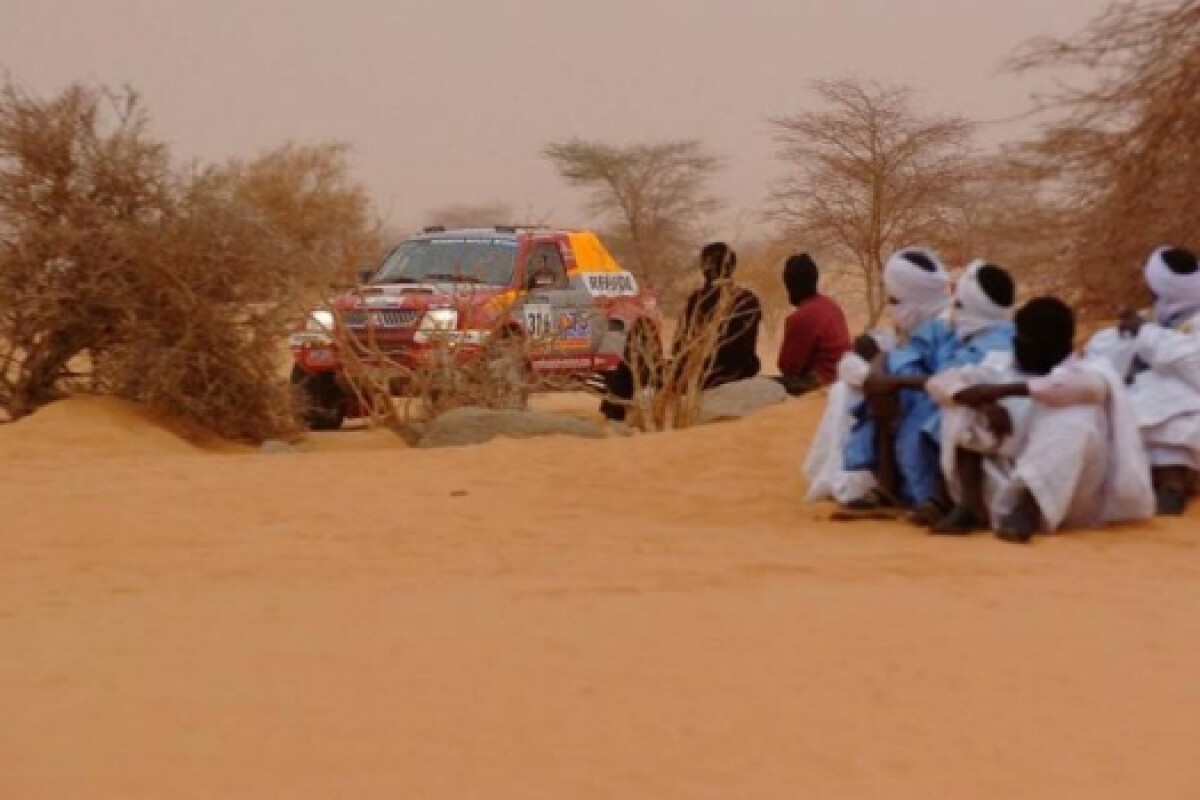
EXTREME WEATHERThe race experiences extreme heat much of the time, though it has been run through extremes of cold too. Sandstorms are a common problem for competitors and support crews.
LOCAL WARS On many occasions competitors have been fired upon by bandits, rebel factions, disoriented soldiers fighting in local wars and simply persons unknown.
LANDMINESLandmines have also taken a toll. In 1996 a vehicle hit an explosive device in Morocco killing the driver and injuring several others. In 2001, a Portuguese driver had his car blown to pieces and his right foot blown off.
GETTING LOSTDame Margaret Thatcher's son Mark was one of many people who have been lost during the running of the event.
TERRORISTSA few years ago, radical Islamic group Mokhtar Benmokhtar, a group with strong ties to al-Qaeda, threatened to attack participants in the rally. In December 2004, authorities in Mauritania (host of six stages of the 2005 rally) arrested a man with links to al Qaeda who was planning to attack Americans taking part in the 2005 Dakar Rally. The U.S. Embassy subsequently issued a bulletin to all Americans involved in the rally suggesting "special caution" and advised against the display of any American flags or symbols on their vehicles.
DESOLATIONGiven a vast desert and 400 competitors, it's very easy to crash and not be found for some time. Last year three-time Dakar Rally winner Richard Sainct died during the Rally of the Pharaohs in Egypt. There were no witnesses to the accident and riders who arrived on the scene some time after alerted organisers.
Historical precedents
The massive irony is that we many almost identical historical precedents, the first time almost exactly 100 years ago.
In the beginning, France dominated the automotive industry.
Paris was the start and finish of the first motor race in history - Paris to Bordeaux and return. All the major races of the early years were from one major city to another, and Paris was usually one of them. Paris-Rouen was next and other famous city-to-city races followed.
The Automobile Club of France was founded in 1895 to become the governing body of motor racing.
The Club held major inter-town races each year, including the first international race, from Paris to Amsterdam and back in 1898, Paris - Berlin in 1901, Paris - Vienna in 1902, and the granddaddy of them all, the Paris - Madrid of 1903.
The Automobile Club of France also held the first closed-circuit race meeting in 1900 and the first Grand Prix in 1906. This was the beginning of organised motorsport competition and these events have direct lineage all the way to Formula One and the Fédération Internationale de Sport Automobile (FIA).
But in the early years, safety was not one of the primary concerns. The safety measures were close to non-existent and the situation was compounded by the rapid evolution of the motorcar.
In 1894 Levassor's Daimler-engined Peugeot had averaged 24 kmh to win the first race. As competition improved the breed, the performance of the cars rapidly progressed.
By 1900, the faster cars could top 100 kmh, and average speeds had more than doubled. The engineering and metallurgical knowledge of the day meant that the exponentially mounting speeds were creating problems as the forces multiplied on every component. Suspension and steering breakages were common, with the deadliest apparently being projectile wheels hurtling onwards after an accident.
Crowds gathered where the action was, on the corners. There were no safety fences.
Not all of the cars had brakes on all four wheels, yet the cars quickly got bigger and heavier and as there was no engine capacity limit, massive engines of 15 plus litres regularly started these events.
Speeds quadrupled in less than a decade
By 1903, average speeds for these races had quadrupled in less than a decade to more than 100kmh.
The inevitable happened and the Paris-Madrid event became the most notorious motor race in history and spelled the end of racing on public roads in France.
The event was stopped at the end of the first stage, just 550 kilometres into the 1000 kilometre event because of a mounting death toll.
In all, two drivers, one mechanic (mechanics rode in the vehicle in those days) and five spectators had died by the half way point and both Spanish and French authorities concurred and the event was stopped.
The two leading drivers (one being Louis Renault, founder of the Renault empire) ran at such a fearful pace, they averaged over 105 kmh for the distance to Bordeaux, indicating they were capable of much higher top speeds.
Four wheel brakes was the latest fad at the time. Think about that - very large, heavy cars travelling at probably 120kmh WITHOUT brakes on all four wheels. With brakes just on the front wheels of many of these vehicles, retardation under brakes would have been mild at best, and would have resulted in a stopping distance similar to an oil tanker. Yet they raced on public roads without safety fences, or track marshals or corner stewards.
Eight deaths proved the vehicles had become too fast for the environment and a massive outcry from a rightfully indignant public resulted in a ban on racing on public roads in France. The first of several bans as automotive industry forces rallied to save their sport.
Every time in history it has ended exactly the same way. The Targa Florio and Mille Miglia both withstood several attempts to close them down before succumbing to public pressure.
It didn't help though that Stirling Moss averaged 97.96 mph in the 1955 Mille Miglia, the same year a car ploughed into the crowd at Le Mans. Just two years later the Marchese de Portago was killed during the Mille Miglia and the event was stopped.
Perhaps it's time to move on.
Motor racing is one of man's great love affairs.
But it's not okay to keep killing people.