


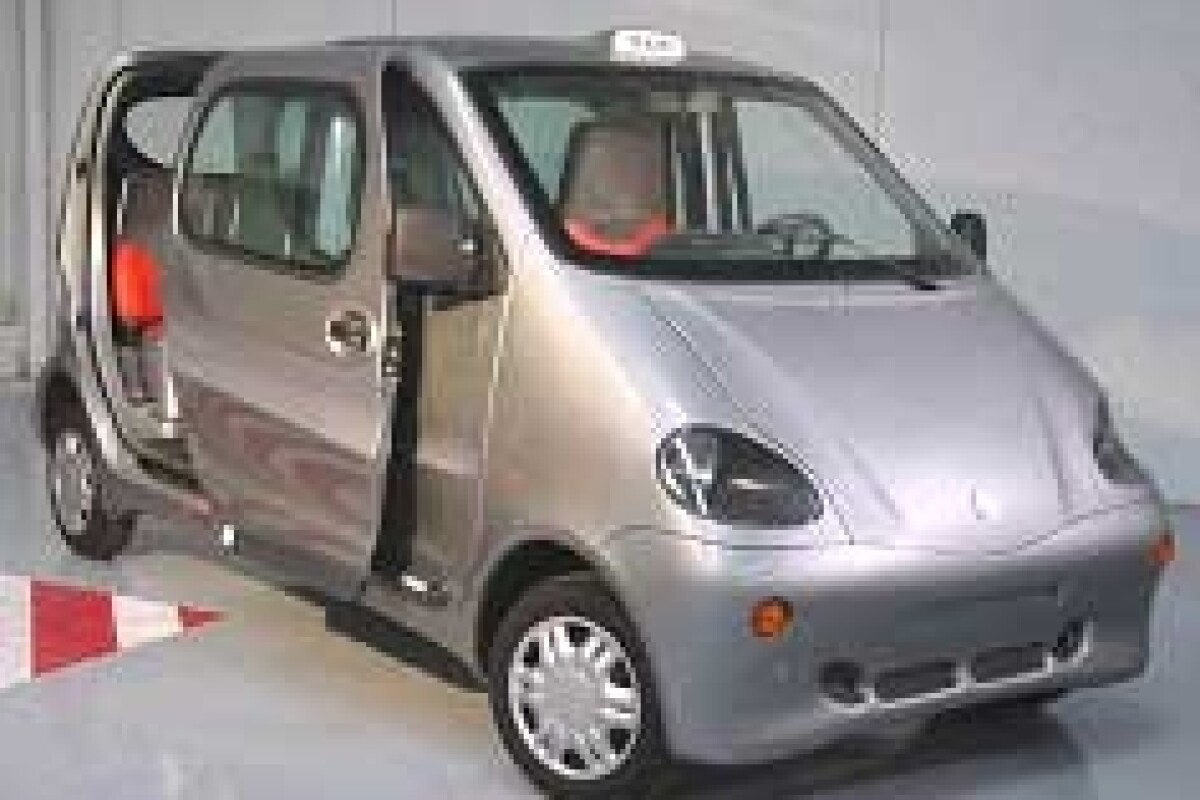



December 2, 2004 French engineers have designed a low consumption and low pollution engine for urban motoring that runs on compressed air technology. The CATS (Compressed Air Technology System) "air car" from Motor Development International is a significant step for zero-emission transport, delivering a compressed air-driven vehicle that is safe, quiet, has a top speed of 110 km/h and a range of 200 km. Costing next to nothing to run, the Zero Emission Vehicle (ZEV) range - which includes a pick-up truck and van - is set for release in early 2005.
Cyril Nègre is the head of Research and Development at Moteur Developement International (MDI) cars, where the Zero Emission Vehicle (ZEV) prototype has been in production since 1994. The two-stroke engine is powered by compressed air stored in tanks at about 150 times the pressure of tyres on a car. The expansion of the compressed air drives the pistons to create movement, replacing the burning of fossil fuel in a conventional engine. In an air-refilling station (currently unavailable as service stations have not been fitted yet) it is estimated to take between three and four minutes to re-fuel. At home, with a 220V plug, it takes three and a half hours.
Nègre estimates a full tank of air will cost around 1.50 euros to fill and that the extra reward is knowing that you are pumping nothing harmful into the atmosphere. The hidden environmental cost with the CATS is that electricity must still be generated and the means of that production may still employ fossil fuels that discharge pollutants. Still, the savings to the pocket and environment appear well worth investigating. Four models are available for the commercial market - the MiniCAT car at approximately €6 860 euros, or the CitiCATs, including a taxi (with room for up to 5 passengers), a Pick-Up truck and a van, all retailing for approximately €9,460 euros plus taxes.
Air powered engine
This engine uses an innovative system to control the movement of the 2nd generation pistons and one single crankshaft. The pistons work in two stages: one motor stage and one intermediate stage of compression/expansion. The engine has 4 two-stage pistons, i.e. 8 compression and/or expansion chambers. They have two functions: to compress ambient air and refill the storage tanks; and to make successive expansions (reheating air with ambient thermal energy) thereby approaching isothermic expansion. Its steering-wheel is equipped with a 5kW electric moto-alternator. This motor is simultaneously:
• the motor to compress air• the starting motor• the alternator for recharging the battery• an electric moderator/brake• a temporary power supply (e.g. for parking)
No clutch is necessary. The engine is idle when the car is stationary and the vehicle is started by the magnetic plate, which re-engages the compressed air. Parking manoeuvres are powered by the electric motor. The CAT´s 34 P04 engine is equipped with patented variable-volume butts and a dynamic variable-volume volumetric reducer.
The dual energy system
The Series 34 CAT´s engines can be equipped with and run on dual energies - fossil fuels and compressed air - and incorporate a reheating mechanism (a continuous combustion system, easily controlled to minimise pollution) between the storage tank and the engine. This mechanism allows the engine to run exclusively on fossil fuel, which permits compatible autonomy on the road. While the car is running on fossil fuel, the compressor refills the compressed air tanks. The control system maintains a zero-pollution emission in the city at speeds up to 60 km/h. The MDI con-rod system allows the piston to be held at Top Dead Centre for 70º of the cycle.This way, enough time is given to create the pressure in the cylinder. The torque is also better so the force exerted on the crankshaft is less substantial than in a classic system.
Gear changes are automatic, powered by an electronic system developed by MDI. A computer which controls the speed of the car is effectively continuously changing gears . The latest of many previous versions, this gearbox achieves the objective of seamless changes and mimimal energy consumption.
Safety Concerns
Air powered vehicles have a long history of use in Europe but were discontinued for safety and efficiency reasons. The CATS air cars have undergone stringent safety testing for modern conditions and requirements and appear to have conquered the concerns of air compression engines.
The CATS air tanks store 90m3 of air at 300 bars of pressure (four tanks have a capacity of 90 litres, and they store 90m3 of air at a pressure of 300 bars), just like tanks already used to carry liquefied gases on some urban buses. That means that the tanks are prepared and certified to carry an explosive product: methane gas.
In the case of an accident with air tank breakage, there would be no explosion or shattering because the tanks are not metallic but made of glass fibre. The tanks would crack longitudinally, and the air would escape, causing a strong buzzing sound with no dangerous factor. It is clear that if this technology has been tested and prepared to carry an inflammable and explosive gas, it can also be used to carry air.
In order to avoid the so-called 'rocket effect', this means to avoid the air escaping through one of the tank's extremities causing a pressure leak that could move the car, MDI made a small but important change in the design. Where the valve on the buses' tanks are placed on one of the extremities, MDI has placed the valve in the middle of the tank reducing the 'rocket effect' to a minimum.
Availability
The CATS air cars are at the final approval stage and advance orders are being taken with a release date towards the end of 2004/early 2005.


