



January 19, 2004 Helper, security and companion robots will be commonplace a decade from now. There are already more than 100 robotic commercialisation projects in the global public arena, and a dozen commercially available robots in the Japanese domestic market. In the next two to three years, that number will grow considerably, with research companies forecasting the home robotics market may one day be equal in size to the automotive market.
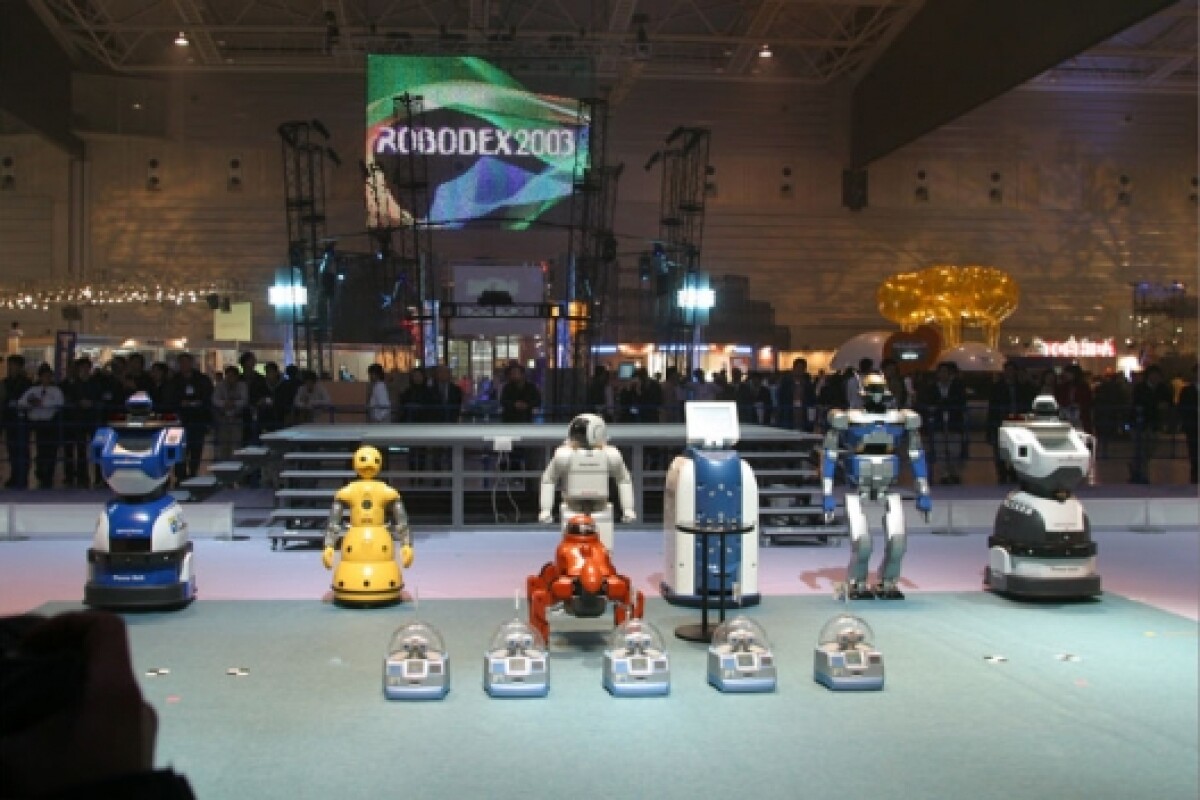
The robots on this page are some of the 100 robots demonstrated at the 2003 Robodex conference in Japan.They represent the current state-of-the-art for domestic helper and security robots and from left to right they are: the SOK C4 GuardRobo (on each end of row), Mitsubishi’s Wakamaru, Honda’s Asimo, tsmuk’s Banyru Guard Dragon (in front of Asimo), Matsushita’s HOSPI Hospital delivery robot, Kawada’s HRP2 and five Fujitsu MARONs.
The event which is the mecca for the rapidly evolving consumer robotics industry, saw robots demonstrate their value in performing simple manual labour, delivery and security duties, helper and companionship roles, with some even capable of conversation, recognising their owner, receptionist duties and language translation.
The most compelling commercially-viable area for consumer robotics in the short term appears to be that of security, where a robot can patrol the home in the owners absence, with smoke and motion detectors, and send video directly to the owner’s 3G mobile phone in the event of detecting intruders or fire. The word “robot” is relatively new – it was first used in 1920 by Czech playwright Karel Capek and comes from the Czech “robota”, which means “tedious labor”, though the concept of artificial lifeform was popularised in 1822 when Mary Shelley published the landmark novel “Frankenstein.”
Not just another writer, Isaac Asimov, layed down the ideas and principles in 1941, giving us the term robotics and the three (subsequently four) basic laws of robotics in 1942, at the same time forecasting the massive ubiquitous robotics industry about to unfold in the next decade, some 60 years ago.
One hundred years hence, by 2040, analysts predict that most households will own a robot, or at least be considering one. Robotics is already a US$8 billion industry globally, comprised mainly of industrial robots for welding, painting and assembly line tasks.
The consumer robotics marketplace is just emerging, with a gross of US$600 million in 2002, comprised mainly of programmable robots which mow lawns, clean floors and amuse children. The next level of robotics will be even more compelling and much more affordable.
Korean robotics start-up Mostitech recently rocked the fledgling personal robotics industry by announcing the mid-2004 availability of a home security robot that will sell for around AUD$1,100.
The as-yet unnamed robot is battery-operated and patrols the owners home, monitoring for intruders, fire and smoke and alerting the owner by sending digital images to their cell phone should it encounter anything amiss - the same functionality offered elsewhere.
Japan intends to own the consumer robotics industry and prices for robots with similar functionality are available in its domestic market for AUD$15,000+
Motitech’s robot appears to have identical functionality, at 10% of the price, indicating that competition will be very fierce in this industry.
The 50cm tall robot security guard can be controlled from a mobile phone and the home can be monitored in real time. Face-recognition will be added to the 12 kilogram robots impressive repertoire before it lands.
Gizmo has covered a number of robotic security guards including Banyru, Artemis,GuardRobo and Sanyo’s Robot Guard Dog.
Momentum is expected to build rapidly from this year forward, with the reasonable expectations that computer processing power will continue to become exponentially cheaper (Moore’s Law article 1417), and the economies of mass production and global competition will see a price-performance curve which might be even steeper than that of the PC, the digital camera and the mobile phone.
Useful semi-autonomous home robots will soon become available for early adopters with deep pockets and the mass market is expected to follow soon after.
Within a decade, affordable home robots will be playing a role encompassing some, maybe all, of the duties of a housekeeper, personal assistant, security guard, gardener and attentive, ever-serving companion.
If one ambitious project meets fruition, that goal might be achieved before the year is out.
Valerie is a domestic android. Valerie will clean your house, change light bulbs, wash the dishes, do the laundry, check the sports scores for you, book plane tickets and call the police in an emergency, even if she does look like hell without her make-up. She speaks English but more importantly, understands English and can hence be programmed by non-programmers.
Valerie will go on sale this year at US$59,000.
Most of the world’s robotics activity and hence expertise, is concentrated in one spot (Japan) but work is being done in all countries and the era of the useful, affordable household robot is almost upon us.
According to projections from UNEC the personal robotics industry will have grown to US$5.4 billion by 2005 and to US$17.1 billion by 2010 – spectacular growth indeed, but humble by comparison to the following decade. A quarter century from now, the robotics industry is expected to rival the automobile and computer industries in both dollars and jobs.
The next generation of robots will interact with humans on an extremely sophisticated level, making decisions, helping, caring and giving companionship.
Just how sophisticated?
NEC recently announced the availability of a PDA-based, speech-to-speech Travel Interpreter which enables a traveller speaking only English to converse with someone who speaks only Japanese. Incorporating speech recognition, conversation-based speech translation and speech synthesis technology, this unit has gone a long way towards eliminating the language barrier which exists between massive groups of the world population. It is available from Narita Airport now! It will also be available in Papero, NEC’s companion robot.
It’s all just beginning, and it will be a fascinating study.
The Three Basic Laws of Robotics
Isaac Asimov defined the “Three Laws of Robotics” in “Runaround”
He added a fourth law at a later date.
LAW 0: A robot may not injure humanity or, through inaction, allow humanity to come to harm (added later).
LAW 1: A robot may not injure a human being, or, through inaction, allow a human being to come to harm.
LAW 2: A robot must obey the orders given it by human beings except where such orders would conflict with the First Law.
LAW 3: A robot must protect its own existence as long as such protection does not conflict with the First or Second Law.