


UPDATED Nov 19, 2004 The Unmanned Aerial Vehicle (UAV), is a term you'll hear a lot more about over the coming years. In the past it has mainly been mentioned whenever a technologically advanced country (aka the USA) is involved in warfare. The biggest advantage of a UAV is that it can be put 'in harm's way' - it can be put in a dangerous situation where the odds of losing a pilot (the most valuable part of any aircraft) are simply too great. Now Yamaha has unveiled a range of Unmanned Ground, Marine and Air Vehicles that bring autonomous capability to the world around us.
As technology has advanced rapidly in recent decades, the cost of UAVs has fallen rapidly, and now corporations and universities all over the globe are working on various types of UAVs to perform tasks which were previously too expensive, in financial or human terms, to be considered.
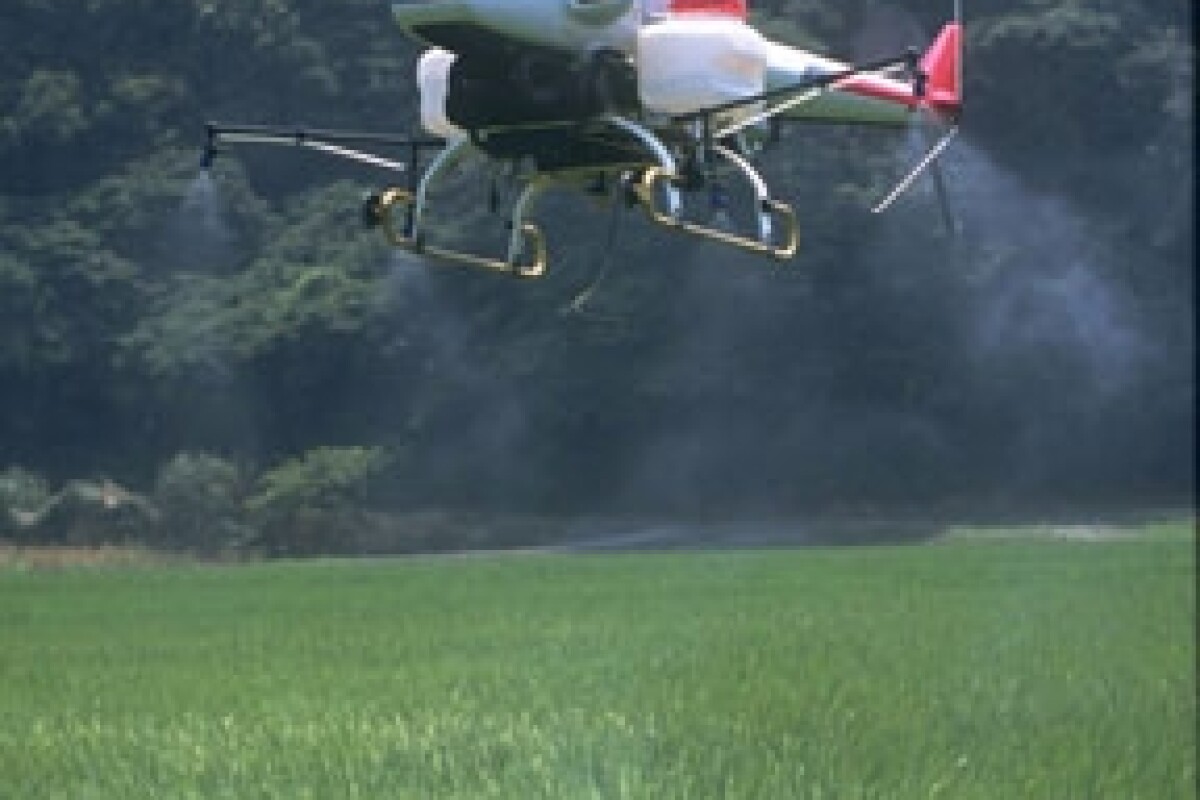
Filming a volcanic eruption from close quarters, for example, is something people have simply not been able to do before now. The Yamaha RMAX helicopter is the most advanced commercially available UAV in the world right now.
Long known for its musical instruments and motorcycles, Yamaha's unlikely direction for diversification was the result of yet another Japanese Government initiative, which supported the development of high technology to solve practical everyday problems.
Yamaha's development of utility-use unmanned helicopters began with a request in 1983 from the external branch of the Japanese Ministry of Agriculture, Forestry and Fisheries, which was also in charge of agricultural aviation. They wanted an unmanned helicopter for crop dusting that could help reduce labour and costs in Japan's labour-strapped rice farming industry.
After extensive research and development efforts, Yamaha completed its first utility-use unmanned helicopter, the 'R-50' in 1987. It was the world's first unmanned helicopter for crop dusting with a 20 kg payload. Adoption at agricultural schools around the country began in 1988, and in 1991 the Ministry of Agriculture, Forestry and Fisheries of Japan passed guidelines for training in the use of the R-50 for crop dusting of rice paddies.
With this, Yamaha Motor began full-scale marketing of the R-50 helicopter, powered by a liquid-cooled, 2-stroke, 98cc, 12 hp engine. The helicopter enabled high-value crops in difficult-to-access paddy fields, often on very hilly land, to be sprayed with pesticides and specialised nutrients. In some cases this replaced labour which had been done by hand at extreme expense, or work done by manned full-scale helicopters which was equally as expensive but faster.
Once development was underway, the myriad applications for a low-cost aerial platform became obvious - aerial photography was suddenly possible at a fraction the cost of the conventional full-scale helicopter. Experienced helicopter pilots are very expensive to hire and remain in short supply despite the hourly rates they command.
By 1998, Yamaha had developed an entirely new machine based on the research work it had done over the previous seven years. The RMAX brought with it dramatic improvements in functionality and operability. Whereas the R-50 had been powered by a 98cc, 12 hp engine, the RMAX mounted a liquid-cooled 2-stroke, 246cc, horizontally-opposed twin-cylinder, crankcase reed valve intake engine rated at 21 hp.
The massive breakthrough of the RMAX though, was its Yamaha-exclusive flight attitude control system YACS, characterised by its vastly improved ability to hover stationary position, and that complete novices could fly the machine. Real helicopters are very hard to fly - we once heard it described as balancing on a golf ball with your eyes closed and radio-controlled model helicopters are equally as difficult to fly, though they have the added advantage of not being life-threatening should you fail.
The Yamaha YACS system is such that if you stop all input from the pilot, the machine stops dead still and hovers in one spot. This further lowered the cost of operation (no need for highly-trained personnel), but combined with an almost complete lack of vibration and a range of other sophistications the machine was suddenly suitable for things which had not been possible before. For example, by adding a GPS, Yamaha found it could take very high definition photos from the same spot, time-and-again, over regular time frames, and measure crop growth very accurately.
This resulted in a further upgrade and in Q2, 2003, Yamaha released the 'RMAX Type II G' with the G short for Global Positioning System (GPS). Since then, Yamaha's domestic rival in the UAV market, Yammar, has begun selling RMAX Type II G on an OEM basis, giving the RMAX a virtual 100% market share.
Now the RMAX is not cheap by any standard but that of full-scale aviation. The absolute base-model airframe suitable for agriculture, with a single GPS and the ability to fly only within sight, and no more than five metres above the ground costs US$86,000. The Aerial Photography version can fly up to 100 metres above the ground and costs between US$150,000 and US$230,000. There's a flight research model specced for universities with manual only flight mode, which sells for US$120,000 and none of the base stations and other niceties.
Then there's the 'hamburger-with-the-lot': the fully autonomous R-Max package which includes the ground station, antennas, computers, monitors and two complete autonomous airframes and a four camera system. The price tag is US$1,000,000.00.
The completely autonomous version enables the 'pilot' to watch what's happening from all four cameras at once while the RMAX goes about the flight plan it has been programmed with from the controlling computer. If the operator sees something they want to look at closely, they can override the plan to get closer and then resume the original flight plan or program a new one.
Operating at 10% the hourly rate of a manned helicopter means a whole range of new applications can be found for this new airborne capability.
Some people see an enormous future for the RMAX in surveillance. Because it lands and takes off vertically and does so in a small footprint, it can be used as an auxiliary capability for coast watch vessels, enabling the coast watchers to look at what's happening on islands, up creeks, on the other side of vessels under observation, and to see over the horizon. It has enormous application for the spraying of high-value crops, aerial photography, perimeter control, and even to usage by fire-brigades so they can get a clear picture of what's happening around, for example, a large building which is on fire, or where the heart of a bushfire is.
Interestingly, Yamaha now sees an enormous future for autonomous vehicles and seacraft. The company is beginning to explore the marrying of autonomous control technologies with watercraft, and four-wheeled all-terrain vehicles, (areas in which it already has considerable expertise). At the AUVSI Show in the USA in August, 2004, Yamaha unveiled prototype models of their UGV (Unmanned Ground Vehicle) and the UMV-H (Unmanned Marine Vehicle).
Unmanned Ground Vehicle
The Unmanned Ground Vehicle (UGV) is a prototype based on the 4WD ATV body of the Yamaha YFM660 'Grizzly', which has a top speed of 20 km/h on a flat surface and can make a four metre radius turn at 10 km/h. Yamaha converted this into an autonomous UGV facilitated by two laser scanners for obstacle avoidance, a long-distance remote control operation based on forward and rear cameras and 360-degree revolving camera images, and a learning function that enables the UGV to self-program and follow a course run on manual control. Avoiding obstacles on the ground whilst maintaining optimal speed is the greatest challenge for the UGVs, and the GPS and visual recognition systems draw from Yamaha's experience with electromagnetically guided golf cars to ensure a comfortable ride.
Unmanned Marine Vehicle
The latest Unmanned Marine vehicle (UMV-H ) is a reworked design based on a high-speed powerboat hull that enables it to move on the water and make mobile observations. Powered by a water jet, the UMV-H is 4.44m long and has a top speed of 40 knots. A GPS mapping navigation system enables the UMV-H to cruise a preset course operated either manually with a two-person crew, autonomously over a pre-programmed course with up to 100 navigational co-ordinates, or be driven by means of an extended underwater camera and sonar. The UMV-H can also learn from example and teach itself to follow a course once run on manual navigation.
A successful implementation of Unmanned Vehicle Technology has the potential for very large orders from the military. Right now, however, the RMAX is the finest example of a commercial autonomous aerial vehicle available, with about 2,000 industrial-use unmanned helicopters used for crop-dusting in Japan. We suspect the bar will be raised rapidly over the coming decade.