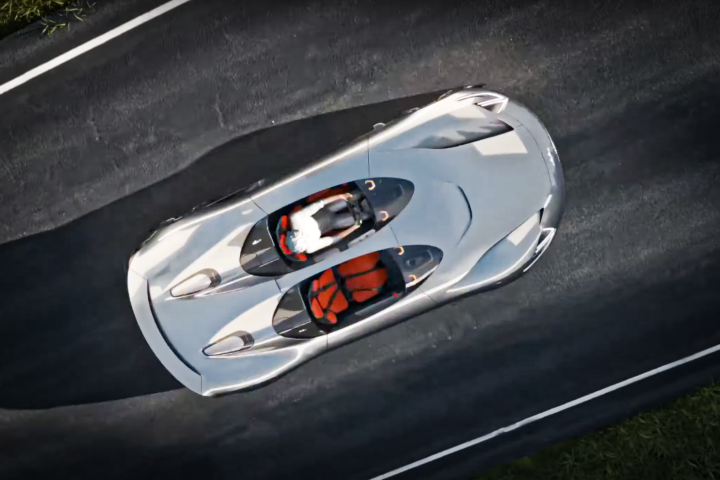
The unusual Hoggar concept from Peugeot stood out from the crowd at the 2003 Geneva motor show - not only by virtue of it's radical open design, but through the use of two turbocharged four cylinder HDi (diesel) engines, one at the front, and the other at the rear, to achieve the attributes of a four-wheel drive. Each power unit has dual overhead camshafts and sixteen valves and displaces 2168 cc for an output of 180 bhp with gobs of torque. The two engines therefore supply a combined power of nearly 360 bhp and a maximum torque of ... 800 Nm!
Each engine’s exhaust incorporates a catalytic converter, a particulate filter (FAP) and a silencer. The left-hand exhaust system corresponds to the front engine, while the right-hand exhaust system corresponds to the rear engine.
Both radiators are set well back at windscreen level to reduce the length of the front overhang. While the radiators are common to both engines, the one on the right features a low temperature loop to cool the intake air. Air from outside is captured at the front of the vehicle and is supplied to the radiators through a conduit incorporated in the bonnet lining.
Each power train has its own electronics. A global electronic control unit (the supervisor) distributes instructions to both engines from a single accelerator pedal and a single gearbox control. The supervisor controls all safety functions and provides downgrade modes if necessary (for example if running on a single engine). The Hoggar can of course be driven with only one of its two power trains.
Each ML 6C gearbox is driven by electrically controlled hydraulic actuators. The sequential gear change operates by means of control "paddles" under the steering wheel or a gear lever on the central console. A fully automatic mode is also available.
The suspension of this concept car features double wishbones at the front and rear. Each axle is equipped with an anti-roll bar. The light-alloy wishbones allow generous clearance both in terms of compression (250 mm) and expansion (250 mm).
To guarantee steering accuracy despite a total travel of 500 mm, each front suspension unit has a detached pivot. The four suspension units are fitted with two spring/gas damper units, each equipped with a gas reservoir. This additional capacity makes it possible to increase the volume of available gas while retaining a compact damper body.
Assisted braking is provided by four ventilated 380 mm discs and six piston brake callipers.
The 21" diameter light-alloy wheels have original styling. They are fitted with Michelin tyres, with a design which matches that of the wheel.
Two separate fuel tanks each with a capacity of 80 litres give the vehicle a considerable range in view of the low fuel consumption of the HDi engines.
On board this ultra high-tech, open-air vehicle, natural leather and aluminium feature strongly. Two people can sit in the one-piece, cast light alloy seats, which have leather upholstery. Each occupant is secured by a safety belt, a true four-point harness connected to four small inertia reels.
This low-slung Hoggar is a 2-seater designed with recreation in mind. Less than 4 m in length, 2 m wide and 1.5 m high, the lines of the Peugeot Hoggar are reminiscent of the classic dune buggy shape and 'gull-wing' doors are also featured.The interior of Hoggar is a blend of aluminium and leather.
The fascia panel has two central dials indicating the engine speed of each power train. The console houses a touch screen connected to a PC controlling the GPS satellite navigation system for direction finding, the speedometer and the inclinometer, and also features an MP3 player.
At the top of the central console there is a vertical touch screen. Occupants can navigate between the different pages by means of bookmarks. The main page, displayed by default, is dedicated to driving and contains the speedometer (supplied by the GPS), the odometer, the current destination, the compass and the inclinometer display (pitch and roll). A page dedicated to the input of "way points" on the GPS also contains the cartography.
Another page allows images from the on-board camera to be displayed simultaneously with information from the inclinometers to facilitate difficult manoeuvres. One page is devoted to the selection of on-board music in the form of digital files (MP3 type). Finally, there is a page dedicated to engine operation (coolant, oil temperature, etc). Malfunction alerts are displayed as a priority on the screen.
Because the Hoggar is designed as an open-air vehicle, the driver's position is largely open and the vehicle does not have a roof. The ‘doors’ are in fact two small panels, forming part of the front wings, beneath which the ground can easily be seen. These panels open in the gull-wing style.
Light emitting diode (LED) technology is used for all of the vehicle’s signalling lights. For the direction indicator function, the front headlamps incorporate three orange tinted plexiglass bars, cut like crystal, behind which are located LEDs. The dipped beam and main beam functions have LEDs that illuminate according to lock, pitch and roll angles. The cut ‘crystal’ side lights are slightly blue-tinted.
While the rear-view mirrors are traditional, a front camera facilitates the choice of turning circle, for example to avoid a small obstacle. Proximity detectors complete the driver comfort functions.