

GE bids to increase wind turbine efficiency with fabric-covered blades
December 4, 2012
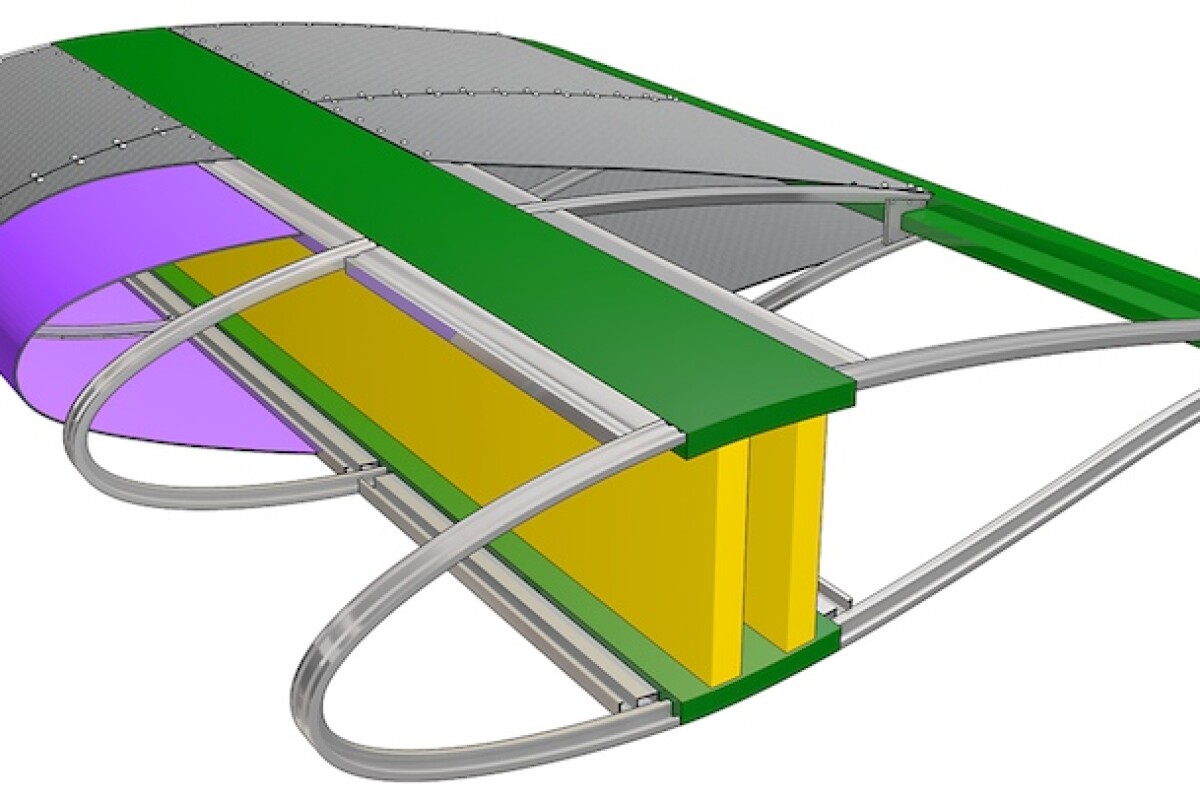
GE's fabric-covered blade is reminiscent of the fabric-covered wings used on World War I fighter planes
In a bid to help shape the inexorable march toward more efficient wind power, General Electric Power and Water is developing a new fabric-covered wind turbine blade which promises to cut the cost of wind turbine manufacture significantly, while also allowing a larger blade size, and facilitating easier transportation.
GE’s project calls for architectural fabric to be tightly wrapped around a metal space frame, to create a viable wind turbine blade. According to the company, such a design should allow for rotor diameters which exceed 120 meters (393 feet) – a feat generally not thought practical with the more widely-used fiberglass blades.
Favoring fabric over fiberglass could also ease wind turbine blade production costs by an impressive 25 to 40 percent. Indeed, GE reckons the technology will eventually allow wind turbine power to be as economical as fossil fuels, without government subsidies.
“GE’s weaving an advanced wind blade that could be the fabric of our clean energy future,” said Wendy Lin, a GE Principal Engineer and leader on the ARPA-E project. “The fabric we’re developing will be tough, flexible, and easier to assemble and maintain. It represents a clear path to making wind even more cost competitive with fossil fuels.”
Additional benefits of the fabric technology cited by GE include a 20-year lifespan, during which no regular maintenance is required, and easier transportation, with the blades perhaps assembled on-site.
GE’s proposal was one of 66 transformative energy proposals to be awarded a grant from the U.S. Department of Energy’s Advanced Research Projects Agency (ARPA-E) program, alongside groups such as MIT, Brown University, and the University of Colorado. In total, the fabric blade project received US$5.6 million, and is projected to span a total of three years development.
Though GE chose not to reveal the exact kind of architectural fabric that would be used, the company does already make rugged fabrics for wind protection and architectural design, so presumably much of the required expertise will already be in-house.
Source: General Electric via Treehugger

Adam is a tech and music writer based in North Wales. When not working, you’ll usually find Adam tinkering with old Macintosh computers, reading history books, or exploring the countryside with his dog Finley. All articles by Adam Williams
Not sure what they are making the "fabric" out of, but what about maintenance cost?
I have a hard time imagining the canvas blades outlasting fiberglass. So they will have to pay someone, with equipment, to go out; stop the turbine and then repair it.
The initial cost would be less, but the long term cost may be more....
PrometheusGoneWild.com4th December, 2012 @ 10:01 am PST
Why is golf-ball dimpled? Why jets have winglets? Aerodynamic. Why is windmill blade not *dimpled* or winglet?
TechThinker464th December, 2012 @ 10:08 am PST
or at least 100 years back to when planes were built by stretching fabric over spars. . .
socalboomer4th December, 2012 @ 10:58 am PST
@TechThinker46: Dimples are not so much aerodynamic as they simply reduce drag. Windmill blades are in a sense just airplane wings turned at a very sharp angle to the direction of air flow, so I would think dimples would just reduce their efficiency. As for winglets, which take advantage of the wingtip vortex on aircraft wings, (vortices which form from the flow of air down the wing) I believe that because the direction of air flow over windmill blades is a bit different from that over aircraft wings, the vortex isn't the same. Additionally, since a windmill is balanced and the "lift" that the wings produce is not in opposition to gravity, the best way to add more "lift" to the windmill blade is simply to make the blade longer.
Joel Detrow4th December, 2012 @ 02:11 pm PST
I still use fabric to cover aircraft wings.
Mark A4th December, 2012 @ 06:49 pm PST
Almost exactly 40 years ago, the November 1972 issue of Popular Science had a sailwing wind turbine on its cover. That also used fabric (in that case Dacron) stretched over a rigid framework to form light, strong, inexpensive turbine blades. However, those blades were a lot smaller and didn't have any chordwise ribs.
Gadgeteer5th December, 2012 @ 12:20 am PST
Hi Joel.
There are in fact wind turbines with winglets at the tips. (At least here in Germany, where we care for efficiency) but they are not so easy to design: Pointing in the most efficient direction, winglets need to be oriented towards the turbine tower, making a mast-strike more likely, or to avoid this, requiring a longer hub to allow more clearance.
Making them point away from the tower (and into the wind) is only the second best solution, efficiency-wise.
Dimples are not per se aerodynamically efficient. There is, however boundary layer tripping on some blades (which is what dimples do), in certain well defined places.
Besides that, fabric covers have deficiencies in surface quality. I wonder how they will come by this, and how they want to control it flexing and making noise on the covered blades.
martinkopplow5th December, 2012 @ 02:08 am PST
I wonder how they will compare for Lightning Protection?
Tim Collins5th December, 2012 @ 04:30 am PST
It is a good idea. I think that any dimpling should be done to certain portions of car bodies, not to wind turbine blades, to reduce air resistance and to give the car a lower Cd. Someone would have to come up with a machine that would imprint dimples into the metal before it is folded or shaped since once the sheet metal is shaped, it would be difficult to imprint curved surfaces.However, bending the sheet metal with dimples may not be conducive to hydralic benders. A better method might be to cut holes into the metal sheet where the dimples are to be located, bend the sheet meta into the desired shape and then press in prefabricated dimples after the edges of the sheet metal have been treated or painted. Dimples would actually be of different shapes, depending upon the curvature of the metal and might be made of rubber or plastic. The seal would have to be good to avoid water leaks.
Adrian Akau5th December, 2012 @ 12:00 pm PST
Adrian, the body panels on your average car are still made by traditional large bed presses. While they may be hydraulic, hydraulic benders are something else. Hydraulic benders are used in the fabrication of products made of tubular materials, such as exhaust pipes.
Putting dimples in wouldn't be impossible, but it would raise tooling costs quite a bit and I don't think the average person would like it. Not to mention if you needed body work done after a fender bender you'd have to replace instead of repair.
Siegfried Gust5th December, 2012 @ 01:57 pm PST
Nasa has some pretty good pages on drag foils (parawing). I'd always wondered about replacement costs of 4mil poly sheet 'sails' 70ft or so. this is a good bit larger.
drag coefficient on an inverted hemisphere is 1.2 isn't it?
The air foil curved blade ones have Cp on up higher though (ie a savonius like performance out of a daisy wheel ? vs. 1.2 for lift/drag as a sail plane)
interesting idea- like a fabric canoe instead of a fiberglass one.
Kwazai5th December, 2012 @ 02:57 pm PST
I fly my Lazair regularly and it has Tedlar covering. Tedlar has a 20 year life span.
scooterdave5th December, 2012 @ 05:49 pm PST
The title is definitely misleading. There is no efficiency gain from using fabric. It is entirely uncertain if it will work at all...oh wait...it does...Orville and Wilbur anyone? Warp wing ... fabric covered...WWI and even WWII mono and bi-planes used fabric for wings and fuselages at much higher loading than any wind turbine of any size (past or present). Nothing new here!! Nothing close to break through and transformative. Why does ARPAE still exist?
Only question is, why does GE need $5.6MM in ARPAE to re-discover fabric covered wings/blades? Don't they have the money to do this themselves? Thought ARPA E was for innovation and breakthrough, or is it re-distribution to "friends" now?
And advanced wind turbine blades already use micro-vortex generators, micro-tabs, vortex strips, et al (similar to golf ball dimples) for lower wave drag and winglets to improve blade efficiency and minimize losses at the blade tip from re-circulation...that isnt' new either.
Divide $25,000 by 5.6MM and the resultant is how many college bound kids, their families and college going kids got screwed out of grants, low cost loans, tuition waivers, more teachers. You know the real transformative technology is age 18-24....with no income.
KuttaKon22nd December, 2012 @ 02:05 pm PST
Or Login with Facebook:
Just enter your friends and your email address into the form below
For multiple addresses, separate each with a comma
Privacy is safe with us because we have a strict privacy policy.
So the Danes were right? Wow 300+ years of technology and we are going back to what was done in the Middle Ages!
Dennis Schmalzel4th December, 2012 @ 08:04 am PST