October 29, 2008 After last year being asked to provide a glimpse of what automobiles will look like 50 years into the future, design studios vying for recognition in this year's LA Auto Show Design Challenge are leaving city streets behind and heading for the racetrack under the theme "Motorsports 2025". Throwing away preconceptions of what motor racing should be and incorporating the possibility of cars that never crash or need re-fueling, nine of Southern California’s big-name automotive design houses have submitted entries, and again the results are both outrageous and thought provoking - from vehicles that race over land, sea and air to 8 x 4 wheel-drive ATVs and solar sailing energy-miser's that compete on see-through tracks.
Starting with our pick of the bunch, the nine entries are:
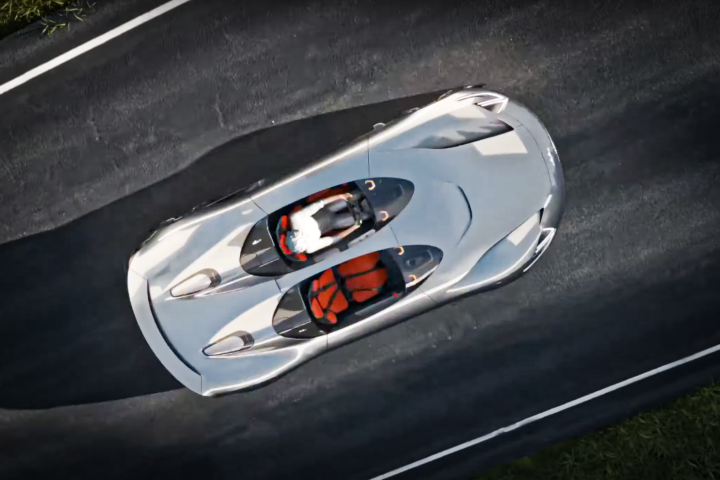
Mercedes-Benz Formula Zero - Mercedes-Benz Advanced Design of North America
An amalgam of Formula One racing and Olympic bobsledding, this elegant concept adds an aero-efficient solar skin and rigid sail to a 1930’s inspired racer powered by electric hub motors. The idea is to allocate the same amount of stored energy for each vehicle in the race with the winner determined by a combination of total elapsed time and energy efficiency. An awesome extra dimension for spectators is the curving, transparent track which would allow the cars to be viewed from all angles - including from underneath.
(Design team: Alan Barrington, George Yoo, Kevin Verduyn)
Audi R25 - Volkswagen/Audi Design Center California
Audi also envisions the evolution of race tracks that incorporate high-velocity banks and tunnels which would see cars passing each other upside-down. While still retaining the look of a traditional Le Mans racecar, the electric R25 design applies a range of innovations such as a flexible Dynamic Space Frame, active micro-control surfaces which optimize airflow and a sophisticated Man Machine Interface which not only transfers all vehicle data to the driver’s helmet visor, but also uses sensors and integrated HD cameras to facilitating real-time VR systems that would allow spectators to sit drivers seat.
The low-fuel consumption (and action) is enhanced by wireless electrical charging zones on the top sections of the tunnels and banks which let the drivers access free energy instead of making fuel stops.
(Design Team: Claus Potthoff, Hendrik Veltmann, Jae Min, Craig Durfey, Raul Cenan, Taeho Kim, Tomi Lin, Nancy Holman, Alex Marzo)
BMW Hydrogen Powered Salt Flat Racer - BMW Group DesignworksUSA
BMW has opted for hydrogen as the power source for its salt flat racer which takes a tongue-in-cheek approach to the challenge by making use of discarded materials like old oil barrels and barbeque lids in its construction and even carrying a goldfish onboard to act as a “canary-in-a-coal mine” - if your fish get sick, you must be running “rich” (not one to keep animal-lovers happy).
(Design Team: Verena Kloos, Chris Chapman, Erik Goplen, Richard Kim, Jason Rowlands and Blair Taylor)
GM Chaparral Volt - General Motors Advanced Design, CaliforniaGM are expecting the Volt label to stay with us for the next 17 years, naming their energy-efficient concept the Chaparral Volt. Like the Mercedes entry, the design envisages a brand of racing where energy-efficiency is as important as speed, employing multiple sources to supply its own power including gravity and momentum-capture regeneration rear turbine extractors for power cell cooling and integrated thin-film PV panels to make solar energy the primary energy source for the vehicle.
(Design Team: Frank Saucedo, Steve Anderson, Thamer Hannona, Jussi Timonen, Loren Kulesus, Alessandro Zezza, Sean Moghadam, Tony Liu and Phil Tanioka)
Honda’s The Great Race 2025 - Honda Research and Development
The team at Honda hope to see the 22,000 mile Great Race of 1908 reborn in the 21st century, but instead of taking six-months the competitors in this race would be required to circumnavigate the globe in 24 hours on land, sea and air. Their morphing design submission (which has shades of Battlestar Gallactica) would use sonar/echolocation sensors to detect changes in terrain and switch configuration accordingly.
(Design Team: Franco Corral)
MAZDA KAAN - Mazda Research and Development
Mazda's take on the future of motorsport is an interesting combination of electric-powered Formula One and road-race cycling tactics. The California in which the MAZDA KAAN would race is equipped with electroconductive freeways that provide power to EVs as they drive (wouldn't that be nice). The KAAN would use an electronic tire system to tap into the same system and propel cars along at speeds reaching 250 mph with teams of up to thirty vehicles using a peleton-like formation to increase their aerodynamic advantage.
(Design Team: Jacques Flynn, Carlos Salaff, Minyong Lee, Greg Lee, Tim Brown, Jordan Meadows)
Mitsubishi Motors MMR25 - Mitsubishi Research & Design of North America
With each omnidirectional wheel consisting of eight independently-controlled motors giving it ultra-off road capabilities, its just as easy to imagine the Mitsubishi MMR25 traversing the surface of the moon as taking part in an earth-bound race. The design would enable the car to be driven forward while pointing in any direction - so it could be pointed out of a corner when its still on the way in - and adjustable "Memory Metal Alloy" would be used to optimize the aerodynamics of the central wing. Jon Hull (design, surfacing, rendering and animation)
Toyota Lemans Racer - Calty Design Research, Inc.
Described as "the ultimate race car that never needs to stop", the Toyota Lemans Racer is another shape-shifting design that integrates hydrogen fuel cell-powered electric motors fed by photovoltaic panels. In "High Speed Mode", the vehicle becomes narrower to reduce drag while in "Cornering Mode" its footprint is widened for stability and control. The concept also envisions a robot co-pilot and fully digitized cockpit that incorporates virtual reality, computer trajectory plotting, collision avoidance assistance and diagnostic systems that can repair the car during the race.
(Design Team: Kevin Hunter, Erwin Lui, Craig Kember)
Volkswagen Bio Runner - Volkswagen/Audi Design Center California
Another favorite in the Gizmag office, the Volkswagen Bio Runner would see a “One Tank Unlimited Solo Class” introduced into the Baja 1000 rally in 17 years time. The rules would be simple - one driver and one 10-gallon tank of fuel per competitor. Powered by dual-turbine engines running on bio-synthetic jet fuel, the Bio Runner has the enclosed rider seated in an motorcycle position from which the independent "synthetic muscle-based suspension" can be operated. There are no windows, with the driver instead relying on 360-degree panoramic screen and camera system to navigate the desert sands. The designers have also included a Reconnaissance Drone in the package that would assist in repairs or rescue and supplement the video feed to the driver in low-visibility scenarios.
(Design Team: Derek Jenkins, Patrick Faulwetter, Ian Hilton)
Now in its fifth year, the annual LA Auto Show Design Challenge is part of the Design Los Angeles automobile designers’ conference to be held on November 20. The 2008 Los Angeles Auto Show runs from November 21-30.
Check out the gallery for more pics of all the entries.
Noel McKeegan
Source: LA Auto Show.