While nearly everyone enjoys a good astrophoto, the precision with which the astrograph (the telescope taking the photograph) must follow the stars is not widely appreciated. To take a good astrophoto of any but the brightest objects requires following their motion through the sky accurately. There are a number of approaches toward addressing this problem in the digital era. Perhaps the best option has now been enabled by Innovations Foresight's new ON-Axis Guider (ONAG).
It is far easier to make a good telescope for astrophotography than it is to make a good telescope mount to hold it during long exposures. The digital image of a star can be made fuzzy by tracking errors as small as those caused by wiggling the end of a telescope a few microns this way and that. The telescope mount performs two main functions: holding the telescope rock steady and moving smoothly to keep the telescope pointed at the target. A telescope mount which excels in both these tasks is a rare and expensive bird.
If you are lucky enough to have a good telescope and a good mount, are you ready to take long-exposure astrophotos? Probably not. If your mount is an equatorial mount, one of the mount's axes is supposed to point at the North Celestial Pole, and the other is supposed to be at right angles to the first. In reality, errors abound. The polar alignment, perpendicularity of the axes, evenness of the drive motor and gears, and the like will ensure that a practical amateur telescope will not perfectly follow the heavens without additional intervention. This intervention is called active guidance.
While taking an astrophoto, you accept the limitations of your mount, and make small and frequent adjustments in the pointing direction of the telescope based on your observation of tracking errors. Before the onset of the digital era there were a number of very tedious methods of active guiding. Fortunately, this problem is more tractable now, even on an amateur astronomer's budget. A webcam monitors the movements of the guide star away from the center, and reports them to a computer, which provides instructions to (usually) geared down stepping motors to return the guide star to its original position. The sensitivity of a CCD or CMOS camera is also at least ten times higher than that of photographic film and plates. As a result, active guiding does not have to be administered for nearly as long a time, avoiding a considerable amount of observer fatigue.
The most common approach to guidance for amateur astrophotos is to piggyback a guiding telescope on the astrograph. The astrograph is aligned with the desired target while the guiding telescope is moved about on its mounts so that a suitable guide star appears at the center of its field of view. A guiding telescope and its mounting system is relatively easy to set up, but tends not to hold position very well, mostly because the mounting system is rarely sufficiently rigid. Another problem is that you cannot guide on the object of which you are taking an astrophoto. This is a real problem in photographing dim objects having their own motion against the sky, such as comets and asteroids.
It's better practice to guide the astrograph by using its own optical image – comparing apples to apples, so to speak. This presents new difficulties. First, you don't want to shadow the astrophoto with a mirror that picks off the image of a guide star, so the area around the perimeter available for finding a guide star is quite limited. Second, a guide star sufficiently bright for the guidance system to work with may or may not appear in that limited area. This type of method is not very popular in today's amateur circles.
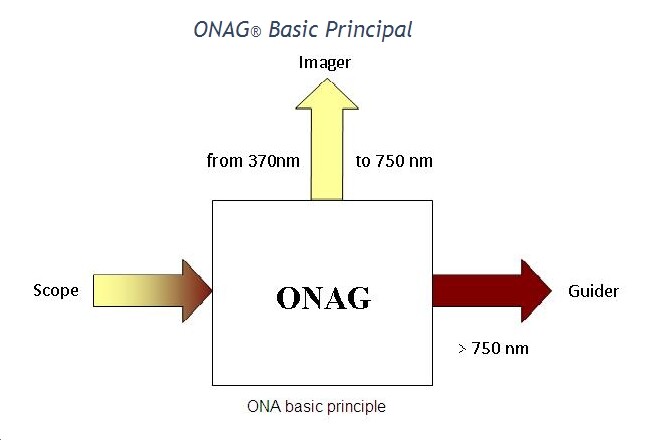
There remains a method of using the optics of the astrograph which makes the entire field of view of the astrograph available for finding a suitable guide star. This is the approach enabled by the Innovations Foresight ONAG. As shown in the above image, the light the optics of the astrograph, just prior to forming an image, is partially reflected so that both the imaging camera and a guiding camera can access the entire image. This has been tried in the past with partially transparent beamsplitters, but such significantly reduce the amount of light available to produce the desired astrophoto.
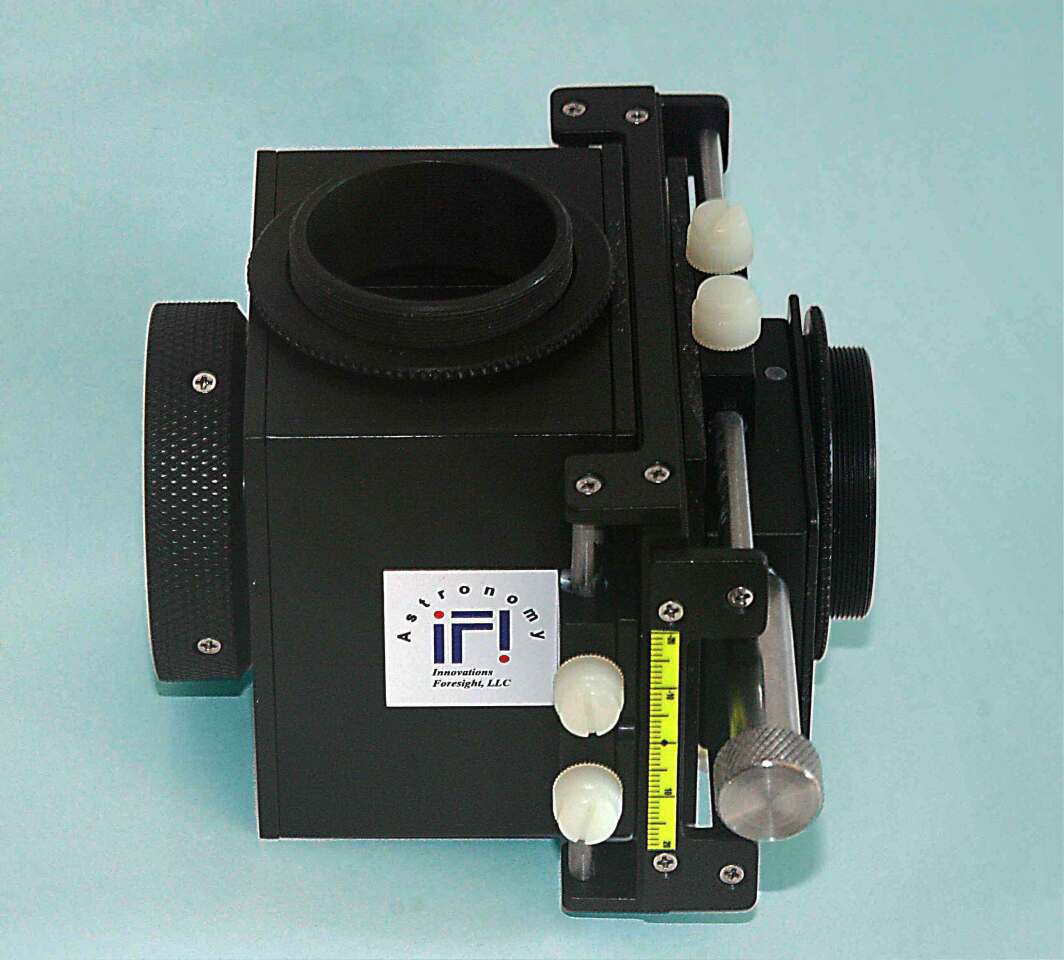
To avoid this, the ONAG uses a cold mirror, which is a special type of interferometric beamsplitter that reflects almost all light having wavelengths between 370 and 700 nm, but transmits most light of longer wavelengths. In the ONAG arrangement, the visible reflected light is directed to the imaging camera, while the transmitted near infrared (NIR) light goes to the guiding camera. (If the cameras swap places, the astrograph is ready to take guided near infrared astrophotos.)

Hydrogen-alpha light makes up most of the visible light from red emission nebulae such as M42, the Orion Nebula. In stock DSLR cameras, this light is removed by a filter intended to increase sharpness of the pictures. However, hydrogen-alpha light has a wavelength of 656 nm, so it is reflected into the imaging camera. As to the guiding side of the equation, roughly three-quarters of potential guide stars are at least as bright in the NIR as they are in visible light. By choosing NIR images to direct active guiding, more guide stars are made available for use.

Even with the ONAG's imaging geometry, the accuracy of the guidance depends on the imaging and guidance cameras being rigidly locked into position, so that they cannot move independently. This condition is solidly met by the mechanically robust construction of the ONAG. Despite the rigidty of the design, the ONAG only weighs 1.7 lb (770 g), which will not represent an unreasonable load on any astrograph or mount.
To sum up, the Innovations Foresight ONAG appears to be a clever, robust, and quite successful device with which the serious astrophotographer can address their most difficult guidance problems. At US$989, the cost is a bit dear, but with imaging cameras, telescopes, and mounts for high-quality amateur astrophotography all priced in the thousands, the differential cost is probably justified for the ease and robustness of using the ONAG to improve your astrophotography performance.
Source: Innovations Foresight