Transdermal patches are currently used for the controlled release of medication, as long as that medication is made up of molecules that are small enough to be absorbed through the wearer’s skin. For solutions with larger molecules, scientists are looking into the use of patches incorporating arrays of skin-piercing microneedles. In many of these cases, however, the patches would require some sort of tiny battery-operated pump, to push the medication through the needles. Now, researchers from Indiana’s Purdue University have developed what could be an alternative – microneedle patches that use the wearer’s own body heat to deliver the drugs.
The adhesive-backed patches are composed of layers of the rubber-like polymer polydimethylsiloxane, which is commonly used in pumps. On the bottom of the patch, sandwiched between two of those layers, is a chamber containing a mixture of Baker's yeast and sugar. The medication is contained in a chamber above that one, separated from it by a layer of the polymer.
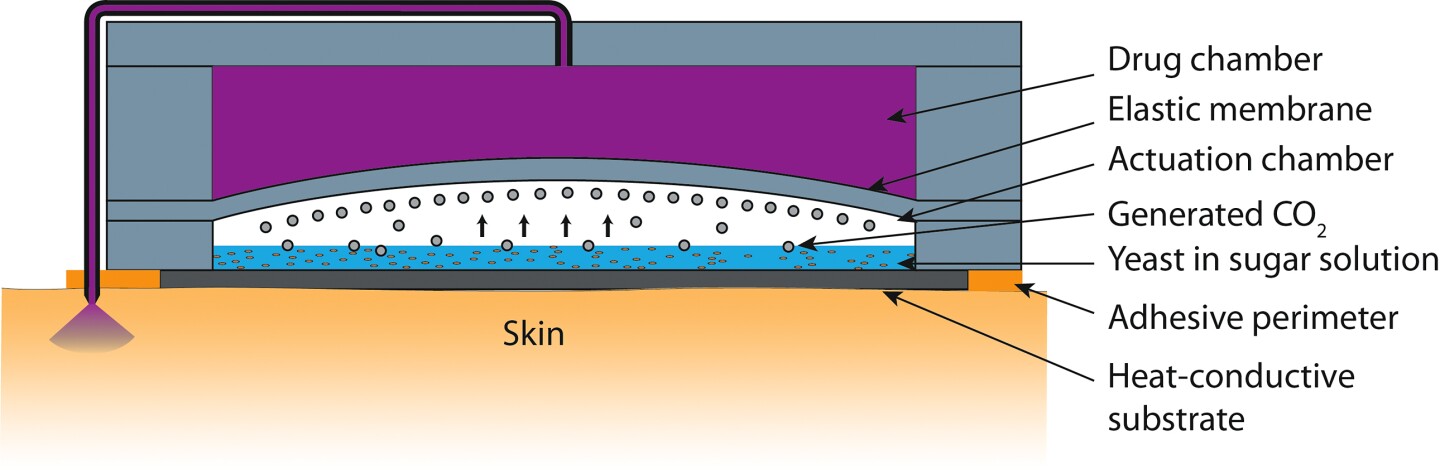
When the patch is applied to the skin, the user adds water to the yeast/sugar mixture. The patient’s body heat is then conducted through the polymer layer adjacent to the skin, warming the now-liquid mixture and causing it to ferment. Carbon dioxide gas is generated by the fermentation process, causing the chamber to expand, exerting pressure on the medication chamber above it. That pressure, in turn, gradually forces the medication out of its chamber, and through tiny channels that lead to the microneedles.
In laboratory tests, a prototype patch was shown to be able to continuously pump out medication for a period of several hours.
According to Babak Ziaie, a professor of electrical and computer engineering and biomedical engineering who is leading the research, the patches should be easy to mass produce, have a long shelf life, and could simply be thrown away after one use ... and they wouldn’t need batteries, to boot.
The university has filed for a provisional patent on the technology. A paper on the research was recently published in the journal Lab on a Chip.
Source: Purdue University