Help us keep Gizmag reader-friendly

David Szondy

The BMW 3 Series Gran Turismo

The BMW 3 Series Gran Turismo is set to make its world premiere at the Geneva International Motor Show in March. The third body variation on the mid-range premium segment model, the aerodynamically focused Gran Turismo leads a BMW line-up for the show that includes the M6 Gran Coupe, Z4, Concept Active Tourer and i3 Concept Coupe.  Read More

First sample drill hole made by Curiosity (Image: NASA/JPL-Caltech/MSSS) NASA’s Mars rover Curiosity collected its first drilling sample on Saturday. The 4x4-sized robot used the drill in its hand to collect samples from the interior of a flat, veiny sedimentary bedrock that was formed by ancient Martian water.  Read More

”Mini drill” test by NASA's Mars rover Curiosity (Image: NASA/JPL-Caltech/MSSS) NASA’s Mars rover Curiosity made the historic first drilling ever attempted on the Red Planet on February 6. The drilling, at a patch of flat, vein-bearing rock called "John Klein" at Gale Crater, was the 4X4-sized robot’s first full use of its drilling unit and a major test before it uses the drill to collect pulverized rock samples for analysis in its internal laboratories.  Read More

The incomparable ELI429 (Image: BMW) Who says that car makers don’t listen to their customers? A reader at Jalopnik asked for help in producing a concept image for a car built to the specifications of his four year-old nephew, Eli – BMW responded with the ride we all secretly wish we owned.  Read More

The Lernstift digital pen

Use digital technology long enough and you start to become dependent upon it for such mundane tasks as spell checking. That means when you pick up a garden variety ballpoint pen you’re back in dictionary and “I before E except after C” territory. Like LiveScribe, the creators of the Lernstift digital pen hope to bring handwriting into the 21st century by having the pen vibrate to indicate when the writer makes spelling and grammatical errors or exhibits poor penmanship.  Read More

The purpose of the new jets is to increase the speed of the LCS while lowering running cos... The U.S. Navy is fitting Rolls Royce water jets to its Littoral Combat Ships (LCS). The new water jets can pump out half a million gallons (1.9 million liters) of high-density seawater per minute, pushing the LCS at over 40 knots (46 mph, 74 km/h) while providing more power for less weight.  Read More

Test drilling carried out on the rock called “John Klein” on February 2nd (Image:  NASA/JP...

NASA’s Curiosity rover recently took a step closer to its historic first drilling on Mars, as it tested its drilling system. Last Saturday, the nuclear-powered explorer conducted a "drill-on-rock checkout" on a rock designated “John Klein” in Gale Crater. The brief test of the drill’s percussive action in a back and forth motion was part of a series of tests to determine if the rover’s drill is ready for full operation.  Read More

Comparative sizes of Earth and a 'super-Earth' (Image: NASA/JPL-Caltech/R. Hurt (SSC))

In the past couple of decades, nearly 900 planets have been identified outside of our Solar System with thousands more candidates to be considered. Among the most exciting of these exoplanets are the so-called “super-Earths” – planets somewhat larger than the Earth, yet some of which might be capable of supporting life. Unfortunately, a team led by Helmut Lammer at the Space Research Institute (IWF) of the Austrian Academy of Sciences has produced new models that indicate some of these super-Earths may really be mini-Neptunes, with deep, hydrogen-rich envelopes covering a small rocky core.  Read More

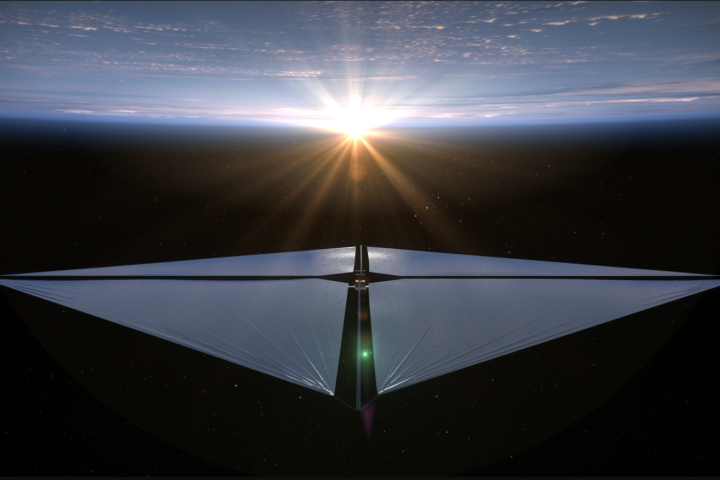
The 20-meter (65.6-ft) solar sail and boom system, developed by L'Garde Inc. of Tustin, Ca...

NASA is getting ready to ride the “winds” of space on sails lighter than gossamer, yet large enough to cover a small field. The space agency’s Solar Sail Demonstration, also known as the Sunjammer Project, may launch as early as 2014 when it will send the largest solar sail yet built into orbit, to demonstrate the technical viability of the device.  Read More

Zebra mussels fouling a marine sensor (Image: NOAA/Wikipedia)

Engineers at Duke University have developed a polymer that keeps ships’ bottoms clean by twitching like living skin. The paint-like material combats hull fouling by preventing marine organisms from collecting on hulls by physically moving on the microscopic level and thus dislodging bacteria from the surface without toxic chemicals.  Read More

Looking for something? Search our 22,623 articles