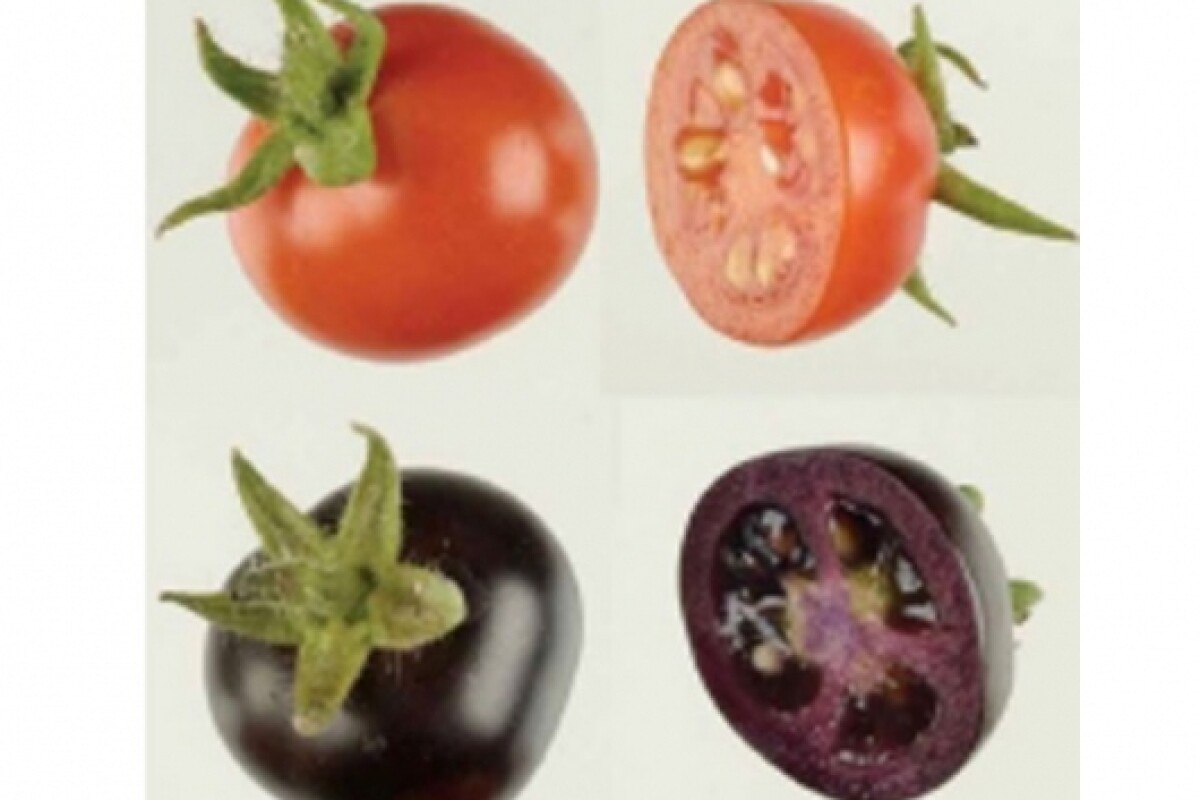


October 28, 2008 It seems purple might just be your new favorite color if you’re interested in staving off cancer. British scientists are reporting in the journal Nature Biotechnology that they have genetically engineered a purple tomato that significantly extended the life of cancer-prone mice. The purple coloring is due to a class of pigments called anthocyanins, which are found in high concentrations in blackberries and blueberries and and have been associated with protection against a broad range of human diseases.
Since the majority of people fail to get the recommended daily intake of five servings of fruit and vegetables, the scientists are hoping to help by modifying crop plants to provide people with a bigger dose of helpful chemicals in those items that we do eat. The scientists chose to modify tomatoes as they are a popular food crop and can be easily incorporated into a variety of meals. Since tomatoes already contain very small amounts of flavonoids like anthocyanins, it should be straightforward to give them a boost.
Previous attempts to modify tomatoes only managed to improve the contents of the skin, which makes up very little of the fruit, but the scientists at the John Innes Centre were able to engineer tomatoes that contained anthocyanins throughout the entire fruit at levels comparable to blueberries and blackberries (2.83 mg of anthocyanins per gram of tomato). As a side effect, the tomatoes became purple upon ripening and the newly-inserted genes were passed on to future generations of tomatoes, lasting through five generations as of the time the paper was prepared.
The researchers were able to accomplish this by engineering tomatoes to express two genes that normally promote the biosynthesis of anthocyanins in snapdragons (the Delila and Rosea1 genes). In a pilot test, cancer-susceptible mice fed a diet supplemented with the high-anthocyanin tomatoes showed a significant extension of life span – 182.2 days compared to 142 days for mice fed a diet without the tomatoes. Regular tomatoes had no affect on the average life span.
Scientists are now attempting to determine if anthocyanins need to be consumed as they naturally occur in fruits and vegetables, or if they can simply be ingested on their own in pill form to get their benefits. Even if that turns out to be the case it may not be long before the local fruit and veg shop takes on a decidedly purple hue.
Via: Ars Technica / John Innes Centre.
Source: Nature Biotechnology, 2008. DOI: 10.1038/nbt.1506.